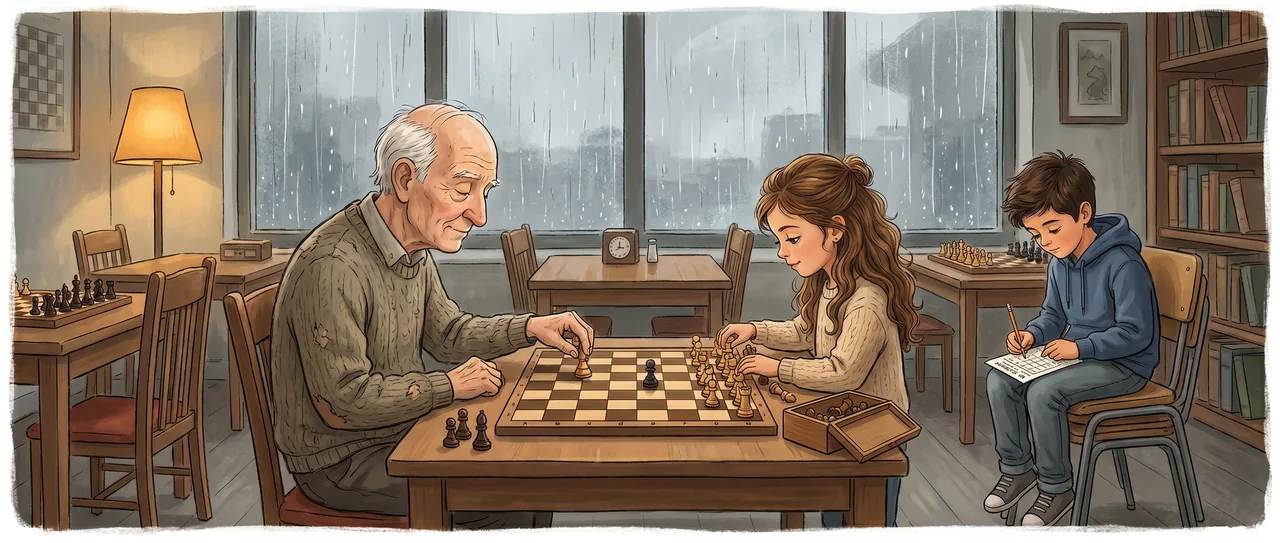
The Board That Wasn't There
The tournament was over. Everybody had gone except an old man at the last table, sitting in front of a board with no game on it. Just the empty starting rows, thirty-two pieces standing where they always stood at the beginning.
Maya was stacking chairs. Soren was collecting scoresheets, the little pages where players wrote down every move.
"You two," the old man said. "Set up a position for me. Anything. Then let me look for five seconds."
"Why?" Maya asked.
"Because I want to show you something, and I need you to not believe me first."
Soren put down the scoresheets. Maya liked people who wanted to be doubted, so she came over.
They pushed pieces around until the board looked like a real game, halfway through. Knights forked in, pawns broken into little clumps, a king tucked behind a wall.
"Okay," Soren said. "Look."
The old man looked. He counted quietly. One, two, three, four, five. Then he closed his eyes.
"Sweep it away," he said.
Maya scattered the pieces into the box.
And he rebuilt it. Every piece. The broken pawns, the tucked king, the knights. He put them back with his eyes still half closed, like he was copying something off a wall only he could see.
"That's a trick," Maya said. "You memorized it."
"Do it again," the old man said. "But this time don't make a real game. Put the pieces anywhere. Nonsense. Scatter them."
So they did. A rook on a random square, a bishop stranded in a corner, pawns dropped anywhere with no shape at all. Pieces that no real game could ever have produced.
He looked. One, two, three, four, five. Eyes closed.
"Sweep it."
Maya swept it.
He reached for the pieces. He put a rook down. Stopped. Moved a pawn. Frowned. Put a knight somewhere, took it back.
He got maybe half of it. Then he opened his eyes and laughed.
"Terrible," he said. "Just terrible. Same five seconds. Same pieces. Same board."
Maya stared at the ruined nonsense position, half remembered, half wrong.
"That's backwards," she said. "The real game is harder. There's more going on. You should have gotten the nonsense one easier. Less to remember."
"Should have," the old man agreed. "Didn't."
Soren was already counting on his fingers. "Thirty-two pieces both times. Same number. Same five seconds." He looked up. "So it's not how many pieces. It's something else."
"Guess," said the old man.
Soren didn't like guessing before he understood, but he liked the old man, so he tried. "When it's a real game, you're not remembering thirty-two pieces. You're remembering something bigger. Like, the whole king wall counts as one thing."
"Say more."
"The broken pawns." Soren pointed at the box now. "To me that's four pawns. Four separate things I have to hold in my head. What is it to you?"
The old man thought about how to say it. "It's a shape I've seen ten thousand times. It has a name in my head. It's one thing. Like a word."
Maya went very quiet, and then she said, "Say a word to us."
"What?"
"Say a long word. Fast. One we know."
"Refrigerator."
"Now say a word we don't know. Same length."
The old man grinned. He said something in a language none of them spoke, a long string of sounds.
"Say it again," Maya said.
He couldn't. Not exactly. He got the front of it and lost the middle.
"That's it," Maya said, and now she was talking fast. "Refrigerator is easy because it's one thing to you. It's a word. But the other one is just noise. It's ten separate sounds and you have to hold all ten. The real chess board is refrigerator. The nonsense board is the noise."
Soren sat down on a stacked chair. "So when you look at the board," he said slowly, "you're not seeing what I see."
"No," said the old man.
"You're not seeing pieces harder or faster. You're seeing different pieces."
"I'm seeing different pieces."
Maya picked a knight out of the box and held it up. "What is this to me?"
"A horse-shaped piece of wood."
"What is it to you?"
The old man took a long time. "When it's standing in a real position, it's not a horse-shaped piece of wood. It's pressure. It's a fork that hasn't happened yet. It's three squares I can feel before I look at them." He shrugged, almost embarrassed. "I stopped being able to see just the wood a long time ago. I can't get it back. If I sit in front of a real game, the wood disappears and the meaning is standing there instead."
"You can't see the wood anymore," Maya repeated.
"I've tried. I sit here with the empty board sometimes just to look at the pieces as pieces. Five minutes later they've turned into ideas again. My eyes won't stay dumb."
Soren was writing now, the pen moving fast across the little scoresheet paper, filling the white space under the printed squares.
"So it's not a trick," he said, not looking up. "It's not that you're better at remembering. Your eyes actually changed. From doing it so many times."
"The eyes are the same," the old man said. "The thing behind them changed."
Maya was looking at the room now, at the stacked chairs, the scoresheets, the rain on the window, and she had the expression of someone whose floor has just tilted a few degrees.
"Then everyone's seeing different pieces," she said. "All the time. The music teacher hears something in a song I can't hear. My mom looks at an x-ray and sees a broken bone where I see gray fog." She turned to Soren. "Nobody's looking at the same board. We just think we are."
The old man reached into the box and set a single pawn on its square, alone, in the middle of the empty board.
"Tell me what you see," he said.
Maya looked at the pawn. She looked at it for a long time, trying to see whatever he saw, knowing she couldn't, wanting to anyway.
Read the interactive version, listen to the narration, and earn a gold star →
A science-verified short story for curious kids · Curiosity Land