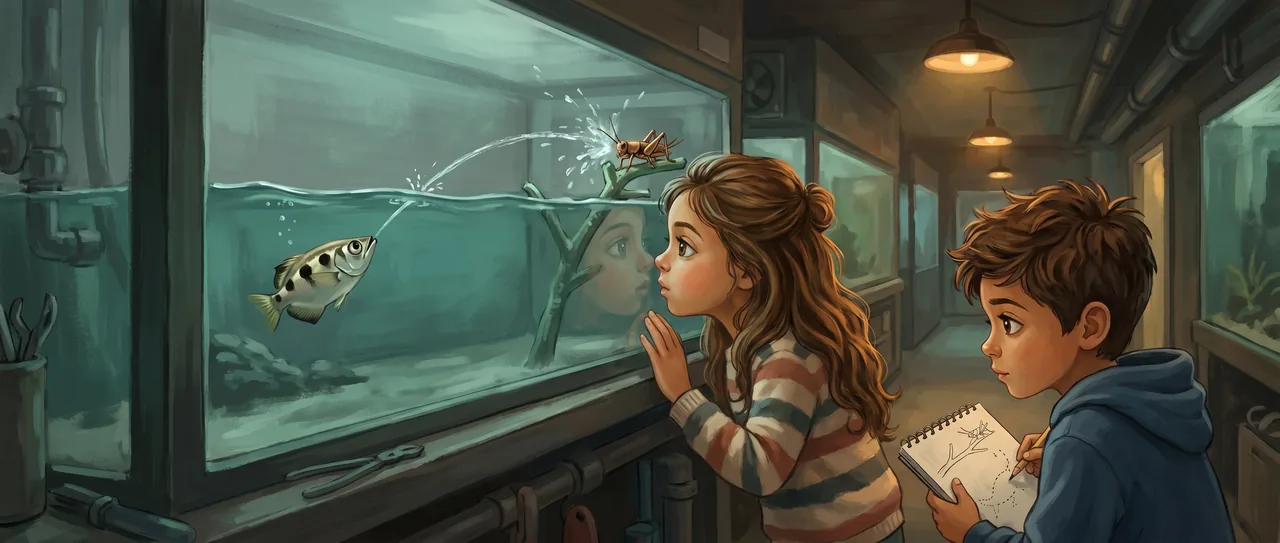
The Bent Line
The keeper had gone to find a mop, which left Maya and Soren alone with a tank that had no sign on it.
Inside were six fish the color of wet newspaper, striped, each about as long as a pencil. Above the water hung a plastic branch, and on the branch sat a cricket that the keeper had placed there before he left.
"They're just sitting," Soren said.
"Watch the cricket," Maya said.
A jet of water shot up out of the tank and hit the cricket dead on. It dropped. A fish swallowed it before it finished falling.
"Okay," Soren said. "Do it again, do it again."
The keeper had left three crickets. The second one sat higher, on the tip of the branch. A different fish rose, tilted, and fired. The cricket went into the water.
"They spit," Maya said. "They aim by spitting."
"That shouldn't work," Soren said.
"It just worked twice."
"No, listen." Soren put his finger against the glass, then pulled it back because a sign somewhere probably said not to. "The fish is under the water. The cricket is up in the air. When you look at something across water, it's not where it looks like it is. The light bends."
Maya went quiet, watching a fish hang under the surface with its eyes turned up.
"Put your arm in the sink at home," Soren said. "It looks broken. Bent at the wrist. That's the light changing speed when it hits the water. The archerfish is looking up through that. The cricket it sees isn't where the cricket actually is."
"So it should miss."
"Every time. It should aim at the fake cricket and hit nothing."
They looked at the third cricket. Nobody had spat at it yet.
"But it doesn't miss," Maya said slowly. "So it's not aiming at what it sees."
"It has to be aiming at where the thing really is."
"Which it can't see."
"Which it can't see," Soren agreed.
Maya crouched so her eyes were level with the water. From down there the branch looked wrong, lifted and shoved sideways, the way a straw looks snapped in a glass.
"Come down here," she said.
Soren crouched.
"That's the fish's view," Maya said. "That's what it's got. A bent branch and a cricket that's lying about where it is."
"And it corrects for the lie," Soren said. "Somewhere in a brain the size of a lentil, it takes the bent picture and un-bends it."
Maya wanted to test it. She always wanted to test it.
"The third cricket," she said. "It's way out on the end. Higher and farther than the other two. If they're just guessing, the far one is where they blow it."
They waited. A fish drifted under the third cricket, angling, the way you angle your head to read a book that's upside down. It held there a long time.
"It's measuring," Soren whispered.
The jet went up. It missed the cricket by a hand's width, splashing the branch. The fish sank back down.
"Ha," Soren said, not happy exactly, more relieved. "See. Far targets are hard. It can't do the correction perfectly at that distance."
But Maya was frowning, and it wasn't a giving-up frown.
"That fish was small," she said. "Look. The one that missed. It's smaller than the two that hit."
Soren looked. She was right. The two crickets that had gone down had been taken by longer fish. The little one had missed the hard shot.
"So the big ones are better," Soren said.
"Better at the correction," Maya said. "The little one can do close. It nailed close-up practice, I bet. But it hasn't learned to un-bend the far ones yet."
"You can't know that from one miss."
"So let's not use one."
The keeper came back with the mop and a plastic tub of crickets and found two kids lying on the floor with their chins nearly on the tile.
"You found the archers," he said.
"Can we put crickets up?" Maya asked. "Different heights?"
The keeper, who had wanted to be finished twenty minutes ago and go home, looked at the tub, looked at the kids, and gave in the way tired people give in. "Low ones only. I'm not cleaning the ceiling."
He went to sweep somewhere else, muttering that the tour groups never once asked to stay.
They set crickets low, in the middle, high. They kept track out loud, Soren counting on his fingers, Maya calling which fish.
The pattern came up out of the misses like a shape out of fog. Close targets, everybody hit. Every fish, every time. But the higher and farther the cricket, the more it was only the two long fish that connected. The little ones fired and splashed short, or fired and splashed sideways, always in the direction the bent light would fool you.
"They're all doing the correction," Maya said. "Even the little ones. They just do it right for close."
"And the big ones do it right for everything," Soren said. "Two meters up. First shot. Through the bent line."
"Which means they learned it," Maya said. "You don't get better at a thing you were born already perfect at."
Soren had his notebook out. He drew the tank, the branch, the cricket, and then a second cricket in dotted lines, off to the side, where the light said it was.
"There's the one it sees," he said, tapping the dotted one. "And it never once spits at it."
Maya put her face right at the glass. One of the long fish was hanging under the surface, eyes up, doing the arithmetic that lets a mind under the water reach a body it can only see through a lie.
The fish tilted, took aim at the empty air beside the cricket, and fired at the place the cricket really was.
Read the interactive version, listen to the narration, and earn a gold star →
A science-verified short story for curious kids · Curiosity Land