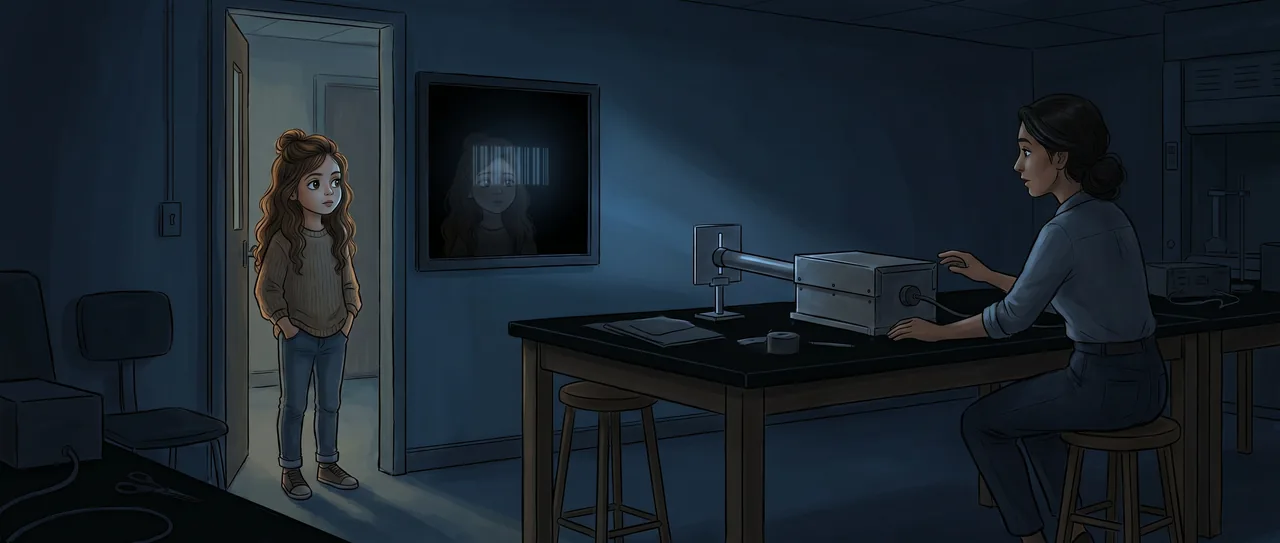
The Wall That Watched Back
Aunt Reza had told Maya to sit still on the bench in the hallway and not touch anything, which was a hard thing to promise inside a building this full of things.
The lecture was over. People had filed out with their coats and their questions, and the corridor lights had dropped to the low nighttime setting. Down the hall, through a propped door, Maya could see Reza bent over a long black table, shutting things off one dial at a time.
Maya went to the doorway. She did not go in. That was the technicality she had decided on.
"You can come look," Reza said without turning around. "Just keep your hands in your pockets."
On the table sat a device the size of a shoebox with a tube coming out of it, aimed at a small plate, and behind the plate a screen. On the screen was a picture that had been left up from the demonstration. Stripes. Light bands and dark bands, evenly spaced, like a barcode someone had drawn with a ruler.
"That's from the marbles?" Maya asked. During the lecture the speaker had said the machine fired particles one at a time. Little things. Molecules. She had used the word marbles because it fit in her mouth better.
"Sort of. It fires them one at a time at a wall with two slits in it. Each one goes through and lands on the screen. That picture is where thousands of them landed."
Maya looked at the stripes. "But if you throw one marble at a wall with two gaps, it goes through one gap. One or the other."
"Right."
"So they'd pile up behind the two gaps. Two clumps." She held up two fingers. "Not stripes."
Reza smiled the tired smile she got at the end of long days. "That's what everybody thinks first. That's the right thing to think. It's just not what happens."
Maya stared at the stripes. Two clumps would make sense. Stripes did not make sense. She kept her hands in her pockets and let the not-making-sense sit there, because it was interesting.
"Where do stripes come from?" she asked.
"Waves," Reza said. "When a wave goes through two gaps, it comes out as two waves that overlap. Where two crests meet you get bright. Where a crest meets a trough they cancel and you get dark. Ripples in a pond do it. Light does it." She tapped the screen. "But this thing isn't firing waves. It's firing one solid particle at a time. One. And they still land in stripes."
Maya thought about one marble making a stripe pattern that needed two gaps at once. "So it goes through both gaps."
"Something like that. Nobody loves saying it out loud, but yes. Each single one acts like it went through both, and interfered with itself."
Maya's stomach did a small strange thing. She looked at the little tube, at the plate with its two slits she could not even see from here, and tried to picture one tiny thing splitting its own path in two and meeting itself on the far side.
"Can you make it do it again?" she asked.
"Not tonight. It's shutting down." Reza flicked another switch. "But there's the part that gets people. If you put a detector at the slits, a little watcher that checks which gap each one actually went through, the stripes go away. You get the two clumps. The sensible picture. The one you had."
Maya went very quiet.
"So," she said slowly, "when nobody checks, stripes. When somebody checks, clumps."
"That's it."
"Just from checking."
"Just from checking. Measuring which path forces it to pick one. You look, and it stops doing the thing that needs both gaps."
Maya turned that over. She was looking for the trick. There was always a trick, some cheat where the answer was boring after all. "The watcher pokes it," she said. "Like, it shoves the marble a little when it looks, and that messes up the stripes."
Reza tilted her head. "That's a good guess. Really good. People argued about exactly that for a long time." She sat down on a stool. "But they got the checking gentler and gentler, and made the checkers weaker and weaker, and it kept happening. The stripes still vanish the moment the which-path information exists. Even when the poke is basically nothing. It's not that looking bumps it. It's that once the information about which slit is out there in the world, the two-path thing can't hold together anymore."
Maya stood in the doorway with her hands in her pockets and felt the floor of the ordinary world tilt a little under her sneakers.
"So it's not the poke," she said.
"Not the poke."
"It's the knowing."
Reza didn't answer right away. "That's the part I can't make comfortable," she said. "I can do the math. The math works perfectly. We build machines on it. But if you ask me what it means, what actually happens to that one particle in the dark when no fact about it exists yet, I don't have a picture for you. Nobody does. We just know where it lands."
Maya looked at the stripes on the frozen screen. Thousands of single things, each one having done the impossible barcode, each one having gone through both and met itself, as long as no one asked which.
"How big can the marbles be?" she asked. "You said molecules."
"Big ones now. Molecules made of thousands of atoms. Things you could almost think of as specks. They've done it with those. Whole clusters of atoms going through both slits at once."
A speck. Something you could almost see. Doing the barcode. Choosing to be one thing only when the world found out about it.
"How big can it go?" Maya asked. "Where does it stop? When does a thing get too big to do it?"
Reza looked at her for a long moment, and this time she wasn't tired. "That," she said, "is a real question. That's a question people are building experiments to answer right now. We don't know where the line is. We don't even know for sure there is a line, or if it just gets harder to keep it in the dark the bigger a thing gets."
"So a person," Maya said. Her voice had gone small. "A whole person is just a lot of specks."
Reza opened her mouth. Then she closed it. She reached over and switched off the screen, and the stripes went black.
"Get your coat," she said. "It's late."
Maya didn't move yet. In the dark screen she could see her own reflection now, one Maya, standing in one doorway, having come down one hallway, and she stood there looking at the single certain girl in the glass and wondered which parts of her the world had checked, and which parts, in the dark, were still doing something else.
Down the hall the last dial clicked, and the tube stopped humming.
Read the interactive version, listen to the narration, and earn a gold star →
A science-verified short story for curious kids · Curiosity Land