The Shrinking Letter
The archive smelled like cold paper and refrigerators. Soren's aunt had parked them at a long table with a stack of printouts and said, do not touch the machines, and then vanished behind a door that beeped.
"These are chromosomes," Maya said. She was holding a printout up to the light. "Somebody printed chromosomes."
"Karyotypes," said Soren, reading the label. "Pictures of all of them lined up. Twenty-three pairs."
"They don't match." Maya slid the page across. "Look at the last pair. One's a normal fat one. The other one is tiny. Like somebody cut it off."
Soren looked. She was right. Twenty-two pairs where each partner was the same size, standing shoulder to shoulder like matched socks. Then the last pair, the twenty-third, and one of them was a stub.
"That's the X and the Y," he said. "I've seen this. The little one is the Y."
"Why is it little?"
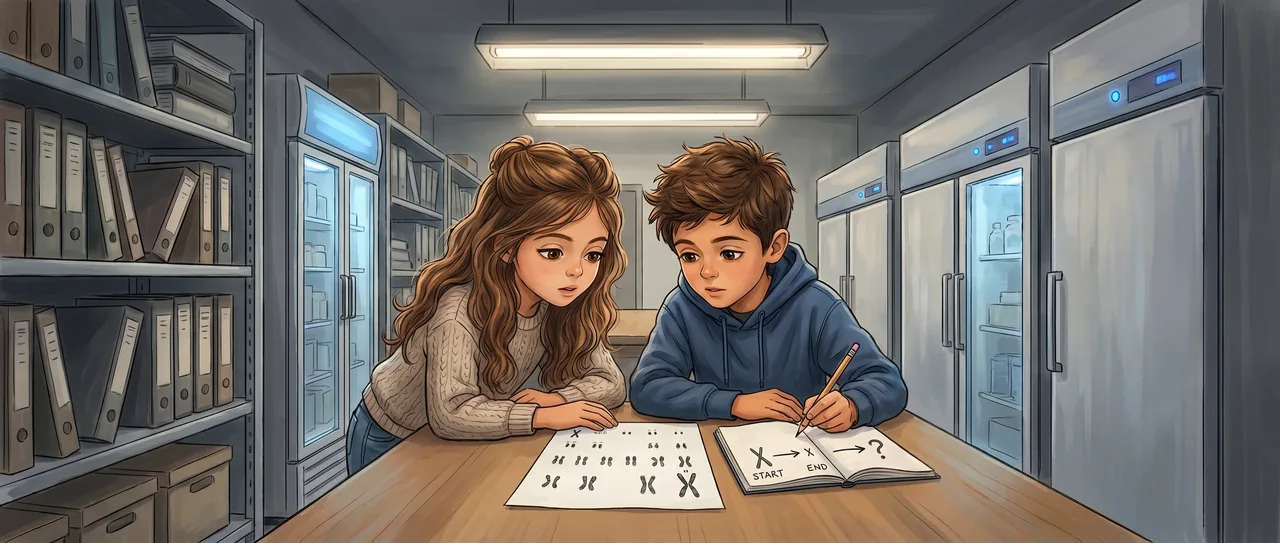
Soren opened his notebook and copied the shapes, the big X and the shrunken Y beside it. His pencil pressed hard on the small one.
"Maybe it was always little," he said.
"No." Maya was frowning at the matched pairs. "They're partners, right? Chromosomes come in pairs. So once upon a time the Y was the same size as the X. Something happened to it."
"You're guessing."
"I'm looking. Every other pair matches. That one used to match too." She tapped the stub. "It lost stuff."
Soren chewed his pencil. "That's a big guess. Chromosomes don't just lose stuff."
"Then why is it small?"
He didn't have an answer, which meant the guess was still standing. He got up and went to the shelf of reference binders his aunt had said they could read, the boring ones, and pulled the one labeled GENE COUNTS.
"Okay," he said, flipping. "Here. Number of genes on each chromosome. The X chromosome." He ran his finger down. "About nine hundred genes."
"And the Y?"
He found it. He read it twice. "Fewer than seventy."
Maya stopped moving. "Say that again."
"Nine hundred on the X. Fewer than seventy on the Y." He looked up. "They were partners."
"They were the same size." Her voice went quiet and fast. "And one of them still has nine hundred and the other one has almost nothing. Soren. Where did the genes go?"
"Maybe they were never there."
"They were there. You just said partners. Partners start the same." She pulled the karyotype back and stared at the stub like it owed her money. "Something ate it."
Soren went back to the binder, because a guess that big needed a mechanism or it fell over. He found a page with a timeline, a long arrow across the bottom.
"Not ate," he said slowly. "Lost. Over time. Look, there's a number. Three hundred million years." He set the binder down between them. "The Y used to be a full partner to the X. And over three hundred million years it lost about ninety-seven percent of the genes it started with."
"Ninety-seven percent." Maya breathed it. "So if it started with a thousand it's down to thirty. It's been shrinking the whole time."
"For three hundred million years."
They both looked at the stub on the page, and it looked different now. Not like a small chromosome. Like a big one, most of the way gone.
"Why does the X keep all of its?" Maya asked. "Why only the Y?"
Soren turned pages, hunting. "Because the other chromosomes have a partner that matches them exactly. When one copy gets a mistake, the matching copy is right there and the cell can copy the good one to fix it. They repair each other."
"And the Y doesn't have a match."
"The Y's partner is the X. And they stopped matching a long time ago." He tapped the timeline. "So when the Y gets a mistake, there's no good copy to fix it against. The mistakes just stay. And genes that break and can't get fixed, the body eventually stops carrying them."
"So it can never repair itself." Maya sat back. "It's alone. That's why it's shrinking. It's the only chromosome with no partner to check its work."
"Basically."
Maya was quiet for a second and then she laughed, and it was not a sad laugh.
"That's the loneliest chromosome in the whole body," she said, "and it's still in there. Everybody who's got one is walking around with a chromosome that's been slowly losing pieces for three hundred million years and still shows up to work."
Soren wrote fewer than 70 in his notebook and circled it, and then wrote from a thousand and drew an arrow between them.
"Does it stop?" he asked. "Does it keep shrinking until there's nothing?"
Maya's eyes went wide. "That's the actual question, isn't it. Nobody at this table knows." She grabbed the binder and flipped to the end of the section, and there was no answer there, just more numbers. "Scientists argue about it. Some think it'll disappear. Some think it stopped shrinking and it'll keep the last genes forever because those ones are too important to lose."
"So it might vanish in a few million years."
"Or it might be done. It might have shrunk down to exactly the pieces it can't afford to lose and just stay like that." Maya put her hand flat on the page over the stub. "And we don't know which. Right now. Nobody knows which."
The refrigerators hummed. Somewhere behind the beeping door, Soren's aunt was filing DNA into drawers like it was ordinary.
"Three hundred million years ago it was a full chromosome," Soren said. "A person that old would look at it now and not recognize it."
"A person that old didn't exist," said Maya. "Fish, maybe. A fish had the Y before it started shrinking." She looked at the karyotype again. "There's a fish somewhere in the beginning of that little stub."
Soren turned to a fresh page and started drawing the timeline himself, the long arrow, the Y at the start big as the X, the Y at the end small as a crumb, and a question mark where the arrow ran off the edge of the paper.
He didn't finish the arrow. He held the pencil at the edge of the page where the next few million years would go, and left it there, not touching down.
Read the interactive version, listen to the narration, and earn a gold star →
A science-verified short story for curious kids · Curiosity Land