The Same Copper Twice
The gym smelled like floor wax and old cardboard, and the man behind the last table wanted to go home.
"Everything in this box, two dollars," he said. "Rocks are rocks."
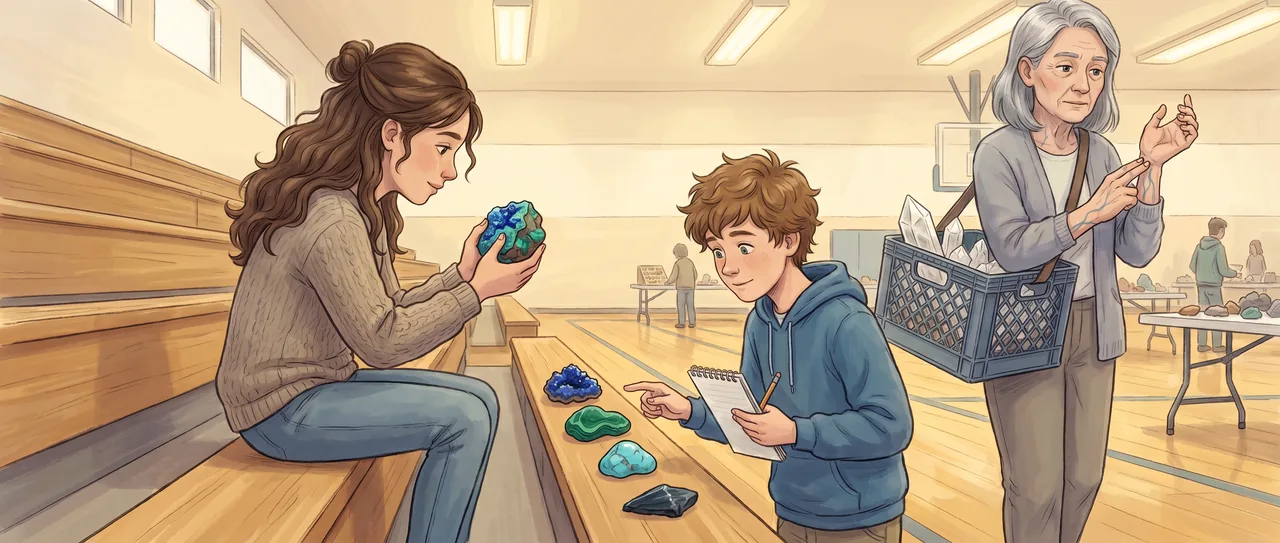
Maya was already digging. She pulled out a lump that was two colors at once, a deep blue crowding against a soft green, both of them shining like wet paint.
"This one," she said. "Soren. Look at this one."
Soren turned it in the light. "Blue on this side. Green on that side. Same rock."
"Azurite and malachite," said the man, not really looking. "They grow together sometimes. Two bucks."
Maya paid before he finished the sentence. They sat on the bleachers with the rock between them.
"Two different minerals," Soren said. "So two different metals, probably. The blue is one metal, the green is another."
"No," Maya said.
"Why no?"
"I don't know why no yet. It just doesn't feel like two metals. Look how they blend at the edge. Like they came from the same thing."
Soren got out his notebook and wrote azurite blue, malachite green, same rock? He tapped the pencil against the page. "There's a way to check. The label at the museum said both of these are copper minerals. Copper carbonate, both of them."
Maya stopped moving.
"Both copper," she said.
"Both copper."
"Then how is one blue and one green."
Soren looked at the rock for a while. "Maybe it's not the copper doing the color. Maybe it's the other stuff. The carbonate part, the water part."
"You don't believe that."
"I don't believe that," he agreed. "Carbonate is what makes soda water. It doesn't have a color. Water doesn't have a color."
"So the color is the copper."
"Has to be the copper."
Maya held the rock up so the blue caught the fluorescent light. "Then the same copper is doing two colors. In one rock. Two inches apart."
That was the thing that neither of them could put down.
"Okay," Soren said, in the voice he used when he was going to be wrong out loud. "Copper is copper. An atom of it is an atom of it. So if the atom picks the color, it should always pick the same color. Blue every time. Or green every time. Not both."
"But it does both."
"But it does both," he said, and underlined it.
There was an old woman two tables down packing zip-top bags of quartz into a milk crate. She had been listening without pretending not to.
"You're closer than the fellow selling it to you," she said. "But you're stuck on the atom being alone. It isn't alone."
"What's it with?" Maya asked.
"That's your question, not my answer," the woman said, and went back to her quartz.
Maya turned to Soren. "In the blue part, what is the copper touching?"
"Carbonate. Some water. Arranged one way."
"And in the green part?"
"Carbonate. Water. Arranged a different way. Different amounts. Different spacing." He stopped. "Different neighbors."
"Same copper," Maya said slowly. "Different neighbors."
"The neighbors are close enough to push on it," Soren said. He was drawing now, a dot with other dots crowded around it, some near, some far. "The copper has electrons. If the neighbors are packed in tight, they push on the electrons one way. If they're spread out, they push a different way."
"And color is light," Maya said. "So if the neighbors change how hard it is for the electrons to jump—"
"Then they change which color of light gets swallowed," Soren finished. "The rock eats one color and shows you the rest. Blue rock ate the reddish light. Green rock ate a different piece."
"Same electrons. Same copper. The neighbors decide how big the jump is."
They looked at the rock again. The blue and the green did not look like two minerals to Maya anymore. They looked like one metal answering two different questions.
"So the copper isn't blue," she said. "And it isn't green."
"It doesn't have a color by itself," Soren said. "It borrows one. From whoever it's standing next to."
Maya laughed, but not because it was funny. "That's every copper rock in the box, then. Every one is a different color depending on who it's holding hands with."
She went back to the box and dug. She came up with a chip of turquoise, blue-green. A crumb of something the color of a robin's egg. A dark shard that was nearly black.
"Copper?" she asked the woman.
The woman glanced over. "Turquoise, yes. That black one too, probably. Copper's in a lot of things."
Soren lined them up on the bleacher between them. Deep blue, soft green, robin's egg, near black. He put the two-dollar rock at the end.
"Same element," he said quietly. "All the way down the line."
"Nobody would guess," Maya said. "You'd swear it was five different metals. You'd bet money."
"The man did bet money. He said rocks are rocks."
Maya picked up the blue-and-green rock and held it so the two colors sat side by side one last time.
"It's like copper doesn't have a face," she said. "It has a face for every room it walks into."
Soren wrote that down exactly.
The woman with the milk crate stood up to leave. She paused at their bleacher and looked at the little row of colors.
"You know what's strange," she said. "You. Me. That rock. Iron in your blood. The iron is why the blood is red. Same idea. An atom leaning on its neighbors, deciding what light to keep."
She hitched the crate onto her hip and walked out, and the gym doors swung shut behind her with a boom. Then she pressed two fingers against the inside of her own wrist, where the blue lines ran under the skin, and looked at the green rock, and looked back at her wrist.
Soren watched her do it, and then he did it too, both of them counting the pulse under the skin against the color they thought they understood a minute ago.
Read the interactive version, listen to the narration, and earn a gold star →
A science-verified short story for curious kids · Curiosity Land