The Rabbit Number
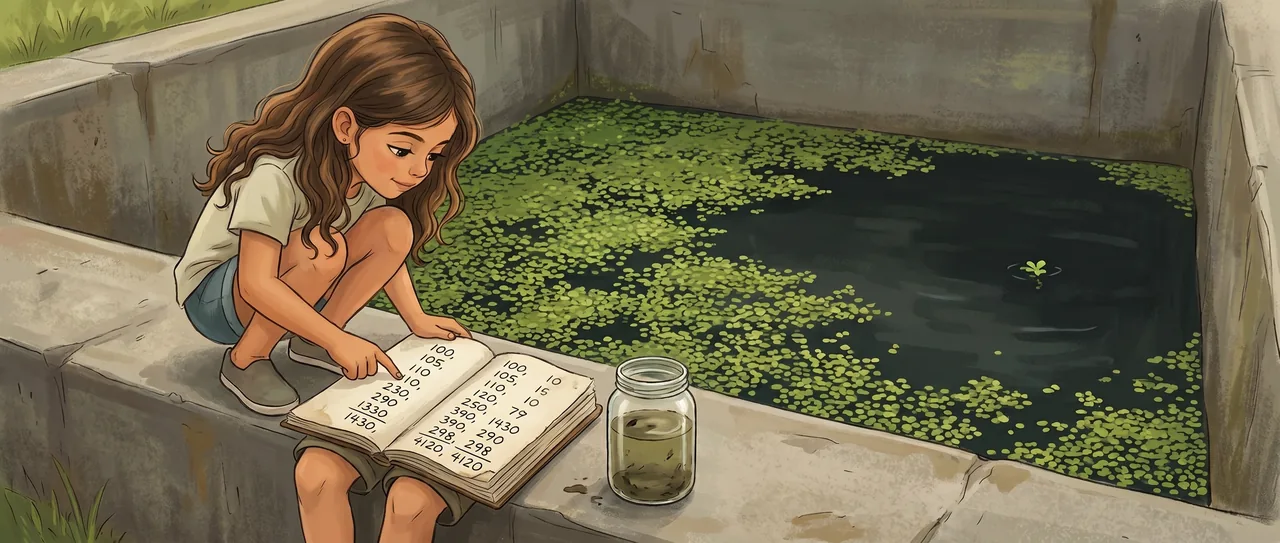
The duckweed had doubled again. Maya could see it from the top of the concrete slope, a bright green skin creeping across the old reservoir.
"Two weeks ago it was a patch the size of a towel," she said. "Now it's half the pond."
Soren had a paper notebook balanced on his knee and a jar of pond water beside him. He had counted the little green plants in the jar twice.
"So it doubles," he said. "Easy. Next week the whole pond."
"That's what I thought." Maya crouched at the water's edge. "But look at the far corner. It's thin there. Almost none."
"Crowded plants can't grow. No room. No light." Soren wrote something. "So it doesn't just double forever. It slows down when it gets full."
"Right. So there's a rule." Maya held up two fingers. "Grow fast when there's room. Grow slow when it's packed. One rule."
Soren liked that. One rule he could write down. He drew a line across the page and put a number on it. "Let's say the pond is one whole. Say it's a quarter full now. If I know the rule, I can figure out next week. Then the week after. Forever."
"Do it in your head?"
"Do it on paper." He wrote a small equation, the kind his uncle had shown him once, about how a number this week makes the number next week. There was a growth number in it. His uncle had called it the rabbit number, because it said how fast things bred.
"Pick the rabbit number," Maya said.
"Small first. Careful." Soren picked a low one and cranked through the weeks. Quarter full. A little more. A little more. Then it stopped moving. "Huh. It settles. Same amount every week. The pond finds a level and stays."
"Boring," said Maya. "But probably true if the weed grew slow. Make it grow faster."
Soren bumped the rabbit number up. He worked the weeks again, his pencil scratching. "Still settles. Just at a fuller pond."
"More."
He bumped it again. This time the numbers wouldn't sit still. "Wait. It's not settling. It goes high, then low, then high, then low. Same two numbers, over and over."
Maya leaned over the page. "Every other week. Full, then thin. Full, then thin."
"That's weird. One rule, and it can't pick a single answer. It picks two." Soren circled the two numbers. "Why two?"
"Because it overshoots," Maya said slowly, watching the real pond, not the page. "It grows too much, then it's too crowded, so next week it crashes, then there's room again, so it booms. It can't calm down."
Soren stared at her, then at his numbers. "That's exactly what it's doing. Boom, crash, boom, crash." He bumped the rabbit number a tiny bit more.
"What now?"
"Four numbers." His voice went quiet. "Not two. Now it cycles through four different weeks before it repeats."
Maya sat back on her heels. "Two became four."
"With almost no change to the number." He nudged it again, the smallest push. His pencil moved faster. "Eight. Eight weeks before it repeats."
"Do it again."
"I can barely tell anymore. Sixteen, maybe. They're all close together." He was writing hard now, the numbers stacking down the page. "Every time I push the rabbit number a hair, the number of steps doubles. Two, four, eight, sixteen."
"And the pushes are getting smaller," Maya said. "You barely touched it."
"Barely." Soren looked at the tiny gap left on his scale, the last sliver before the biggest rabbit number. "There's almost no room left to push. But the doublings keep coming. Faster. Sixteen, thirty-two." He stopped. "They're piling up on top of each other."
"Then what happens?" Maya asked. "When you get to the end of the pushing?"
Soren picked a rabbit number way at the high end, past all the doublings, and started cranking the weeks. Quarter full. Jump. Drop. Jump. Almost empty. Nearly full. He filled a whole column and read it back.
"It never repeats," he said.
"It has to repeat. It's just numbers."
"It doesn't." He turned the notebook so she could see. "Look. No pattern. Not two, not four, not a hundred. Every week is different from every week before. Forever."
Maya took the notebook. She ran her finger down the column, looking for the same number to come around again. It didn't. "One rule," she said. "You could tell me the rule in one sentence. And this comes out."
"That's what's bothering me." Soren pulled the jar closer, as if the answer were in the water. "If I know the rule exactly, and I know exactly how full the pond is, I should be able to tell you every week from now to the end of time."
"Can you?"
"No. Because I don't know exactly how full it is. I know it's about a quarter." He circled his starting number. "Watch. I'll start it a tiny bit different. A hair fuller." He cranked the same rabbit number from the new start.
For the first few weeks the two columns marched along almost side by side.
"They match," Maya said.
"Wait."
By the sixth week the columns had split. By the tenth they had nothing to do with each other. One said nearly full. The other said nearly empty. Same rule. Same rabbit number. A starting difference too small to measure.
Maya looked up from the page to the real green pond, the real weed she had been so sure would cover everything by next week.
"So we can't predict it," she said. "Not because the rule is complicated. Because the rule is simple."
"Because it's simple," Soren repeated. He wasn't writing now. He was just looking at the two columns that had started as twins and ended as strangers. "A whole thing nobody could ever guess, hiding inside a rule you could teach a kid."
Maya stood up. Out on the water, a breeze pushed the green skin into shapes, thin here, thick there, and the far corner that should have filled in was still, somehow, almost bare.
"How full next week?" Soren asked.
Maya watched the weed slide and gather and pull apart. A duckweed plant, no bigger than a freckle, drifted off the edge of the crowd and out across the open black water, alone.
Read the interactive version, listen to the narration, and earn a gold star →
A science-verified short story for curious kids · Curiosity Land