The Man Who Was Right Too Early
The exhibit was mostly about sledges. Maya had already read the sledge cards twice, and the frostbite cards, and the card about a dog named Ivan, when she came around the corner to a case nobody else was standing at.
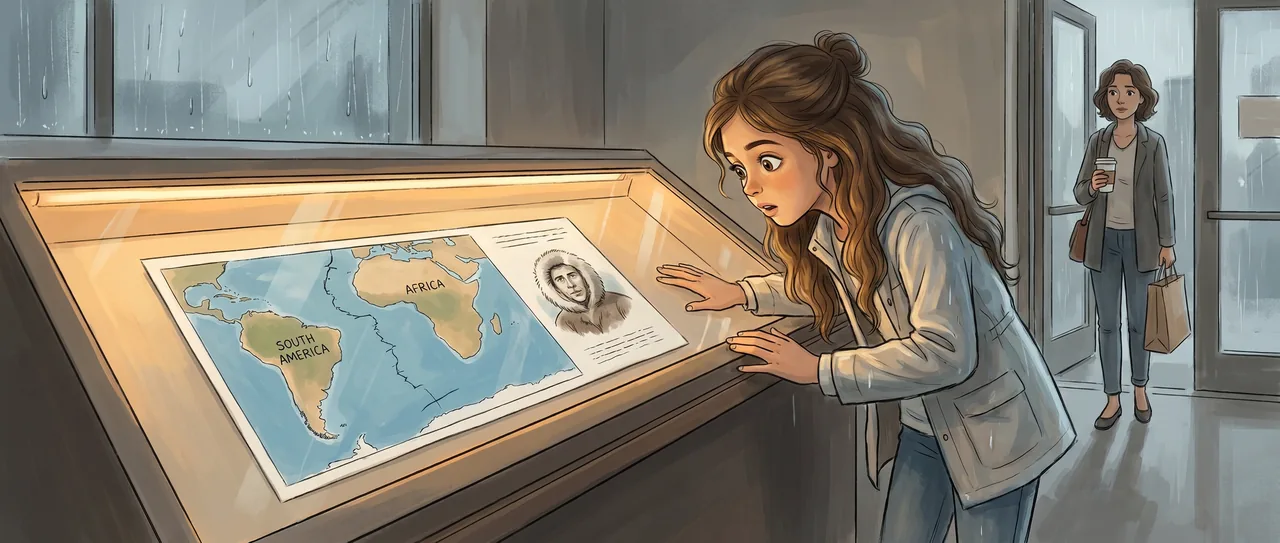
Inside was a photograph of a man in a fur hood, and a map with two continents floating apart, and a card that said his name was Alfred Wegener.
Maya read the card. Then she read it again, slower, because something in it did not sit right.
He had looked at a map, the card said. He had noticed that the coast of South America and the coast of Africa fit together like two torn pieces of one page. He had found the same fossils on both sides of the ocean, the same little swimming reptile in rocks that were now four thousand miles apart. In nineteen twelve he had said the continents used to be joined, and had drifted.
And everyone had laughed at him. For fifty years.
Maya stood very still in front of the case.
Her aunt drifted over, holding a paper cup of coffee. Her aunt liked museums for the gift shops.
"Find something good?" her aunt asked.
"This man was right," Maya said. "And they laughed at him until he was dead."
Her aunt read the first two lines of the card. "Huh," she said. "Well. He couldn't prove it, could he." And she wandered toward the sledges.
Maya looked back at the case. That was the part that did not sit right. Couldn't prove it. But he had the coastlines. He had the fossils. He had the same rock layers, the card said, stacked in the same order on two continents that had never touched, not in anyone's lifetime. If you found the same handwriting in two torn halves of a page, you would not say the halves were strangers.
So she stood there and did the thing she did when something did not fit. She tried to laugh at him. She tried to be one of the people in nineteen twelve, and find the hole.
It took her about a minute.
The continents were made of rock. The ocean floor was made of rock. Rock does not move. You could lean on a boulder with all your weight and it would not slide one hair. So if you told a geologist that entire continents had gone plowing across the planet, the geologist would ask the only fair question in the world.
How.
What pushed them. What could possibly be strong enough to shove a continent, and soft enough to let it through, and where was it, and why had nobody ever felt the ground move like that.
Wegener didn't know. The card admitted it, in small print. He had the fit and the fossils and the rock layers, all the evidence that it had happened, and not one idea about how it happened. He guessed the continents plowed through the sea floor like ships. That guess was wrong, and everyone who was already sure could point at the wrong guess and feel finished.
Maya felt something cold go down the back of her neck.
Because she believed him. Standing at the case, with the coastlines fitting and the fossils matching, she believed him completely, and she still could not answer the question. She was on his side and she was stuck exactly where he had been stuck. Right, and with no way to make anyone stand next to you.
She read the last card in the row.
It said that in the nineteen fifties and sixties, ships began to map the bottom of the ocean, really map it, for the first time. And they found a mountain range running down the middle of the Atlantic, all the way around the world, a seam. And the rock got younger the closer you got to the seam, and older as you went out toward the continents on both sides. As if the sea floor were being made at the seam and carried away from it in two directions. As if the ocean were a conveyor belt splitting down the middle.
The continents had never plowed through anything. They were riding.
Maya read that word, riding, and felt the whole room tilt very quietly under her feet, the way it does when an elevator starts and your stomach knows before you do.
Wegener had the answer to what. He died before anyone found the answer to how. The how was hiding at the bottom of the sea the entire fifty years they were laughing, in the dark, under three miles of water, being made and carried and made again, and no one had a ship that could see it.
So he wasn't wrong. He wasn't even really missing evidence. He was missing a ship. He needed a machine that had not been built yet, to see a place no one had been, and until that machine existed, the truest thing anyone had said about the planet had to sit in a case and wait.
Maya thought about all the things people were sure of right now. Today. This exact Saturday. She thought about how many of them might be somebody's coastlines, somebody's matching fossils, sitting there fitting perfectly together while everyone waited for the ship that could see the seam.
She thought about the man in the fur hood, being right, alone, for the rest of his life.
And then she thought the thing that made her hands go still on the glass rail. Somewhere, right now, someone was being laughed at for being right. Not in the past. Now. And the seam that would prove them was already down there in the dark, already real, just waiting for the ship.
Maya turned around to find her aunt.
Her aunt was near the door, holding two things from the gift shop, mouthing come on through the glass, tapping her wrist where a watch would be.
Maya crossed the room. But at the doorway she stopped and looked back at the little case in the corner that nobody else had come to, the photograph, the two continents drifting apart, the man who had been right too early.
She pulled her phone out and took a picture of the map, the one with the seam drawn down the middle of the ocean, and put the phone in her pocket, and walked out into the rain.
Read the interactive version, listen to the narration, and earn a gold star →
A science-verified short story for curious kids · Curiosity Land