The Fast Ones
The seeds would not come off.
Maya held the little weed by its stem and shook it. The seed heads, spiky green balls the size of peppercorns, stayed clamped to the plant. She shook harder. Nothing.
"Give me the ones from the park," she said.
Soren dug in his backpack and pulled out the plastic bag. Inside were three of the same plant, same spiky green balls, that they had grabbed yesterday near the pond in the big park across the river. He handed her one.
Maya shook it. A little shower of seeds fell into her palm.
"Okay," she said. "That's weird."
"Same plant?" Soren asked.
"Same plant. Same leaves, same everything." She held them up side by side, the lot one and the park one. "Yours lets go. Mine won't."
Soren took the lot plant and rolled a seed head between his fingers. It resisted, then crushed, still holding on. He wrote something on the page. Then he looked at the ground around the base of the plant, which was growing straight up out of a crack in the concrete.
"There's no dirt here," he said.
"There's a little dirt."
"There's a crack with a little dirt. And a wall. And more concrete." He pointed at the park plant. "That one grew in a field. Wide open. Seeds fall, wind takes them, they land somewhere new."
Maya was already ahead of him, looking down at the crack. "And if my seeds blow away here, where do they land."
"Concrete."
"Concrete. The garage. The subway grate." She crouched. "They die."
Soren crouched next to her. "So the ones that let go, here, in the city. Their seeds go nowhere good."
"And the ones that hold on," Maya said slowly, "the seeds stay. They drop right into the same crack. The one good spot."
They looked at each other.
"How long has this lot been here," Soren said. It was not really a question. He answered it himself. "My dad says there was a building. It came down when he was a kid."
"So thirty years. Forty." Maya turned the stubborn plant in her fingers. "That's not long enough to become a different plant."
"It didn't become a different plant. It's the same plant." Soren stopped. He was looking at the seed heads again, all of them clamped tight, every single one on this plant, and the ones in the crack next to it, and the ones by the base of the wall. All holding on.
"But if the let-go ones keep dying here," he said, "every year, and the hold-on ones keep surviving here, every year, then in forty years the lot is full of"
"Hold-on ones," Maya finished.
"And the park is still full of let-go ones. Because letting go still works there."
Maya sat down right on the concrete. "Nobody changed them. The city changed them. Just by being a city."
A train went by underneath. They felt it more than heard it, the grate humming, the little plant in Maya's hand trembling slightly on its stem.
"Test it," Soren said.
They spent the next twenty minutes doing it properly, because Soren would not accept two plants as proof of anything. They pulled ten from the lot. They walked the whole length of the block and pulled six more from other cracks, by the bus stop, behind the laundromat, in the gutter where the drainpipe let out. Then they used the park bag as the control.
Soren held each plant. Maya shook it exactly three times. He wrote L for let go or H for hold on.
Every lot plant held on. All sixteen.
Every park plant let go. All three.
"Three isn't enough for the park," Soren said, frowning at his own page. "We need more park ones to be sure."
"We'll go tomorrow," Maya said. "But Soren." She was quiet. "Sixteen to zero."
He looked at the sixteen little plants lined up on the concrete, all of them born in cracks, all of them holding their seeds so tight that they would only ever fall back into the crack that made them.
"It's happening right now," he said. "It's not a fossil thing. It's not a million years." He looked up at the parking garage, the subway vent, the laundromat, the whole gray weight of the block. "The city is doing it right now. To everything in it. Slow enough that nobody watches."
"The pigeons," Maya said suddenly.
"What?"
"The pigeons here don't fly when you walk at them. The ones in the park do. I always thought city pigeons were just used to people." She stood up. "What if they're not used to people. What if the ones that flew away all the time got too tired and the ones that stayed calm had more babies and now"
"Now the calm ones are the only ones left," Soren said.
"And the coyotes." Maya's voice was getting faster. "There's coyotes in the city now. They cross at the lights. Somebody told me they cross at the lights."
Soren was writing, fast, not looking at the page. "The ones that crossed on red died. The ones that waited"
"Had babies that wait."
They stood in the vacant lot with sixteen small stubborn plants at their feet and the whole city humming around them, and it was the same city as an hour ago and it was completely different.
"Everything here is becoming its own thing," Maya said. "The plants and the birds and the mice and the bugs. All of it. A city version. And nobody drew it up. It's just what's left after the wrong ones stop."
Soren looked at the crack in the concrete, at the seed head clamped shut, holding, waiting for the plant to dry and drop it back into the exact place it came from.
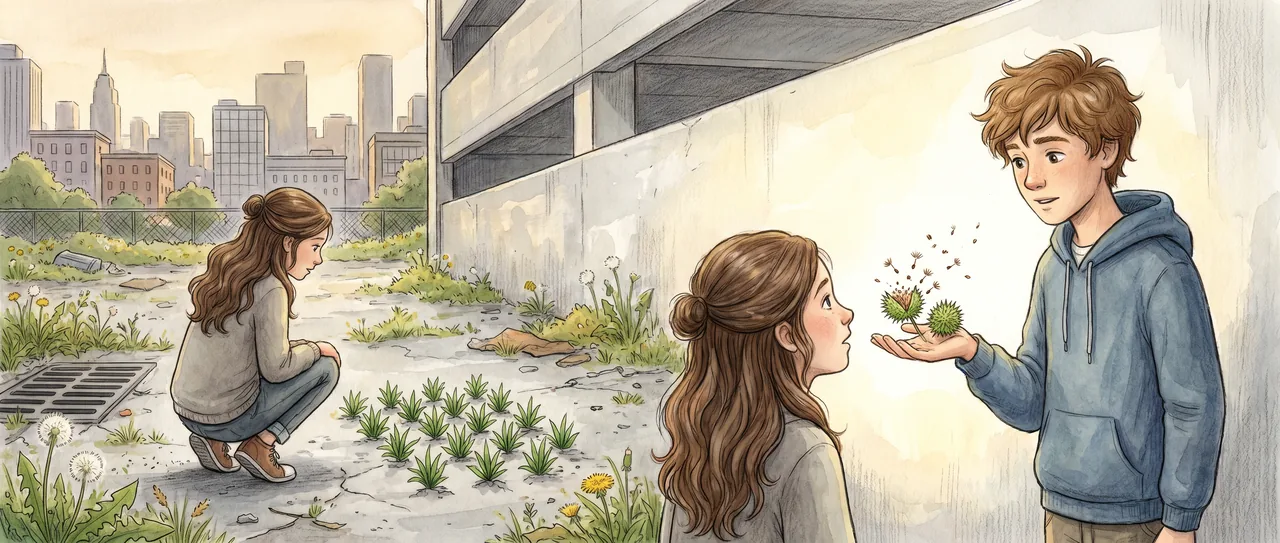
He picked one lot seed head and one park seed head and held them out flat on his palm, side by side, in the light coming off the garage wall.
The train came again. The park seed let go and scattered across his hand. The city seed did not move at all.
Read the interactive version, listen to the narration, and earn a gold star →
A science-verified short story for curious kids · Curiosity Land