The Difference Count
The museum lights had already dimmed in the hall behind them, but the screen at the sequencing exhibit was still awake, still counting.
"They forgot to turn it off," Maya said.
"Or they left it running on purpose," Soren said. He crouched to read the small print at the bottom. "It's a demo. It compares a sample genome to the reference and counts the differences."
The number on the screen was ticking upward, slow and steady. Three million, two hundred thousand. Three million, two hundred and four thousand.
"Whose genome is it?" Maya asked.
"Says it's synthetic. A made-up example." Soren tapped the panel next to it. "The reference is the thing they compare everyone to. Like a master copy of a human."
Maya frowned at the number. "Then it should match. If it's the master copy, and this is a human, they should be almost the same."
"They are almost the same. Ninety-nine point nine percent."
"So why is it counting so high?"
Soren watched the number climb past three million, three hundred thousand. "Because the genome is enormous. Three billion letters. Even a tiny fraction of that is a huge pile."
Maya did the math out loud, fast. "A tenth of one percent of three billion." She stopped. "That's three million."
"About four to five million, actually, once you count all the kinds of differences," Soren read off the panel. "Every person. Not this made-up one. Every real one."
Maya sat down on the floor in front of the screen. "Say that again."
"Every human alive has around four to five million places where their genome doesn't match the reference."
"Four million." She said it like she was testing whether it would hold weight. "Places where I'm not the master copy."
"Places where nobody is the master copy. The reference isn't a real person. It's stitched together from a bunch of people. So everyone differs from it. Even the people it's made of."
Maya looked at the number, still rising. Three million, five hundred thousand. "Okay. But here's the part I don't get." She pulled her knees up. "Four million differences. That's a lot of ways to be broken."
"That's the thing." Soren scrolled the panel. He read slowly, then read it again to be sure. "Most of them do nothing. As far as anyone knows. They're just different. Not better, not worse. Different."
"Most of four million."
"The panel says the large majority have no known effect."
Maya was quiet. Then: "No known effect, or no effect?"
Soren looked at her.
"Those aren't the same," she said. "No effect means it doesn't matter. No known effect means nobody has figured out yet whether it matters."
Soren read the panel a third time. His finger stopped on the word known. "You're right. It says known. They don't know."
"So somewhere in my four million," Maya said, "there could be a difference that does something, and nobody on Earth has any idea what."
"Or millions of differences," Soren said. "Sitting there. Unread."
The number crossed four million. It slowed, the way a kettle slows just before it decides what it's going to do.
Maya stood up. "Wait. Go back to the reference part." She pointed. "It's stitched from a bunch of people. So it never described anyone. Not one single actual human."
"Right."
"Then when they say I differ from it four million times, they're comparing me to a person who was never born."
Soren pulled his notebook out of his jacket and opened it against his knee. He wrote a line, crossed out a word, wrote it again.
"There's no normal one," Maya said. "There's no actual normal human sitting somewhere that the rest of us are copies of."
"There's an average sketch," Soren said. "And everyone is four million steps away from the sketch. In their own direction."
Maya walked closer to the screen until her face was lit by it. "So the museum has this backward."
"How?"
"They're showing it like a difference is a mistake. Like the reference is right and I'm four million typos." She shook her head. "But if nobody matches, then matching isn't the point. The differences aren't the errors. The differences are the whole book."
Soren stopped writing. "Say that slower."
"Every one of those four million places is a spot where somebody, sometime, went a slightly different way. And most of them, nobody has read yet. Nobody knows what they say." Maya turned around. "There are more unread differences in one person than there are people who have ever lived."
Soren looked down at his own hands, then back at her. "There are about eight billion people right now."
"And more than a hundred billion who ever lived. I read that."
"Four to five million differences each," Soren said, and he was working it now, out loud, the way Maya had. "Times a hundred billion people who ever existed."
"Most never read," Maya said.
"Most never read."
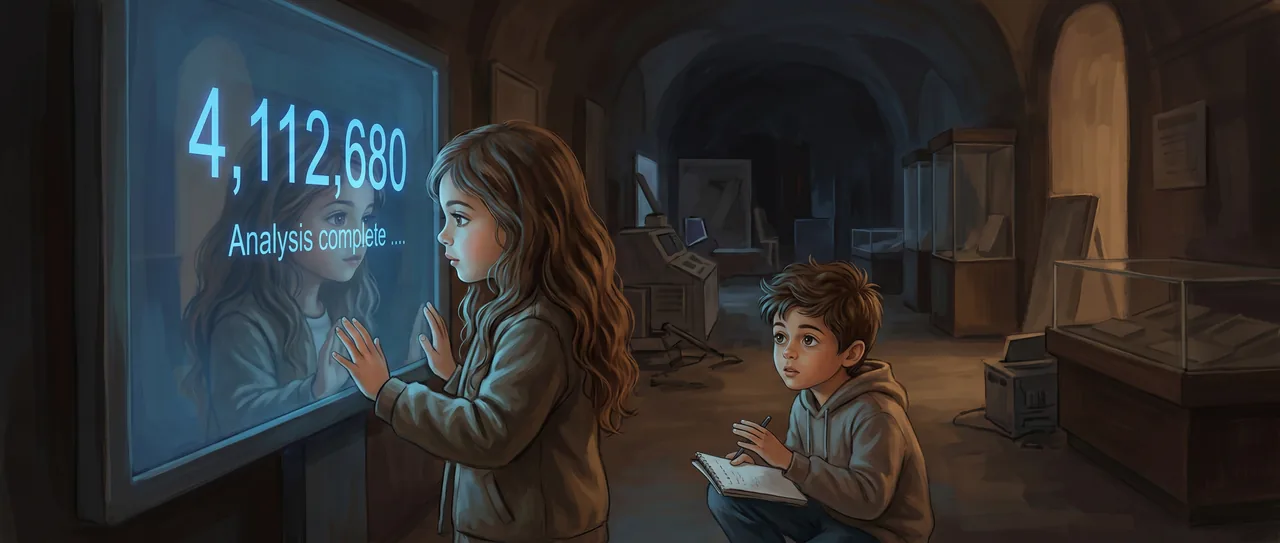
They both looked at the screen. The counter had settled. Four million, one hundred and twelve thousand, six hundred and eighty. A little line of text blinked underneath it: Analysis complete.
"It says complete," Soren said. "But it isn't. Not really. It counted them. It didn't read them."
Maya put her hand near the screen without touching it, the way you hold a hand near something warm to check. "Somewhere in mine there's one that nobody has ever looked at. One that doesn't have a known effect because it doesn't have a knower yet."
"Same in mine," Soren said.
"Different four million," Maya said. "Same nobody-has-read-it."
A guard's flashlight swept the far end of the hall. Neither of them moved yet.
Soren wrote one more line, then held the pen still over the page without lowering it. On the screen, the word complete kept blinking, patient, over a number that had stopped counting but had not finished meaning anything.
Read the interactive version, listen to the narration, and earn a gold star →
A science-verified short story for curious kids · Curiosity Land