The Crystal That Kept Time
The rain came down so hard the shop windows went blurry, and Mr. Okafor said they could dig through the reject drawer while they waited, as long as they didn't cut themselves on anything.
"These are all dead?" Maya asked.
"Dead or wrong," he said, not looking up from the watch he was fixing. "A watch that gains a minute a day is worse than one that stopped. A stopped one is right twice." He held a tiny screwdriver like a surgeon and did not offer to explain anything else.
Maya tipped the drawer onto the counter. Gears, springs, little brass plates, and one clear sliver of something that caught the light wrong. She held it up.
"That's the quartz," Soren said. He had already opened his notebook to a fresh page. "The bar in a quartz watch. It's the part that keeps the time."
"This tiny thing keeps the time." Maya turned it. It was smaller than a grain of rice, a little fork shape of crystal. "Not the battery?"
"The battery just pushes electricity into it," Soren said. "I read the crystal shakes. Really fast. And the shaking is the ticking."
Maya set it down on the counter and stared at it. "A rock that shakes when you plug it in."
"Quartz," Soren said. "Same stuff as sand, mostly. Silicon and oxygen."
"Sand keeps better time than a clock full of gears." She said it like an accusation. "Why?"
Mr. Okafor snorted from his bench but kept working.
Soren tapped his pen against his teeth. "Okay. Something about the shape of it. When you squeeze certain crystals, they make a little bit of electricity. And when you put electricity in, they squeeze themselves. Bend a little."
"Both ways?" Maya looked up. That was the part that snagged her. "Push and it makes power, power and it pushes?"
"Both ways."
"Prove it." She wasn't being mean. She just wanted to see it.
Soren looked at the drawer, then at the shop. "We need to squeeze a crystal and catch the electricity. That's too small." He pointed at the fork of quartz. "But there's a bigger one."
Maya followed his finger to the wall, where a display of cheap plastic lighters sat in a cup by the register. The long kind, for candles.
"The clicker," Soren said. "The lighter that makes a spark without a flint. Mr. Okafor, does that one work?"
"No gas in it," the man said. "Been empty a year. Click it all you like, it won't light."
Soren picked it up. "Empty is fine. We don't want fire. We want the click."
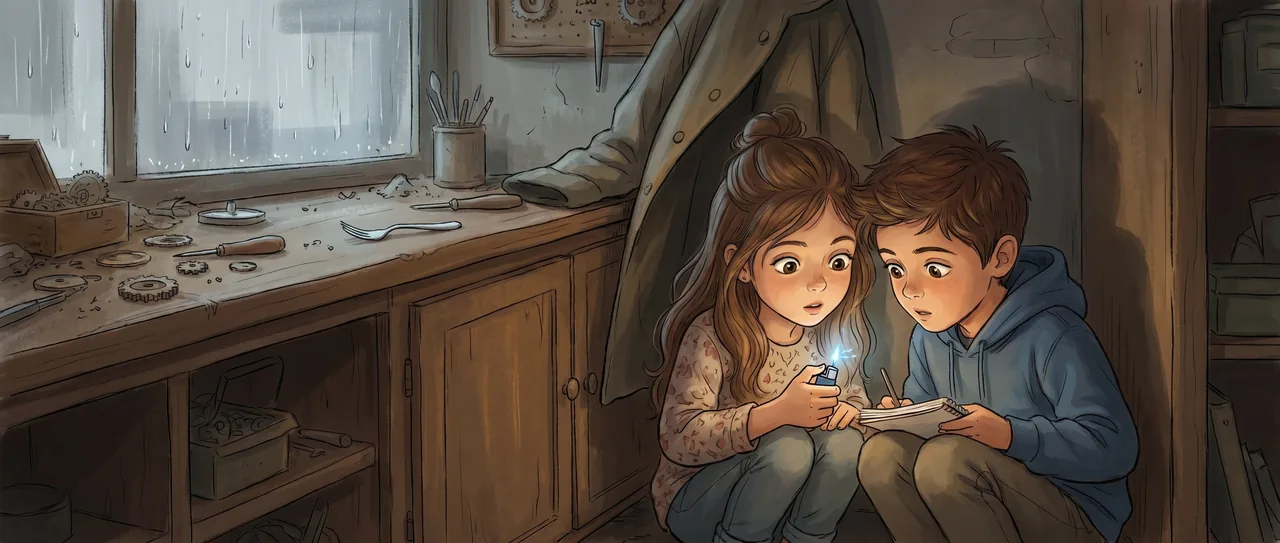
He pressed the button in the dim shop. Nothing seemed to happen. Then Maya pulled him toward the back corner where a coat blocked the gray window light, and he pressed again.
A tiny blue spark jumped inside the plastic tip. Snap. Small as a spark from a cat's fur.
Maya made a sound that wasn't quite a word.
"Do it again," she said.
Snap. A blue thread of light, gone as fast as it came.
"There's no battery in that," Maya said slowly. "There's no battery in a candle lighter."
"No."
"So where's the spark coming from?"
Soren looked at the button under his thumb. "From my thumb." "Say that again."
"Inside there's a little hammer," Soren said. "It smacks a crystal. Hard and fast. And the squeeze makes enough electricity to jump a spark. That's the whole thing. My thumb pushes the hammer, the hammer squeezes the rock, the rock makes lightning."
Maya took the lighter from him. She pressed it. Snap. She felt the small resistance, the click of the hammer letting go, and then the blue.
"I made lightning," she said, "with my hand."
"A very small amount of lightning."
"Soren." She pressed it again and watched the spark. "It's the same crystal."
"What?"
"The watch and the lighter. It's the same trick, going opposite directions." She turned back toward the counter, toward the rice-grain fork of quartz. "The lighter squeezes the crystal and gets electricity out. The watch pushes electricity in and gets the crystal moving. Same door. In or out."
Soren stopped writing. "Yeah," he said. "Yeah, that's exactly it."
"So the watch is doing the lighter backward, millions of times, quietly, forever." She looked at the crystal like it had gotten bigger while she wasn't watching. "How fast does it shake?"
"The little watch fork? Thirty-two thousand times a second," Soren said. "Give or take. It's a specific number. They cut the crystal so it shakes at exactly the right speed and then they count the shakes."
"Count." Maya pressed the lighter one more time. Snap. "The whole watch is just something counting a rock shivering thirty-two thousand times a second and calling every so many shivers a second."
"That's a watch," Soren said.
From the bench, Mr. Okafor finally set down his screwdriver. "The good ones," he said, "they seal that little fork in a vacuum, in a can, so nothing can touch it or slow it. That's why quartz beat the gears. Nothing bumps it. It just shivers." He picked his tool back up. "Still gains a minute if you cut it wrong, though."
Maya wasn't listening anymore. She was holding the empty lighter up to her ear, pressing the button, listening to the tiny mechanical click that came before the spark.
"Soren," she said. "The doctor. When my brother had the thing with his ear, they held that wand on him and there was a picture on the screen."
"Ultrasound."
"Is that—" She stopped. Started again. "Is that a crystal too? Getting squeezed to make sound, and squeezed back by the echo to make the picture?"
Soren opened his mouth. Closed it. Opened it. "I don't actually know," he said. "But it would have to be, wouldn't it. In or out. Same door."
"Same door," Maya said.
She set the lighter down on the counter next to the sliver of quartz, the dead one, the one that had counted out somebody's minutes until the battery quit.
Outside the rain had gone soft and steady, ticking against the glass. Maya put her ear close to the window and listened to it hit, one drop, another drop, another, each one a tiny push landing somewhere, and she started, without meaning to, to count.
Read the interactive version, listen to the narration, and earn a gold star →
A science-verified short story for curious kids · Curiosity Land