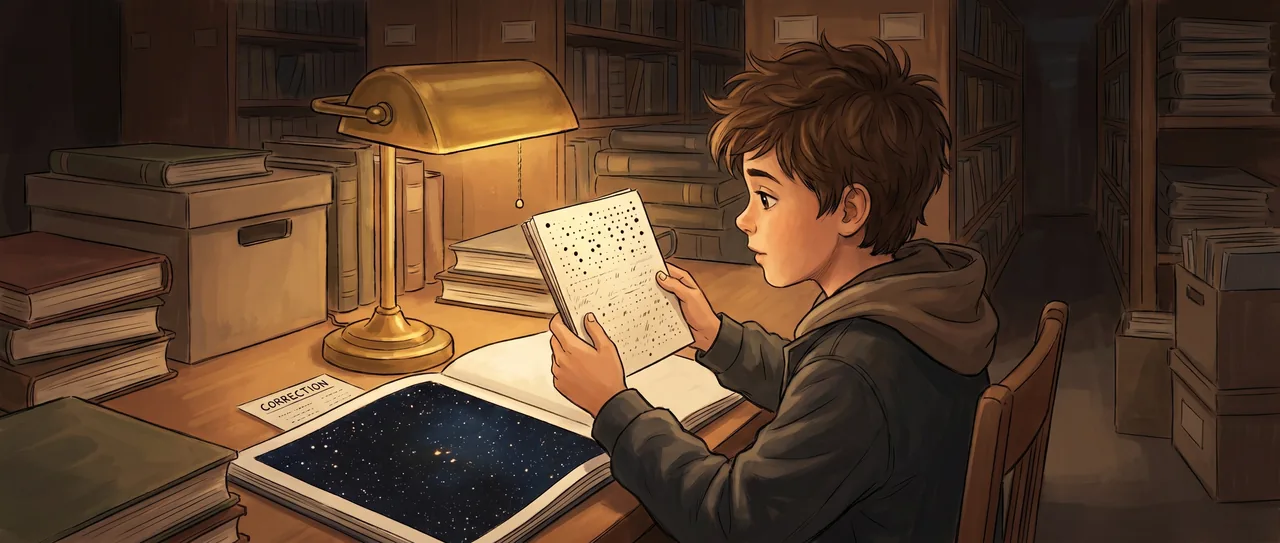
The Uncounted
The library basement smelled like old paper and the hum of a heater that never quite got warm. Soren was supposed to be shelving. He was mostly reading.
Mr. Adeyemi ran the archive the way some people run a train station, which meant he liked things on time and in order and did not like questions that made him lose his place. He had handed Soren a cart of magazines and a list and said, spines out, dates ascending, and then gone back to arguing with the photocopier.
Soren got through most of a shelf before a slip of paper fell out of a magazine and landed on his shoe.
It was thin, cheap paper, the kind that gets folded into a package to correct a mistake. CORRECTION, it said at the top. Below that, in small print, it explained that a figure printed in a previous issue was now understood to be too low. The number of galaxies in the observable universe had been revised. Where the old article had said one hundred billion, this slip said two trillion.
Soren read it twice.
One hundred billion is already a number you cannot really hold. He had tried before. If you counted one galaxy every second, without sleeping, one hundred billion would take longer than all of recorded history. So it was not that two trillion felt bigger in his stomach. Both numbers were past the edge of feeling.
What stopped him was the word revised.
He found the old magazine, the one the correction went with, and read the original article. It was confident. It had a photograph of a dark patch of sky, a famous one, where a telescope had stared at what looked like absolutely nothing for days and days and filled the frame with galaxies nobody had known were there. The article was proud of that. Look, it said, at how many. We counted them.
Soren turned the correction slip over in his fingers.
They had not been wrong about the photograph. The galaxies in the picture were real. They had counted the ones they could see. The slip was saying something stranger than a mistake. It was saying that when new people looked at the same pictures, more carefully, with better math, they found galaxies that had been in the images the whole time. Small ones. Faint ones. Ones so dim they had sat inside the data like whispers under a loud room, and nobody had heard them, so nobody had counted them.
He went back up the metal stairs and found Mr. Adeyemi crouched at the open belly of the photocopier.
"The galaxy number changed," Soren said.
"Mm."
"It went up twenty times. From one to twenty. Not because they found new sky. Because they looked at the old pictures again and the galaxies were already in them."
Mr. Adeyemi did not look up. "Numbers change. That's science. Spines out, please."
Soren stood there a moment. That's science was the kind of answer that closed a door, and he could feel the door was actually open, so he went back down.
He put the correction slip on the table under the reading lamp and looked at the deep field photograph beside it. He tried to imagine the astronomers who had first counted. They had not been careless. They had been careful. They had counted every galaxy they were sure of, and stopped where they stopped because past that point the light was too faint to be certain, and a good scientist does not count what she cannot defend.
So the first number was not a guess that was too small. It was the honest edge of what could be seen at the time.
And the twenty-fold jump was not the sky getting fuller. It was the edge moving.
Soren pulled his notebook out of his back pocket. He drew a small square for the deep field and filled it with dots until his hand got tired, and then he drew, very lightly, in pencil so faint he could barely see it himself, more dots between the dots. Then more between those.
He held the page up to the lamp. Under the light, the faintest pencil marks almost disappeared. He had to look slightly away from them to catch them at all, the way you catch a dim star by not staring straight at it.
That was the thing. That was the exact thing.
The faint galaxies had always been sending their light. The light had crossed billions of years and arrived at the telescope and gone into the picture and sat there, in the data, patient, uncounted, waiting for someone to look in the right way. The universe had not gotten bigger in 2016. People had gotten better at listening to the quiet part of it.
And if looking harder at one old picture could multiply the number of galaxies by twenty, then two trillion was not the answer either. Two trillion was just the current edge. The honest edge of what could be seen now. Somewhere there were galaxies fainter than the faintest ones anyone had found, sitting in pictures already taken, or in pictures not taken yet, whispering under the loud room, waiting.
Soren thought about how many things get counted as zero only because nobody has looked closely enough to count them as one. Faint stars. Faint galaxies. Quiet kids in loud classrooms who notice the slip of paper fall and pick it up.
He carried the correction slip and the old magazine back up the stairs. Mr. Adeyemi had the photocopier working again and was feeding pages through it with the satisfaction of a man whose machine had surrendered.
"I want to put this back," Soren said, "but I want to write on it first."
"Write on an archive document and I'll retire on the spot."
"Not the original." Soren was already reaching for a blank slip from the copier tray. "A new one. To go with it. For whoever finds it after me."
Mr. Adeyemi finally looked at him.
"What would it say?"
Soren picked up the pen. On the fresh slip he wrote, in his careful small print, one line, and slid it into the magazine facing the old correction, so that anyone opening the volume would see both.
The slip said: this number is also too low.
Read the interactive version, listen to the narration, and earn a gold star →
A science-verified short story for curious kids · Curiosity Land