The Tablespoon Under the Car
The mechanic's name was Dev, and he had grease on his elbows and a phone wedged between his shoulder and his ear, arguing with a parts supplier. He waved Maya and Soren toward two folding chairs and mouthed the word soon.
Soren had already found the thing on the workbench. It was a rusted metal canister, cut off a car, about the size of a loaf of bread. Someone had sliced it open lengthwise with a saw.
"Look at this," he said.
Maya leaned in. Inside the canister was a block like a honeycomb, thousands of tiny square tunnels running end to end, the whole thing the pale color of old ceramic.
"It's a screen," Maya said. "For air."
"For exhaust." Soren tilted it toward the window. The little tunnels caught the light. "Dev, what is this?"
"Catalytic converter," Dev said, phone still on his shoulder. "Bad one. Thieves cut those off cars to sell. Worth more than you'd think." He turned back to the phone.
Maya ran a fingernail along the honeycomb. "It's just ceramic. Why would anyone steal ceramic?"
"Not the ceramic," Soren said. He was reading a smudged label glued to the side. "There's metal in it. Platinum. Palladium." He looked up. "That's why."
"How much platinum?"
Soren checked the label again, then frowned. He tapped Dev on the arm. Dev sighed, said something into the phone, and lowered it.
"How much platinum's in this?" Soren asked.
"Couple grams, maybe." Dev shrugged. "Whole car has less than a tablespoon of the precious stuff. Spread out so thin you'd never see it."
Maya stared at the canister. "A tablespoon."
"That's it."
"And it cleans the whole car's exhaust."
"Every mile it drives," Dev said. "For years." The phone was back at his ear before she could ask anything else.
Maya sat down slowly. She had her thinking face on.
"Okay," she said. "That doesn't work."
"Which part?"
"All of it. A car burns, what, thousands of gallons of gas over its life. Makes poison gas the whole time. Carbon monoxide. The stuff that kills you in a closed garage."
"Right."
"And a tablespoon of metal, spread out on some ceramic, fixes all of it? A tablespoon can't touch that much gas. There isn't enough of it."
Soren picked the converter back up. He was quiet, turning it over, and then he held it very close to his eye and looked straight down one of the tunnels.
"You can see through it," he said. "Straight through. The gas doesn't stop here. It just passes over the metal and keeps going."
"So the metal barely touches it."
"No." He set it down. "The gas touches it and then leaves. And then the next gas touches the same metal." He looked at her. "The metal doesn't get used up." "Say that again."
"The platinum isn't an ingredient," Soren said, slower now, working it as he spoke. "If it were an ingredient it'd run out. You'd need a truckload. But a tablespoon lasts the whole life of the car. So it isn't being turned into anything. It's just... there. When the gas is on it."
"It helps and then it's back," Maya said. "Ready for the next one."
"Ready for the next one. Forever. Or close to forever."
They both looked at the honeycomb. Maya reached out and put her finger down one of the tunnels, feeling the smooth ceramic wall.
"Wait," she said. "That's why the tunnels. That's why it's not just a lump."
"Say it."
"If it were a lump of metal, only the outside touches gas. The inside just sits there, wasted." She pulled her finger out. "But if you smear the tablespoon over all these walls, thin as paint, then almost every single atom is on a surface. Every atom gets to touch gas."
Soren grabbed his notebook off the chair and opened it flat on his knee. His pencil moved fast. He drew a cube, then drew it again cut into tiny cubes, and started counting faces.
"A spoonful of solid metal," he said, "has a surface the size of a coin. But spread over all these walls..." He stopped counting. "It could be the size of a football field. Bigger. The same tablespoon."
"So it's not a tablespoon of metal doing a little," Maya said. "It's a football field of metal folded down into a tablespoon."
Dev had finished his call. He was watching them now, arms crossed, half smiling.
"You know it works at room temperature too," he said. "Well, engine-warm. Not fire-hot. That poison gas would sit there being poison forever on its own. Put it on that surface and it fixes itself in a fraction of a second."
"How?" Maya asked.
"That," Dev said, "is above my pay grade. The metal just makes the reaction easy. Speeds it up a million times. Nobody fully knows why platinum's so good at it. They just know it is."
Maya looked at Soren. Soren looked back.
"Nobody knows why," she repeated.
"Not all the way," Dev said. "People study it their whole lives." He picked up the converter, weighed it in one hand. "Funny part. The metal's the same platinum that's in a ring. Just sitting there, being pretty, doing nothing, on a hand. Put it on this ceramic and it saves your life every morning on the way to work."
He set the converter back down between them and went to find the part he'd been arguing about.
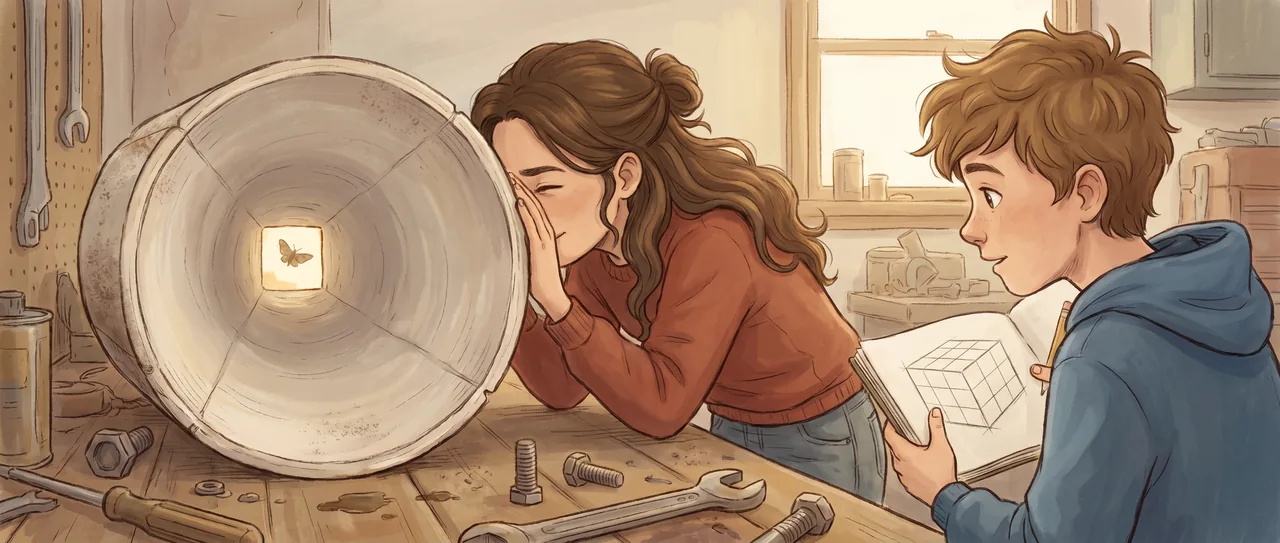
Maya put her eye to the tunnel now, the way Soren had, looking down the long ceramic corridor at the little square of window light at the far end.
"Somewhere in there," she said, "the same speck of metal has helped a billion poison molecules turn safe. And it's still there. Waiting."
Soren wrote one more line and stopped.
Maya kept her eye against the honeycomb, and down the tunnel a moth crossed the far light, its shadow flickering the whole length of the folded football field she was looking through.
Read the interactive version, listen to the narration, and earn a gold star →
A science-verified short story for curious kids · Curiosity Land