The Storm That Made Itself
The rain kept Soren inside the harbor museum longer than he meant to stay. His aunt was three rooms away, photographing a whaling ship's figurehead for her students, and she had said the words take your time in a way that meant she had forgotten he was there.
So he was alone in the archive room, which smelled of salt and dust and the inside of old paper. Glass cases held ships' logs open to their most interesting pages. Most of them were about weather and fish. Soren walked the row slowly, reading the handwriting, which slanted and looped and sometimes gave up halfway through a word.
He stopped at the fourth case.
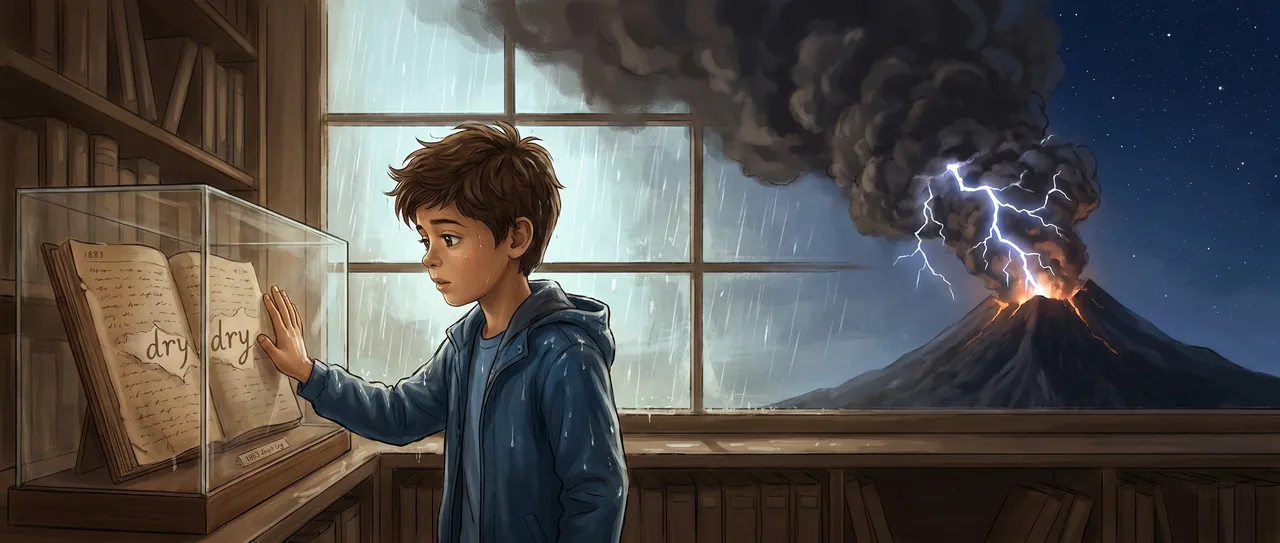
The log was open to a page dated the year eighteen eighty-three. The ink had gone brown. The sailor had written in a hand that got smaller and shakier as the entry went on, as if he were trying to fit something too large into the space he had.
Soren read it twice.
The sailor described a mountain in the distance throwing fire into the sky. That part Soren understood. Volcanoes did that. But then the sailor wrote about lightning. Lightning walking up and down inside the smoke. Lightning by the hundreds, by the thousands, cracking through the ash while the stars stayed clear overhead. No storm clouds. No rain. A dry sky, and lightning pouring out of the mountain like something the mountain was making itself.
Soren stood very still and looked at the glass.
Lightning came from storm clouds. He knew this. Clouds rubbed ice and water against each other high up, built charge, and let it go. That was the rule. That was how the sky did it.
But the sailor swore there were no clouds. He swore it twice, underlining the word dry, pressing so hard the nib had torn a small hole in the paper. Soren put his face close to the case and found the tear, a tiny wound in the page a hundred and forty years old.
The rain drummed on the museum roof. Real lightning, somewhere out over the water, lit the archive room white for half a second and then let it go dark again.
Soren waited for the thunder. It came. He counted the gap the way everyone does. Then he went back to the sailor, because something in the man's shaking handwriting felt like a question being handed across a hundred and forty years to whoever would take it.
What rubs together in a volcano.
He thought about the storm outside. Ice against ice. Water against water. Little pieces moving fast and hitting each other and stripping charge off one another until the whole cloud was split into a top half and a bottom half that could not stand being apart.
A volcano did not have ice. A volcano had ash. Soren pictured the plume the sailor had watched, a column boiling up miles high, and inside it not one calm thing. Rock ground to powder. Grit. Grains. Millions of them thrown upward and slamming into one another the whole way up.
He stopped picturing it and started feeling it, the way you feel a wool sweater lift the hair on your arm. Rub things together and charge moves. He had shuffled across enough carpets in dry socks to know a spark did not need a cloud. It needed collisions. It needed enough small things hitting each other.
A volcano threw up more small things in one minute than a person could count in a lifetime.
Soren's breath fogged the glass over the sailor's page. He wiped it with his sleeve.
The mountain was not borrowing a storm. The mountain was building one. Not out of water and ice like the sky did, but out of its own broken rock, ash grinding on ash until the plume split into charged halves that could not bear the distance between them, and closed it, again and again, thousands of times, while the stars looked down through clean dry air.
The sailor had seen a thing that made no sense and written it down anyway. People must have read this page and decided he had been half asleep, or frightened, or lying. A dry sky full of lightning. Impossible. Except he had pressed so hard describing it that he tore the paper, and a boy standing in a rainstorm a century and a half later was pressing his own hand flat against the case, believing every word.
Soren took out his notebook and drew the plume. A tall column. Arrows going up. Small marks all through it for the ash, and jagged lines where the small marks were thickest, low and violent near the mountain's mouth where the grinding was worst.
He looked at what he had drawn and then at the sailor's torn word, dry, and the two things sat side by side and agreed with each other.
His aunt appeared in the doorway with her camera. She glanced at the case.
"Sad old log," she said. "Some poor man watching a volcano wipe out an island. Krakatoa, I think. Terrible year."
"He saw lightning in it," Soren said. "With no clouds."
"Trick of the eye," his aunt said kindly. "Ash and fear. People saw all kinds of things back then." She lifted the camera to photograph the figurehead through the far doorway and moved on.
Soren stayed.
He did not think it was a trick of the eye. He thought the sailor had been the first person in that whole ocean to write down honestly a thing that was true and would not be explained for another hundred years, and that the not-being-believed had torn the paper as much as the pressing had.
Outside, the rain thinned. The lightning over the water had moved off, taking its clouds with it. Through the archive window the sky began to clear, and a last stroke of it flickered far out where the storm was leaving, one bright thread against the dark, and Soren watched it and thought of a mountain making that same light out of nothing but its own ground-up self.
He put his finger under the torn word and read the sailor's page one more time, all the way to the end.
Read the interactive version, listen to the narration, and earn a gold star →
A science-verified short story for curious kids · Curiosity Land