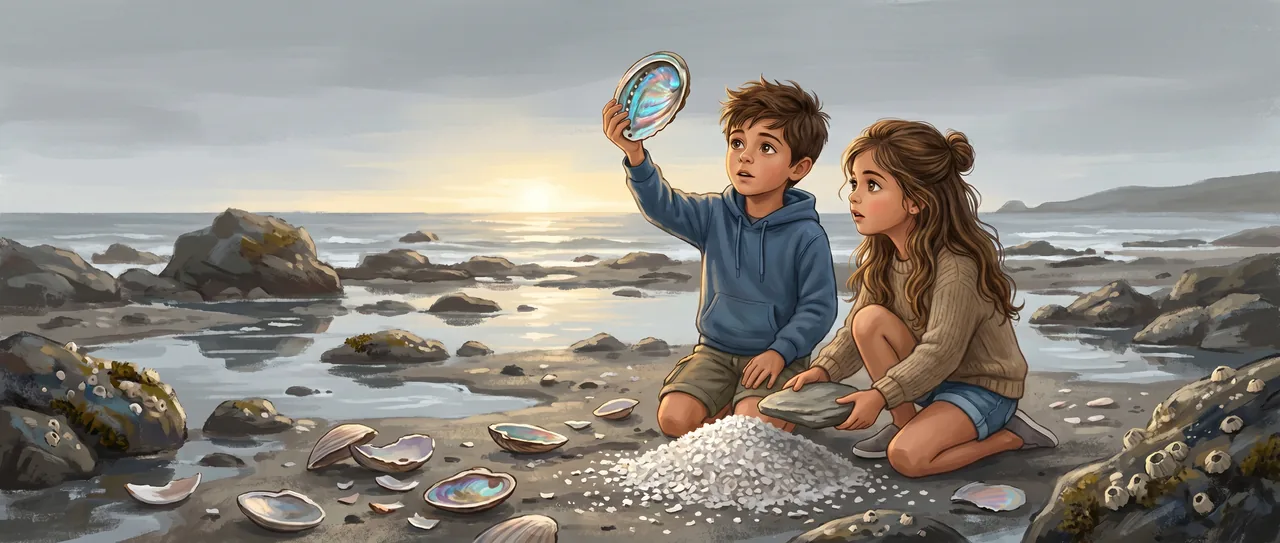
The Shell That Wouldn't Break
Maya had already broken three shells. Not the abalone ones. The plain white clam shells, the ones that shattered when you looked at them wrong. Those made lovely tinkly pieces for the wind chime. The abalone shell was the problem.
"Hit it again," said Soren.
"I have hit it eleven times."
"Hit it a twelfth."
Maya brought the flat rock down. The abalone shell jumped on the boulder, skittered, and sat there. Rainbow on the inside, rough gray on the outside, and completely, insultingly, not broken.
"The clams break if you breathe near them," she said. "This thing is the same stuff. Chalk. Calcium whatever."
"Calcium carbonate," said Soren. "Same as chalk, same as the clams. Same as the white cliffs you can crumble with your thumb."
Maya picked the shell up and looked at the broken edge where her rock had chipped it. She held it close to her eye.
"It didn't crack," she said. "It sort of. Frayed."
"Frayed?"
"Like when you break a stick that has strings in it. The crack tried to go through and something stopped it. Look."
Soren looked. Along the chipped edge the rainbow layer had come apart in tiny flat steps, like the world's smallest staircase, or a stack of playing cards someone had shoved sideways.
"Layers," he said. "It's not one solid piece. It's a stack."
"A stack of what?"
He got out his notebook and a pencil. He drew a straight line and pushed the pencil hard until the point snapped through the paper. Then he tore a fresh page, folded a stack of about ten thin strips, laid them flat on top of each other, and pushed the pencil into that.
"The single line rips straight through," he said. "The stack doesn't. The point has to get through the first strip, then the gap, then the next strip."
"So the crack has to start over every layer."
"Every single layer."
Maya took the shell back and ran her thumbnail along the inside. It was smooth as a spoon, but she could feel it now, or believe she could, ridges too small to see.
"How small are the layers?"
"Smaller than we can see. Way smaller. My science book said abalone builds them out of little flat tiles. Thousands of them, stacked, glued with something soft in between."
"The animal builds them?"
"The animal builds them. One tile at a time. It decides where each one goes."
Maya stopped moving. The rock was still in her hand.
"Soren. The clam is made of the same chalk and it breaks if you look at it. This one is made of the same chalk and I hit it twelve times. The only difference is how the animal stacked it."
"The arrangement," he said. "Not the stuff. The arrangement of the stuff."
"So the abalone took the weakest, crumbliest, most useless material on this whole beach." She held the shell up against the gray sky. "And it stacked it so carefully that now I can't break it with a rock."
"Three thousand times," Soren said quietly.
"Three thousand times what?"
"That's the number from the book. Nacre, the rainbow stuff, is about three thousand times tougher than plain calcium carbonate. Same atoms. Same chalk. Three thousand times harder to crack, only because of how it's arranged."
Maya set the shell down on the boulder very gently, the way you'd put down something that might be listening.
"That's not a shell," she said. "That's an argument."
"A what?"
"An argument. It's the animal saying, give me the worst material on earth and I'll show you what stacking it right can do. And it's winning. It won twelve times."
Soren was drawing the staircase edge in his notebook, layer over layer, tiny brick over tiny brick. His hand kept going.
"A crack wants to run in a straight line," he said. "That's the fast way, the easy way. The soft glue between the tiles makes the crack go sideways instead. It stops, it slides, it starts again. It never gets to build up speed. That's why it frays instead of snapping."
"The crack is being sent the long way around."
"On purpose. By the way the tiles are laid."
Maya picked a clam shell off the sand and crushed it in her fist without trying. Chalk. Dust. It fell between her fingers.
Then she picked up the abalone shell again and looked at the rainbow, and this time she was not seeing color. She was seeing the tiles. Thousands and thousands of flat little tiles, each one set down by an animal with no eyes for the pattern and no plan on paper, each one exactly where it needed to be so that a girl with a rock, thousands of years later, would fail.
"We build bridges," she said slowly. "Out of steel. And they still crack."
"They do."
"And a sea snail figured out how to make chalk stronger than my rock, out of the softest thing on the beach, by stacking. Just stacking." She turned to him. "Soren. If you could stack anything like that. Anything. Any cheap crumbly thing."
He stopped drawing.
"You could make it tough," he said. "You wouldn't need the strong material at all. You'd need the strong arrangement."
They looked at each other, and then at the pile of broken clams, dust and glittering nothing, and then at the one shell in the middle of it that would not break.
Maya put the rock down.
"I don't want to break it anymore," she said. "I want to know how it counts the layers."
Soren turned the shell over in his hands and held it toward the low sun. The rainbow moved across it, band after band after band, and every band was a wall the crack would have to climb, and there were more of them than either of them could count before the tide came back over the boulders and took the light.
Read the interactive version, listen to the narration, and earn a gold star →
A science-verified short story for curious kids · Curiosity Land