The Sheet That Was Only Edges
The gallery was closed and the lights were half off, and Maya's mom had told them to sit on the bench by the carbon exhibit and not touch anything until nine.
Maya was already not sitting on the bench.
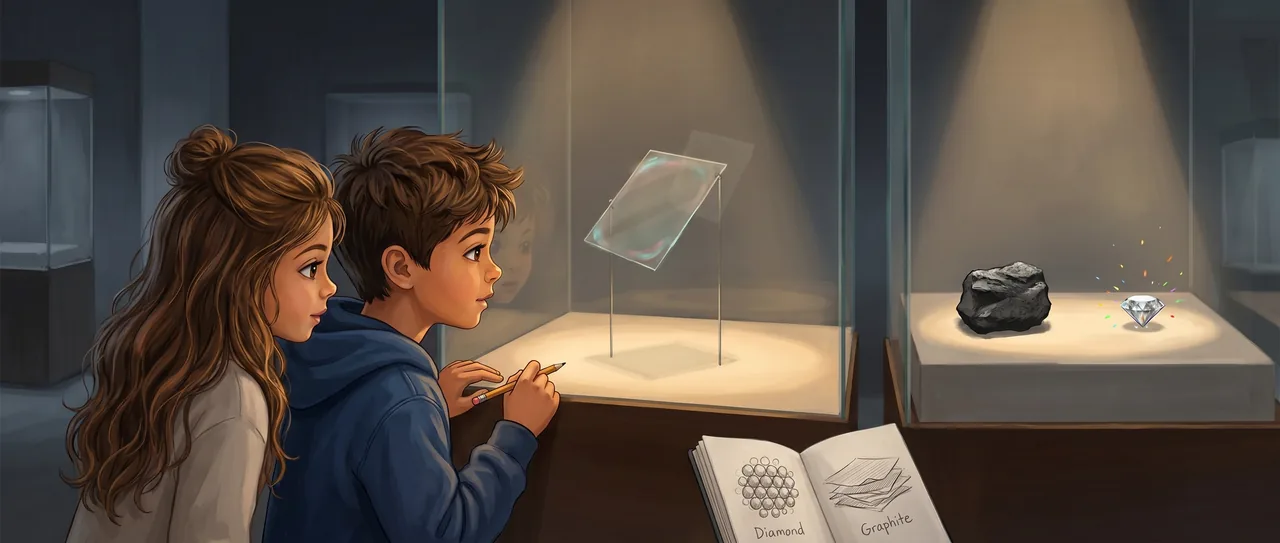
"Look at this," she said. She was standing in front of a glass case with a spotlight in it and, as far as Soren could tell, nothing else. "Empty case. Full spotlight. Somebody labeled the empty."
Soren came over. There was a card. It said GRAPHENE, and under that, one square meter, and under that, a little paragraph nobody had bothered to light properly.
"It's not empty," Soren said. "The card says one square meter. That's a big something."
"So where is it?"
Soren leaned until his nose almost touched the glass. He tipped his head so the spotlight slid across the inside of the case. For a moment, at one angle only, there was a faint gleam, like the ghost of a soap bubble, a rectangle of almost-nothing hanging in the air on two thin wires.
"There," he said. "Tip your head."
Maya tipped her head. The gleam came and went.
"It's see-through," she said.
"It's nearly see-through. The card says it lets almost all the light pass. That's why you can't find it. It's one square meter and you walked right up to it and called it empty."
"Because it's thin."
"Read how thin."
Maya read. Then she read it again, slower, the way she read things when the first read had made no sense and she suspected the sentence, not herself.
"One atom," she said. "It says the sheet is one atom thick."
"That can't be a sheet," said Soren. "A sheet has a top and a bottom. If it's one atom thick, the top and the bottom are the same atoms. There's no in-between layer. It's all surface."
Maya stared at the gleam. "It's a whole square meter, and it has no inside. It's only edges."
They stood there with that for a second.
"What's it made of?" Maya asked.
"Carbon." Soren pointed at the case next to it, which was doing a much better job of being a museum exhibit. "Same as those."
Those were two chunks under their own spotlights. One was a black lump of pencil-lead graphite, soft enough that the card invited you to imagine it smearing. The other was a diamond, small, behind extra glass, throwing little colored sparks.
"Wait," Maya said. "Same as both of them? The soft one and the hard one?"
"Carbon and carbon and carbon," said Soren. "All three. The diamond, the pencil, and the ghost."
"That's not possible. You can crush the pencil one with your thumb. You can't scratch a diamond with anything."
"It's the same atoms," Soren said. "So it has to be how they're holding hands."
Maya turned to look at him.
"The pattern," she said. "It's the pattern. Not the stuff. The stuff is identical. It's the shape they line up in."
Soren pulled out his notebook and drew a diamond first, carbon atoms reaching in every direction, up and down and sideways, a whole solid crowd of them. Then, on the next line, he drew the pencil: flat sheets stacked loosely, the sheets sliding off each other like cards in a deck.
"That's why the pencil smears," he said, tapping the loose stack. "The sheets slide. That's the gray on your finger. You're peeling off sheets."
Maya's eyes went from the drawing to the case with the ghost in it.
"Peel off one," she said. "Peel off exactly one of those sheets."
Soren looked at the ghost. Then at his own drawing. Then he stopped drawing.
"That's what it is," he said quietly. "The ghost is one sheet off the pencil. One layer of the pencil, all by itself."
"The pencil is the ghost stacked up a million times," Maya said. "You've been holding it your whole life. It's in your bag right now."
Soren actually looked at his bag.
"But the card," Maya went on, faster now, walking back to the first case, "the card says the ghost is stronger than the diamond. One layer off a pencil, the softest thing in here, and it's stronger than the hardest thing in here."
"Because inside one sheet, the atoms don't slide," Soren said. "Look at my drawing. Inside a sheet they're locked in hexagons. Six-sided. It's the loose stacking between sheets that makes the pencil soft, not the sheet itself. Take away the stack. Keep one sheet. Nothing to slide."
"Hexagons," Maya said. She traced a six in the air with her finger. "A honeycomb. It's a honeycomb of carbon one atom thick and it's stronger than a diamond and it carries electricity better than the copper in the walls and you can't even see it."
"All of that from the same thing the pencil is made of," Soren said. "The only difference between the softest and the strongest is how you fold the exact same atoms."
Maya went very close to the glass again and tipped her head until the gleam swam up out of nothing, that faint rectangle of held-together edges.
"So when you write with a pencil," she said, "you're tearing off pieces of the strongest sheet there is. You just tear off millions at once so it feels soft."
"You leave them on the paper," said Soren. "Every word you write is stacked ghosts."
Maya didn't say anything for a moment. She was looking at Soren's open notebook, at the gray marks his pencil had left across the page.
Then she reached over, took the pencil out of his hand, and pressed a single dark line onto the corner of the paper, slow, watching the tip drag.
Soren leaned in beside her. "Somewhere in there," he said, "there's a layer that's just one atom thick."
Maya lifted the paper toward the spotlight and turned it, the way you turn a thing to find the exact angle where it stops hiding.
Read the interactive version, listen to the narration, and earn a gold star →
A science-verified short story for curious kids · Curiosity Land