The Same Letters
Maya had cut all forty strawberry plants from the same mother.
That was the whole point. Her aunt ran the community garden and had let Maya take over the back bench of the greenhouse, and Maya had spent a whole Saturday snipping runners, the little green babies that strawberry plants throw out on long stems, each one an exact copy of the plant it came from. Not a cousin. Not a sibling. A copy. Same letters, top to bottom.
So they should have grown up the same. That was the rule. Same code, same plant.
Except row three was wrong.
Maya crouched with her chin on the bench and looked down the line. Rows one and two were leafy and low and stubborn about flowering, exactly like the mother. Row three had bolted upward, thin and pale, flowering early like it was in a hurry to be done. Same mother. Same letters. She had labeled them herself.
"You overwatered," said her aunt, walking past with a tray of onions. Her aunt believed most problems were watering problems. She was often right, which made her hard to argue with.
"Same water," Maya said. "Same hose. Same day."
"Then it's the light."
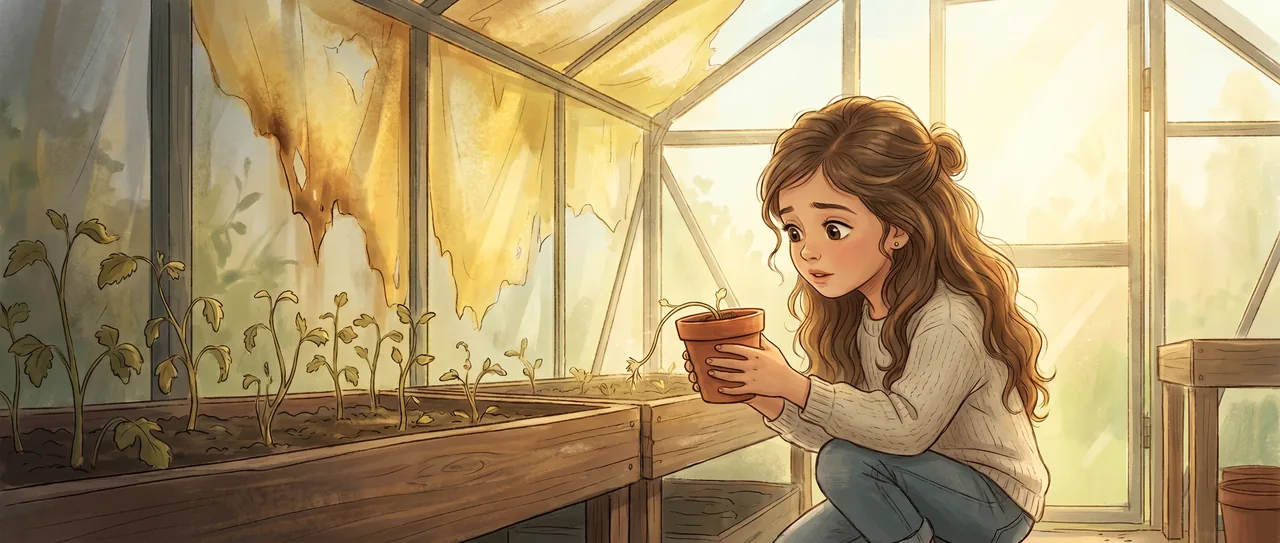
Maya looked up. Above row three, the greenhouse plastic had a long scorched patch where last summer's sun had cooked it yellow. Less light came through there. All winter, row three had grown up under a dimmer sky than its sisters.
"Light," Maya said slowly. "But light doesn't change the letters."
"No," her aunt agreed, already walking away. "Light doesn't change anything. It's just light."
But that was the part that would not sit still in Maya's head. The plants had the same letters. She had made sure. If the code was identical and the code decided everything, then something that was not the code had reached in and turned row three into a different plant.
She kept a running list in her head of things that did not make sense yet, and she filed this one near the top.
She went to the library that afternoon, because her aunt's answers had run out and Maya's had not. She typed in a question the wrong way three times before she found the right words for it. Same DNA, different plant, why.
The screen gave her a word she had never seen. Methyl.
Maya read for a long time without blinking much. A methyl group, the page said, was a tiny chemical tag. Just a smudge of atoms. It did not rewrite a single letter of the DNA. It could not. What it did instead was land on top of a gene, like a fingertip pressed over a word on a page, and quiet it. The word was still there. You just could not read it out loud anymore. Silenced, the page said. The gene is silenced.
And the tags got placed depending on what happened to the living thing. Cold. Hunger. How much light. What the plant went through got written on top of the letters without touching them.
Maya sat back.
Row three had not grown up under a different code. Row three had grown up under a different sky, and the sky had reached down and pressed its fingertips onto certain genes and told them to be quiet. Grow fast. Flower early. Do not waste time being leafy under a dim sun. Same letters. Different words switched off.
She read the next part twice to be sure she believed it, the way she did with things that seemed too big.
The tags could last. In some living things they lasted a whole lifetime. The plant would carry the memory of that dim corner in its silenced genes long after she moved the pot into full sun. The code would not remember. The tags would.
Maya thought about that all the way back to the greenhouse on her bike, pedaling too fast, the list in her head rearranging itself.
Because here was the thing nobody had told her. She had believed, without ever deciding to, that the letters were the whole story. That you were your code and that was that. Fixed. Handed to you. Nothing you could do.
But the letters were not the whole story. On top of the letters there was another layer, a layer written by what a living thing actually lived through. A layer of tiny quiet fingertips saying this word, not that one. Here, not there. The same book could be read a hundred different ways depending on which words were whispered and which were left out.
She thought about herself, which she had not meant to do. She and her older brother had the same parents, close enough to the same letters, and everyone always said how different they were, and everyone said it like it was strange, like it needed explaining. Maybe it did not need explaining. Maybe they had just grown up pressing different fingertips onto the same pages. Two readings of one book.
Back at the bench, Maya crouched again by row three. The pale hurried plants did not look wrong to her anymore. They looked like a message. They looked like a record of a winter under a scorched patch of plastic, written in a language that was not the code and sat on top of it.
She reached up and touched the yellowed plastic above them, the burned place that had made all the difference.
Then she did something her aunt would have called a waste of a good plant.
She took one runner from row three, one pale hurried copy, and she snipped a fresh baby off the end of its stem. A copy of a copy. Same letters as the mother, same letters as its dim-grown parent. She potted it and carried it to the brightest corner of the greenhouse, under the clear plastic where the sun came through whole.
If the tags washed out in the light, the baby would grow leafy and low like the mother, and the dim winter would be forgotten.
If the tags held, the baby would grow up pale and hurried under a bright sky it had never been cold in, carrying a winter it had never lived.
Maya did not know which it would be. Nobody at the library had known either, not for sure, not for a strawberry in this greenhouse this spring. That was the part that made her hands not quite steady.
She set the pot in the sun and wrote the date on the label and marked the row, then pulled a stool over to wait for the first leaf to decide what it remembered.
Read the interactive version, listen to the narration, and earn a gold star →
A science-verified short story for curious kids · Curiosity Land