The Salt Under the Water
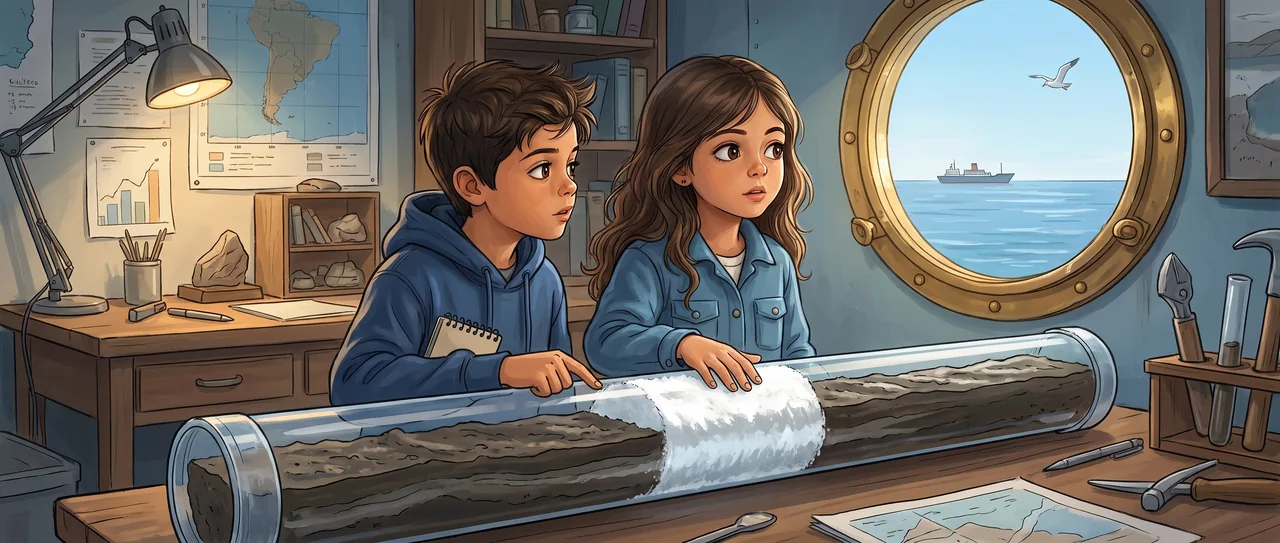
The core came up in a clear plastic tube longer than Soren was tall, and a technician laid it on the bench and left to find lunch.
"It's striped," Maya said.
"Mud on top. Then that white part." Soren leaned close to the middle of the tube. "The white part is really white."
"Taste it."
"I'm not tasting a five-million-year-old rock."
"Not the rock. There's dust on the bench where they cut one open before." Maya touched a fingertip to the powder near the saw and put it on her tongue before Soren could stop her. Her face did something complicated. "Salt. It's salt."
Soren looked at the label taped to the tube. Someone had written a depth on it. Then he looked at the wall chart above the bench, where the depths lined up with ages.
"Maya. The white band is almost six million years old."
"So there was salt at the bottom of the sea six million years ago. That's not weird. The sea is salty."
"No." He put his finger on the tube where the white began. "Salt doesn't just pile up on the seafloor. It stays dissolved. To get a layer this thick, you'd have to take the water away."
They both stopped talking. The lab hummed. Somewhere above them the deck rocked, very slightly, on the actual Mediterranean.
"Take the water away," Maya repeated. "All of it?"
"How thick is that band?"
Maya held her fingers to it. "Longer than my hand."
"And that's just what fit in one tube." Soren pulled his notebook out of his jacket and drew the tube, and drew the white band, and next to it wrote a number and crossed it out and wrote a bigger one.
"You'd need to evaporate the sea to make salt," he said. "But the sea is right there. It doesn't evaporate away. Rivers keep filling it."
"Unless." Maya was looking at the porthole now, at the flat blue water. "Unless something stopped the filling."
"There's only one door." Soren said it slowly. "The Atlantic. Gibraltar. That skinny gap at the far end. Everything comes in through there."
"Close the door," Maya said.
"You can't close a door in the ocean."
"You can if the land moves. Aunt Rea says the whole boot of Italy is being shoved north. Africa's coming up to meet it." Maya pressed her two hands together until they touched. "If they pinch shut at Gibraltar, no more Atlantic. And the sun's still up there."
Soren stared at his own drawing. "The sun keeps evaporating. Nothing refills it. The sea goes down."
"How far down?"
"I don't know. Until it's gone?" He said it as a question and then heard himself and stopped. "Maya, if it went all the way down, the bottom would be way below where the water is now. Kilometers below. It'd be a hole in the world."
They went to the porthole together. Out there the water met the sky in a clean flat line, ships on it, gulls over it.
"So down there," Maya said, and her voice had gone quiet, "under all of that. There was a desert."
"A salt desert." Soren tried to build it in his head. "Three kilometers down. Hotter than anywhere. Salt flats where the fish used to be. And the rivers, the Nile, they wouldn't stop. They'd pour off the edge of the old coast in these enormous canyons, down into the empty part."
"There'd be nobody to see it."
"There'd be nobody anywhere. It was six million years ago." He looked at the tube. "Except the salt saw it. The salt is the seeing."
Maya put her hand flat on the cool plastic over the white band. "Okay. But it's a sea now. We're floating on it. So the door opened again."
"The land moved back?"
"Or the Atlantic just won. It's a whole ocean pushing on one little dam of rock." She spread her fingers. "How long would that hold?"
Soren imagined the rock at Gibraltar cracking. Water finding the crack. Water widening it. Once a little came through, it would cut faster, and the more it cut the more came through, and the more came through the more it cut.
"It wouldn't be slow," he said. "Once it starts it can't stop itself. A whole ocean, falling three kilometers down into an empty desert."
"Falling for how long?"
"I don't know. Months, maybe. Maybe less." He looked up from the notebook. "The biggest waterfall that has ever existed on Earth, and it happened right out there, and there was no one to hear it."
Maya laughed, but it came out shaky. "We're sitting on top of a flood. The whole sea outside is the flood. It never drained back out."
"It's still full." Soren looked at the porthole, at the ordinary blue, and could not make it look ordinary anymore. "Every drop out there came in through that gap. It filled a hole kilometers deep. And it's just, sitting there, being a sea."
The technician came back with a sandwich and saw them at the porthole.
"That's the Messinian," she said, nodding at the white band, chewing. "Classic evaporite. We pull it up every trip." She said it the way someone says they see the same bus every morning.
"You pull up the desert every trip," Maya said.
The technician paused with the sandwich halfway to her mouth. "I. Yeah. I guess I do." She looked at the tube like she hadn't looked at it in a while.
Maya turned back to the glass. Down through the blue, past the ships and the light, three kilometers straight down, there was a floor made of the salt of an ocean that had died and been buried by the ocean that killed it and then was killed by the ocean that came roaring back.
"Soren." She kept her eyes on the water. "Everything living down there right now is living on top of the salt."
"Standing on the day it dried," he said.
A gull dropped past the porthole and touched the water and lifted off again, and the ring it left spread out flat across the whole enormous flooded desert until the sea took it back.
Read the interactive version, listen to the narration, and earn a gold star →
A science-verified short story for curious kids · Curiosity Land