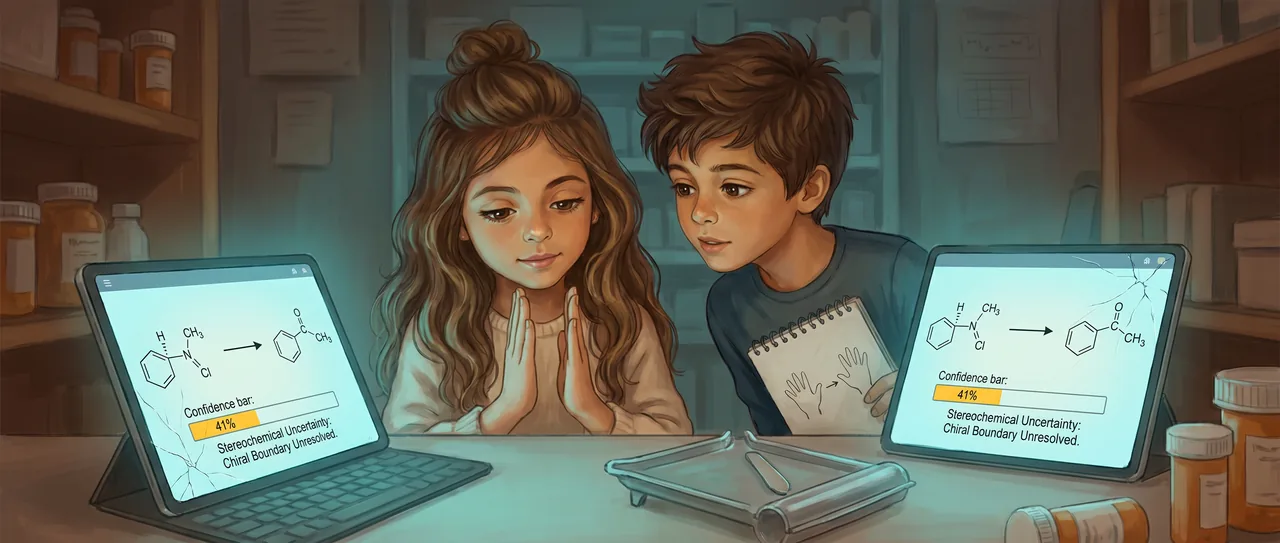
The Reaction That Would Not Say
The tablet was old, the kind with a cracked corner, and it answered everything.
Maya's aunt had left it on the counter of the back room while she counted little white pills into little brown bottles. The tablet ran a chemistry tutor with a voice that sounded like it was smiling. Type in two chemicals, it drew you the product. Fast. Certain. Bored, almost.
"Give it a hard one," Maya said.
Soren typed one in from the poster on the wall. The tablet drew the answer before he finished. A little confidence bar sat under every prediction, a thin green line. Ninety-nine percent. Ninety-eight. Ninety-nine again.
"It's showing off," Maya said.
"It's showing us how sure it is," said Soren. "That green bar. That's the interesting part."
He kept typing. Acids, bases, the burning of things. The bar stayed high and green every single time, like a kid who had memorized the whole test.
"Okay," Maya said. "So it's never wrong."
"It's never unsure," Soren said. "That's not the same."
That sat between them for a second.
Maya reached over and pulled up a picture on her phone, a molecule her science teacher had drawn that week, two versions side by side. They looked identical. Same atoms. Same connections. Same everything.
"They're mirror images," she said. "Left hand, right hand. He said one of them was medicine and the other one made people sick. Same atoms."
"Same atoms, different shape," Soren said slowly. "Because the shape is three-D and the drawing is flat."
Maya was already typing the reaction that made one of the hands. She wanted to see which hand the tablet would pick.
The tablet drew the product. Then it did something it had not done all afternoon.
The green bar shrank. It went yellow. It stopped at forty-one percent.
"Whoa," Maya said. "Do that again."
Soren cleared it and typed the same thing, letter for letter. Forty-one percent. The tablet added a line of small text underneath.
Uncertain. This reaction's outcome depends on three-dimensional approach geometry that is underrepresented in my training data.
They both leaned in. Aunt Priya's pill counter clicked in the background, steady as rain.
"It's telling us it doesn't know," Soren said. His voice was careful, like he'd found a door where there was supposed to be a wall.
"It knew everything else," Maya said. "Why this?"
Soren read the line again. "Approach geometry. It's about how the two molecules come at each other. From which side."
Maya held up her two hands, mirror images, and clapped them together the wrong way. Fingers didn't line up. She turned one hand over. Now they matched.
"It matters which side you come in from," she said. "Like a handshake. You can't shake a left hand with a right hand the normal way."
"And the flat drawing doesn't show the side," Soren said. "So the tablet learned from millions of flat drawings, and for most reactions the side doesn't change the answer, so it never had to care."
"But here it does." Maya was staring at the yellow bar now like it was the most honest thing she'd ever seen a machine do. "Here the shape is the whole answer. And it never practiced on enough of them."
Soren was writing. His pen moved across the notebook page, two little hands and an arrow between them.
"Ask it something," Maya said. "Ask it if a person knows."
Soren typed the question plainly. Does anyone know the answer to this reaction.
The tablet drew a small careful sentence. For some geometry-dependent reactions, chemists determine the outcome by running the experiment, because prediction methods including mine are not yet reliable here.
Maya sat back. "So nobody has this memorized. Not the tablet. Not the whole internet inside it."
"You'd have to actually do it," Soren said. "In a flask. And watch which hand comes out."
"With real molecules bumping into each other from real sides."
"Which the flat pictures can't hold."
They looked at the yellow bar together. All afternoon the tablet had been a wall of green, a thing that already knew, a thing that made the world feel finished. And here was a single crack of yellow, and behind it was not a mistake. Behind it was a place the answer had not been found yet. By anyone.
"It's not broken," Maya said quietly. "It's at the edge."
Soren nodded. "It told us where the edge is. That's the useful part. A machine that says ninety-nine every time can't show you the edge."
Maya picked up her phone and looked at the two mirror-image molecules again, left hand and right hand, medicine and not-medicine, exactly the same on paper and completely different in the world.
"So somewhere," she said, "there are reactions that nobody can predict. Where you have to mix them and see. Because the shape does something the numbers haven't caught."
"A lot of them, probably," Soren said. "A whole class. The tablet just admitted it."
Aunt Priya's counter stopped clicking. "You two find something?" she called, not really listening, already tipping the next batch of pills.
"Kind of," Maya said. "We found something the computer doesn't know."
"There's a lot it doesn't know," Aunt Priya said, comfortable and wrong and right at the same time, and went back to counting.
Maya was still holding her two hands up. She brought them together slowly, palm to palm, mirror to mirror, watching the way one could never quite become the other no matter how she turned it.
Soren cleared the screen and typed the reaction one more time.
The green bar climbed, hesitated, and stopped at forty-one percent, yellow, waiting for someone to go find out.
Read the interactive version, listen to the narration, and earn a gold star →
A science-verified short story for curious kids · Curiosity Land