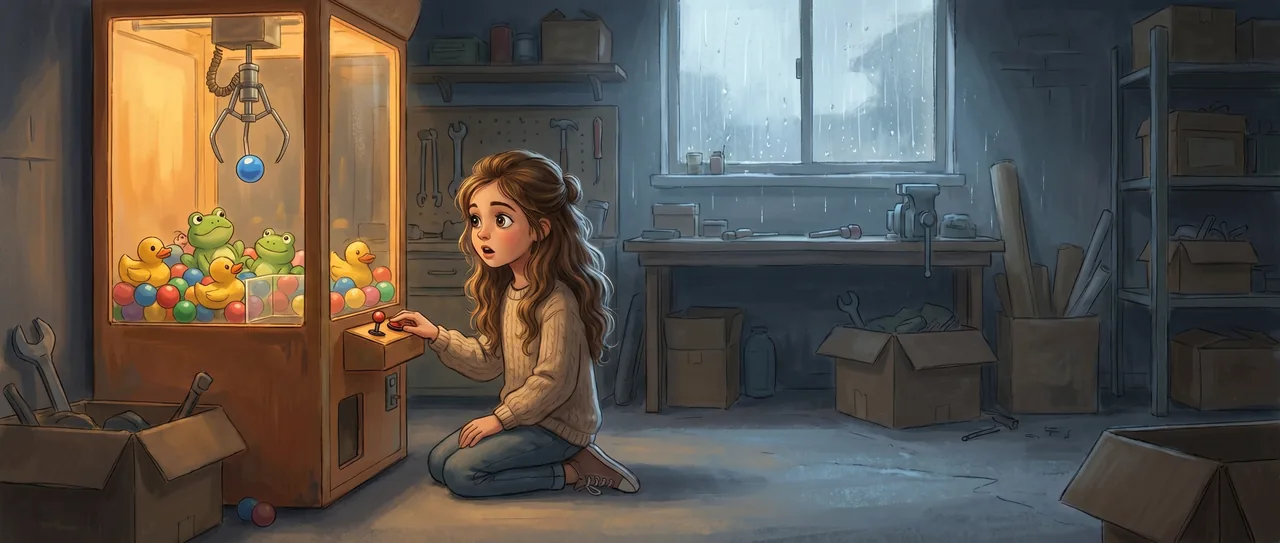
The Machine That Got Bored
The claw machine in Uncle Dev's garage was free now. He had cut the coin box out with a saw, so the button just worked, over and over, for nobody.
Maya pressed it. The claw dropped, closed on a rubber duck, lifted it three inches, and let it fall. She laughed out loud. It was such a stupid little machine and it had almost done something.
She pressed it again. Missed. Again. The claw grabbed a plush frog and actually carried it all the way to the chute. The frog dropped down and thunked into the tray and Maya felt a bright little spark go off behind her eyes, a fizz, like the first sip of soda.
She put the frog back in. Pressed again. Got it again.
The second time, the spark was smaller.
She noticed that. She sat back on the cold concrete and looked at the frog in the tray and thought about the fact that winning twice had felt like less than winning once.
So she tested it. She was good at testing things. She played until the claw grabbed the frog on the very first try, ten times in a row, and by the eighth time she felt almost nothing. Just her thumb moving. The machine was still winning. She had stopped caring that it won.
Then she made it hard. She dug the frog down under the plastic balls where the claw could barely reach, and she played, and she lost, and she lost, and on the ninth try the claw hooked one leg and dragged the frog up out of the pile and the spark came back so hard she actually said yes out loud to an empty garage.
Same frog. Same tray. The only thing that had changed was whether she thought she was going to get it.
She sat with that.
Winning when she expected to win was quiet. Winning when she expected to lose was loud. And winning over and over, so that winning became the ordinary thing, went completely silent, like the machine had gotten bored of her, or she had gotten bored of the machine, she could not tell which.
Maya pulled her knees up. Somewhere under the rain on the roof she had the feeling she got right before something got bigger.
Because it was not the machine. The machine did the exact same thing every time the claw closed on the frog. The spark was not out there in the tray. The spark was inside her head, and it was not measuring the frog at all. It was measuring the gap. The distance between what she thought would happen and what actually did.
Win you expected: no gap, no spark.
Win you didn't expect: big gap, big spark.
She wanted to know what the other direction felt like. So she buried the frog easy and shallow, right where the claw always grabbed it, and she pressed the button already certain, already grinning.
The claw closed on nothing. It came up empty.
And there was a drop. Not sadness exactly. A little cold dip, the opposite of the spark, like a floor she had counted on not being there.
Maya put her hand flat on the warm glass and left it there.
Better than she thought: up. Worse than she thought: down. And when the world matched what she'd guessed, dead level, nothing. Her insides were not keeping score of good and bad. They were keeping score of surprise. Of wrong. Every spark was her own head being wrong in the good direction, and every dip was her head being wrong in the bad direction, and the flat silent nothing was the terrible boring feeling of being exactly right.
She thought about all the times a teacher had said easy, good job, you got it, and how getting the easy one had felt like nothing, had felt gray. She had always thought something was broken in her. That she was greedy, or hard to please, or bad at being happy about normal things.
But her head was not built to feel good about winning. Her head was built to feel the difference. It only lit up when the world did something she had not seen coming. It went quiet the second the world became predictable, so that it could save all its brightness for the next thing it didn't understand.
That was not a broken thing to be. That was the thing pulling her forward. The gray feeling after an easy win was not failure. It was her head saying: you already know this one, go find the frog you can't reach.
She understood, suddenly and physically, why she could never leave a question alone.
Maya got up off the concrete. She went to Uncle Dev's shelf and found the little jar of colored gumballs he kept for no reason, and she came back and dropped six of them into the machine, into the pile, in among the ducks and frogs. Now she genuinely did not know what the claw would bring up. Duck, frog, gumball, nothing. She had made herself unable to predict it.
She pressed the button.
The claw went down into a mess she could not read, closed on something she couldn't see, and started to lift, and she felt her whole chest go tight and bright and waiting in the half second before it cleared the pile, that fizzing, leaning-forward, don't-tell-me feeling.
That feeling, she now knew, was the good part. Not the prize. The not-knowing right before the prize.
Uncle Dev opened the garage door with two mugs of cocoa and found her feeding gumballs to a broken machine on purpose.
"You know it's free, right?" he said. "You can just take the frog."
"I don't want the frog," Maya said.
He waited. "I want to not know," she said.
The claw cleared the pile with a single blue gumball pinched in its fingers, something she had never once won before, and behind her eyes the spark went off like a struck match, brighter than the frog had ever been, brighter than anything the whole rainy afternoon, and Maya pressed the button again before it had even faded.
Read the interactive version, listen to the narration, and earn a gold star →
A science-verified short story for curious kids · Curiosity Land