The Yes-And Cells
The bacteria were supposed to glow green and they were not glowing anything.
Maya had followed the card taped to the bench exactly. Add the sugar called arabinose. Add the little metal, some salt of zinc. The card said the cells would answer with light. She had added the arabinose an hour ago. She had checked the plate under the blue lamp four times. Dark. Dark. Dark. Dark.
The woman who ran the community lab was named Priya, and she was elbow-deep in a broken pipette across the room, muttering at a spring. She had said, at the start, this kit always works, and then had not looked up since.
Maya looked at the card again. Two ingredients. She had added one.
She found the zinc salt in the little rack, unopened. She had skipped it because it seemed like a small thing, a footnote, the kind of ingredient a recipe lists twice by accident. She measured a drop into the tube and set it back under the lamp and waited, arms folded, watching the dark liquid do nothing.
Then it did something. Slowly, from the bottom of the tube, a green came up like dye let loose in water. Not bright. But there. Unmistakably there.
Maya leaned very close.
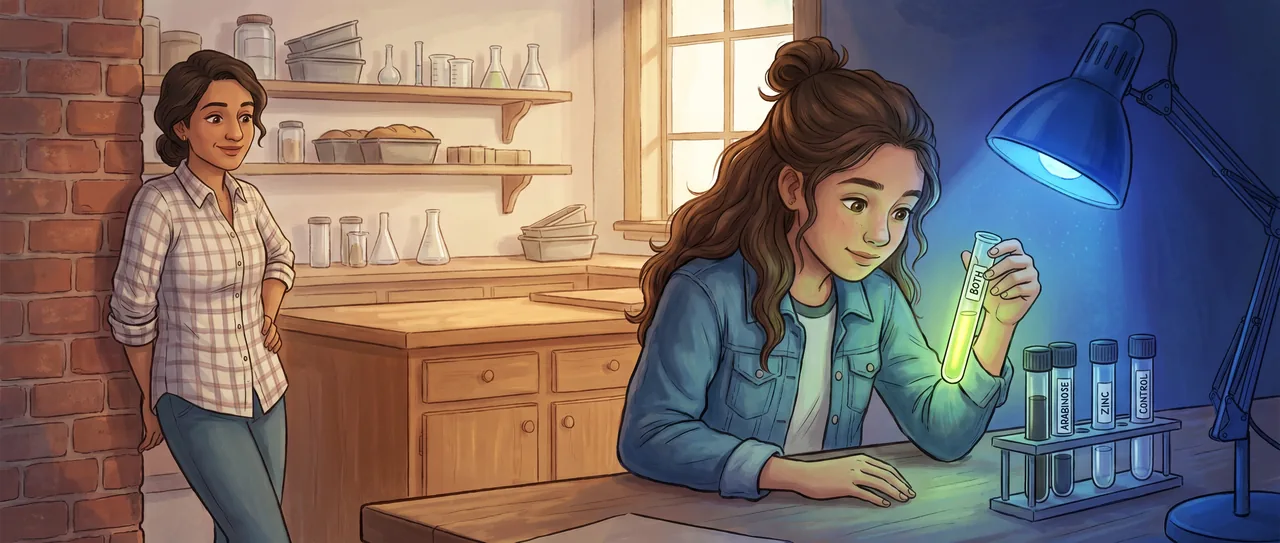
She thought about the two ingredients. She pulled a fresh row of tubes and set up four of them, because four was the number of ways two things could be present or absent. Arabinose only. Zinc only. Both. Neither. She labeled them with a marker on the plastic and dosed them and lined them up under the blue lamp like a small green traffic experiment.
Arabinose only. Dark.
Zinc only. Dark.
Neither. Dark, obviously.
Both. Green.
Maya said, out loud to nobody, so it needs both.
She knew that shape. She had drawn that shape. In the electronics club last spring they had wired little gates on a breadboard, and there had been one where the light only came on if you pressed both buttons at once. One button, nothing. Other button, nothing. Both buttons, light. The teacher had a name for it. And.
The cells were doing And.
She sat down. Not because she was tired.
Inside the tube there were millions of bacteria, each one smaller than a speck, each one with no wires, no metal, no buttons, no breadboard. And each one was checking two things at once. Is the sugar here. Is the zinc here. Only if the answer to both is yes does the cell build the green. It was a machine that decided. It was a machine made of the same soft stuff as her, running the same logic as the breadboard, holding the light back until both conditions were true.
Somebody had built that. On purpose. Somebody had sat down and decided the cell should say yes only to both, and had put that decision inside a living thing so small she needed a lamp to see it answer.
Maya went and got Priya, who came over wiping her hands, ready to explain why the kit had not worked.
Maya pointed at the four tubes. "It's a gate," she said. "It only glows for both. It's an And gate."
Priya stopped with her mouth already open for a different sentence. She looked at the row. Dark, dark, dark, green.
"Yes," she said, in a smaller voice than before. "That's exactly what it is. That's what they engineered it to be."
"Why?" said Maya. "Why would you want a cell that waits for two things?"
Priya sat down on the stool across from her. The pipette spring stayed broken on the far bench, forgotten.
"Because two things is safer than one," she said. "Say you want a cell that makes a medicine, but only inside a tumor and nowhere else. One signal isn't enough, lots of healthy places have that signal too. But maybe a tumor has this signal and that signal, both at once, and almost nothing else does. So you build a cell that waits. Both, or nothing. People are trying to build exactly that. Right now."
Maya looked back at the tubes. The green one had deepened while they talked.
"So you could stack them," she said. "And, and, and. Make it wait for four things. Ten things."
"You could," said Priya. "People do. They draw the circuit first, on paper, like a wiring diagram. Then they build it out of genes and put it in the cell and the cell runs it."
Maya was quiet. .
"On the breadboard," she said slowly, "you can wire And, and Or, and the one that flips things to their opposite. And out of just those three you can build anything. A calculator. A whole computer."
Priya did not say anything. She was watching Maya's face.
"So if a cell can do And," Maya said, "and a cell can do the others too, then a cell can do anything a computer can do. A computer you can't see. Growing."
"That," said Priya, "is the thing that keeps a whole field of people up at night. In the good way."
Maya picked up the tube that had waited for both. It was warm from her hand and green from the middle out, and it was, as far as she could tell, thinking. Not the way she thought. But deciding. Holding an answer until the answer was earned.
She had spent the whole morning believing she had failed because she left something out. She had left out the second yes. The whole point of the cell was that it needed both.
"Can I make the Or one," she said. "The one that glows for either."
Priya laughed, the surprised kind. "That's a different kit. Different genes. It's harder."
"Do we have it."
Priya looked at her for a second. Then she went to the freezer at the back, the one with the padlock, and came back with a small foil pouch and set it on the bench between them.
Maya reached for a clean tube and uncapped the marker with her teeth.
Read the interactive version, listen to the narration, and earn a gold star →
A science-verified short story for curious kids · Curiosity Land