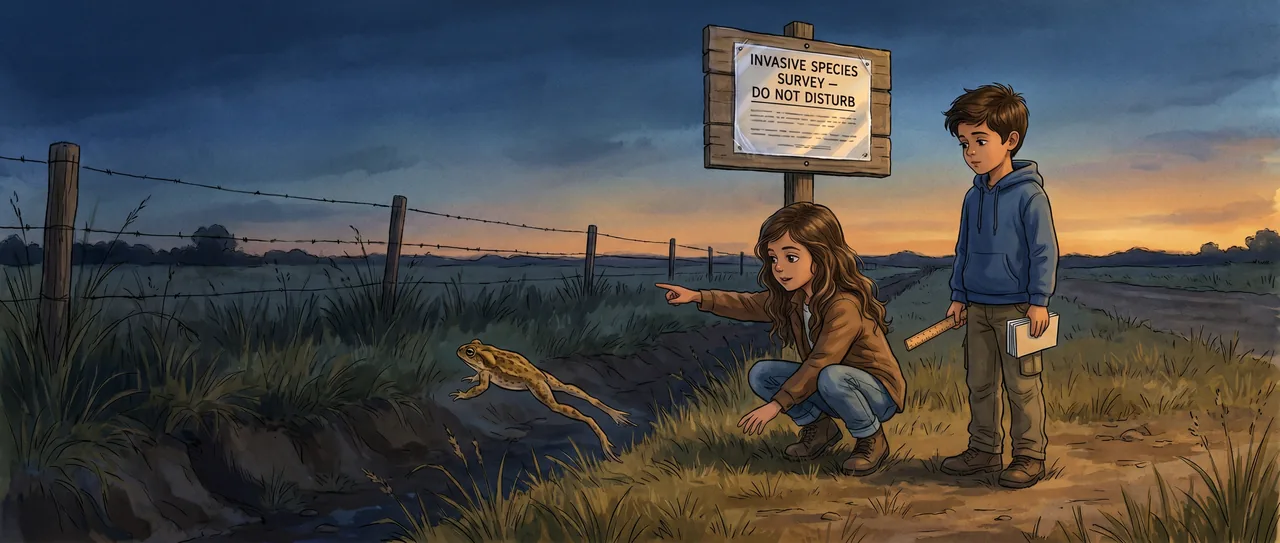
The Toad at the Edge of the Map
The volunteer, whose name was Dell, had given them a bucket, a ruler, and a warning.
"Don't touch the glands behind their heads," she said, already walking back toward her ute. "They're poison. And don't let them out of the bucket. Measure the leg from hip to toe, write it on the card, let them go past the fence line. I've got forty more roads to do tonight."
Then she was gone, headlights swinging away, leaving Maya and Soren under a road sign with a bucket of toads and a stack of index cards.
"She didn't say why we're measuring legs," Maya said.
"She said forty more roads." Soren clicked his pen. "I think why is our problem."
Maya lifted the first toad by its clammy back, careful of the glands. It hung there, patient and ugly and enormous, and kicked one long leg.
"Whoa," she said. "Look at that leg."
Soren held the ruler. "Hip to toe. Say when."
"When."
"That's long," he said. "For a toad that fat."
They wrote it down. They did another. Then a smaller one, a young one, and its leg was long too, long for its little body.
"They're all leggy," Maya said. She set the young one in the grass and it went off toward the fence in three big bounds, gone before Soren finished the card. "That one nearly beat the pen."
Soren looked at the road sign above them. Somebody had stuck a laminated notice to the pole. INVASIVE SPECIES SURVEY. FRONT LINE. He read it twice.
"Front line," he said. "Dell's road is the front line. Where the toads are still spreading. They came in on the coast eighty-something years ago and they've been moving west ever since."
"So?"
"So the toads out here are the great-great-grandkids of the ones that traveled the fastest." He tapped the card. "The slow ones never got this far west. Only fast ones make it to the edge. And they breed with other fast ones that made it to the edge."
Maya went quiet with a toad in her hand. "Fast ones make more fast ones," she said slowly. "Out here at the edge, the whole crowd is just the fastest ones, over and over."
"Longer legs," Soren said. "That's what fast looks like in a toad."
"Eighty years," Maya said. "That's not even that long. My gran is older than these toads being in Australia."
She let the toad go. It hit the grass running, low and long, a shape built for getting somewhere.
"So the toad is changing while we watch," Maya said. "Basically. In gran-years."
"Basically."
They worked the bucket down. Somewhere out past the fence a curlew screamed like a hurt kid, and neither of them jumped, which felt like an accomplishment. Maya kept turning something over.
"Here's what I don't get," she said. "If the toads are winning, why does anybody bother measuring them? Dell drives forty roads a night. For what? To watch them win?"
Soren didn't have that one. He wrote the number, capped the pen, and thought about it out loud, which was how he thought.
"The toads are poison," he said. "So the things that eat toads die. Snakes especially. A snake eats a big toad, it dies."
"Right. So the toads win and the snakes die." Maya frowned. "That's a sad map."
"Unless." Soren stopped. "Unless it's the same thing that's happening to the toads. But backwards."
Maya looked at him.
"Think about which snakes die," he said. "The ones that can swallow a big toad. Big mouth, big toad, big dose of poison, dead snake. So the big-mouthed snakes die out here first."
"And the small-mouthed ones?"
"Can't fit the big toads in. So they only eat little toads, or no toads. Small dose. They live." He was talking faster now. "They live and they breed and their babies have small mouths too."
Maya was already ahead of him. "So the snakes are getting smaller mouths," she said. "While the toads are getting longer legs. At the same time. On the same road."
"On this road," Soren said.
They both looked down at the bucket. Then out at the dark grass past the fence, where they couldn't see any snakes but now could not stop thinking about them, lying out there with mouths a fraction smaller than their grandparents' mouths, because their grandparents with the bigger mouths were the ones who ate the wrong toad.
"The toad changed the snake," Maya said. "By being poison. By being here."
"And the snake didn't change the toad much at all," Soren said. "Because the toads out front are running from everything. That's why they're fast. Not just fast toads winning. Fast toads getting away."
Maya sat down on the edge of the ditch, holding the ruler like it had gotten heavier. "Dell thinks she's counting toads," she said. "She's not. She's counting a fight. She's writing down a fight that's happening in slow motion and nobody can see it because it's slower than a person but faster than a fossil."
Soren stopped writing.
"Say that again."
"Slower than a person. Faster than a fossil." Maya shrugged. "It's happening at exactly the speed where you'd miss it. Unless you had eighty years of index cards."
Soren looked at his stack of cards. Nine of them. Nine legs measured on one road on one night. And somewhere Dell had a box of these, and somebody before Dell had a box, and the leg numbers were creeping longer decade by decade and the snake skulls in some museum drawer were creeping smaller, and it was all written down in exactly this kind of handwriting, on exactly this kind of card, by people standing in exactly this kind of dark.
"We're a data point," he said. "Tonight is a data point."
"We're a frame," Maya said. "Like one frame of a movie that takes a hundred years to play."
The last toad in the bucket climbed the plastic wall, slipped, tried again. Long back legs. Built to get somewhere their parents never reached.
Maya reached in and lifted it out and set it in the grass, pointed west, toward the edge of the map where nothing like it had ever been.
It gathered its legs and jumped, and the dark took it in two bounds.
Read the interactive version, listen to the narration, and earn a gold star →
A science-verified short story for curious kids · Curiosity Land