The Slow Water
The air on the pier was already warm at six in the morning, warm and salty and thick, the kind of morning that promises to be too hot by noon. Maya's shirt stuck to her back. The sun came sideways off the water in long white blades.
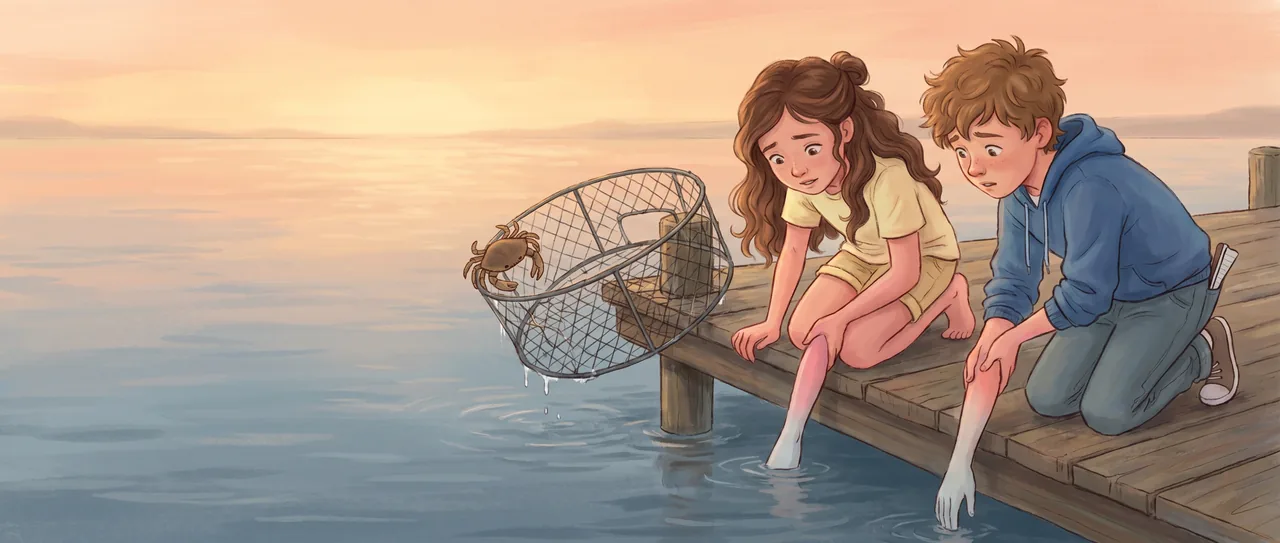
Soren pulled the rope hand over hand. The crab trap came up dripping, empty except for one small crab that had climbed in overnight and now looked deeply offended.
He reached into the water to steady the trap, and yanked his hand back.
"Feel that," he said.
Maya put her hand in. The surface was almost bathwater, sun-warm, soft. But her fingers went down past her wrist and the cold came up to meet them, a hard clean cold that made her knuckles ache.
"That's freezing," she said. "Down low it's freezing."
She pulled her hand out and looked at it, pink from the sun on top, white below the line where the cold had been. The two temperatures had been sitting in the same water, one on top of the other, not mixing, like they were strangers.
"The sun heats the top," Soren said. "That makes sense. The top's warm, the bottom's cold."
Maya wasn't listening to the part that made sense. She was looking at the crab, which had stopped being offended and was now waving one claw at the far end of the harbor, where the water went dark and deep past the breakwater.
"Where does the cold come from, though," she said.
"The bottom's just always cold."
"Why, though." She crouched at the edge of the pier. "It's summer. It's been summer for weeks. The sun's been on this water every day. Why hasn't the cold given up yet."
Soren opened his mouth to say the bottom is far from the sun, and then he closed it, because that wasn't really an answer. Far from the sun for a day, sure. Far from the sun for a whole summer, and it was still cold enough to hurt.
"Something's keeping it cold," he said slowly. "Or something's replacing it."
Maya looked at him.
"Say that again."
"If the sun's been warming it for weeks and it's still cold, then the cold water we're touching isn't the same water that was here in spring. New cold keeps arriving. From somewhere."
Maya put her hand back in, deep, past the ache. She held it there until it went numb.
"From somewhere colder," she said. "From somewhere that doesn't have our summer."
They both went quiet. A gull landed on the piling and considered the crab.
Soren got his notebook out of his back pocket. He drew the harbor, a little box of water. He drew an arrow going in along the bottom and an arrow going out along the top. He tapped the bottom arrow.
"If cold water is coming in down here," he said, "it came from the poles. That's where water gets coldest. Cold water is heavier. It sinks. It has to go somewhere along the bottom."
"It's going the long way," Maya said.
"What?"
"The warm water's on top. It goes toward the poles, on the top, in the sun. Then it gets cold up there and sinks and comes back along the bottom." She was talking faster now, following it. "So the water under my hand came from the North Pole. Or the South one. It sank way up there and crawled all the way down here along the floor of the ocean. In the dark. Under everything."
Soren felt the cold on his own fingers differently now. Not just cold. Traveled.
"How long does that take," he said. Not to her. To the water.
He pulled his phone out and looked it up, because some numbers you cannot guess. Maya leaned over his shoulder, dripping on the screen.
The number was there in plain letters. The full loop of it, warm water to the poles and cold water back around and up again, took about one thousand years.
Neither of them said anything for a while. The gull gave up on the crab and left.
A thousand years. Maya looked at her wet hand. The cold on her fingers had gone under the ice near the pole and sunk and started its long dark crawl along the bottom of the world back when there were no cars, no lightbulbs, no her. It had been moving the whole time. Through every year of everyone. Nobody rushing it. Nobody able to.
"This water," she said. "The cold part. It went down before anybody we ever heard of was born."
"It's older than the town," Soren said. "It's older than the country."
"It's older than the language we're talking in."
Soren wrote the number down. Then he wrote, under it, the water in the trap left the pole around the year one thousand. His hand was not quite steady.
Maya was thinking about the warm top water, the bathwater part, the part the sun had cooked this very morning. That part was young. That part was leaving now, sliding north on the surface, and it would reach the pole and get cold and sink and begin its own thousand years in the dark. Long after her. It would come crawling up onto some other pier, into some other kid's hand, in a summer she would never see.
"Put your hand back in," she said.
Soren did. Warm on top. The ache below.
"Top part is going to the pole," Maya said. "Bottom part just got back."
They knelt there with their arms in the water, one hand each, holding on to two different centuries at once. The warm skin of the ocean poured slowly north out of the harbor toward ice none of them would ever touch, and underneath it, unhurried, the cold came home from a thousand years away and pressed itself into their fingers.
The small crab climbed back over the lip of the trap and dropped into the water, and the water took it down.
Read the interactive version, listen to the narration, and earn a gold star →
A science-verified short story for curious kids · Curiosity Land