The Silence That Rang
The exhibit hall was closing forever on Sunday, and Maya's aunt was the one packing it up, so Maya and Soren had the whole dark hall to themselves while she wrapped the old models in bubble wrap in the next room.
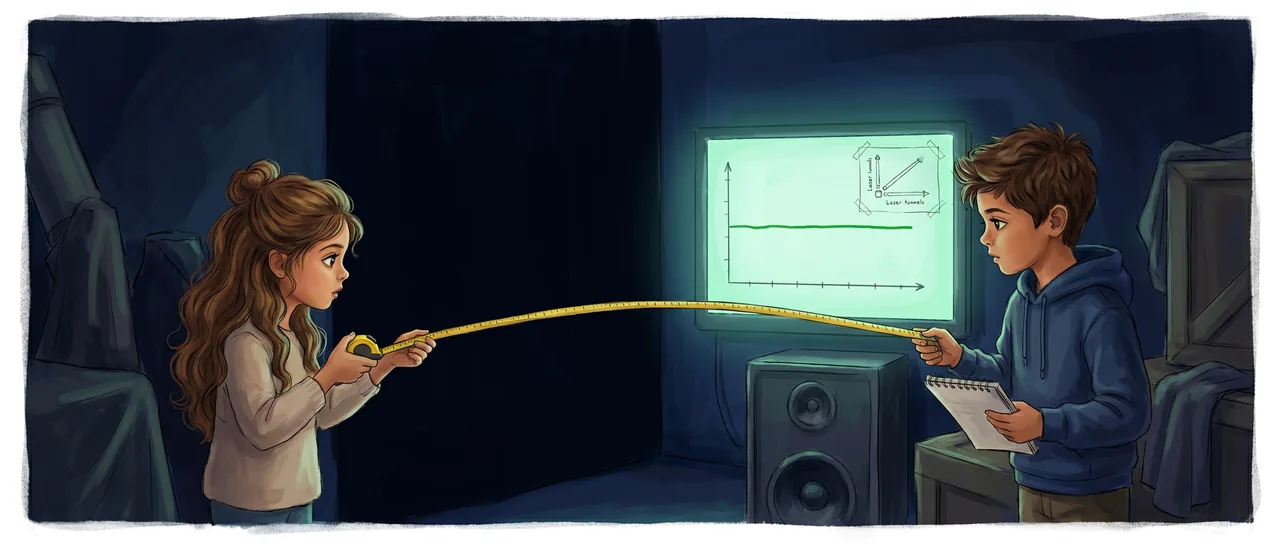
Most of the displays were unplugged. But one screen in the far corner still glowed, showing a flat green line, and a speaker beside it still hummed. Above it a cracked sign read: LISTENING TO THE UNIVERSE.
"It's plugged into something," Soren said. He followed the cable behind the wall. "A live feed. This one's still getting data."
Maya put her ear near the speaker. Nothing. A soft hiss, like a shell.
"There's a headphone jack," she said. "So it's supposed to make sound. But it isn't."
Soren opened his notebook and wrote down the words on the sign, then the flat green line, then the word silent. He looked at the little diagram taped under the screen. Two long tunnels meeting at a corner. A laser split down each one and coming back.
"This is a detector," he said. "For gravitational waves."
"Which are," said Maya.
"Ripples," Soren said. "In space. Not in the air. In space itself."
Maya frowned at the speaker. "Then why does it have a speaker."
That was the wrong thing about it. She could feel it before she could say it. A machine that listened to the universe, wired to make sound, and making none.
"Play the old recordings," she said. "There's a button."
Soren pressed it. The speaker gave a short low swoop, up and gone in less than a second. A chirp. Then quiet.
"That's a black hole," Soren read off the screen. "Two of them. Hitting each other. A billion years ago."
They played it again. The little rising whoop. Maya felt the hair on her arms lift.
"Something crashed," she said, "a billion years ago, and it was that loud, and we heard it just now."
"We didn't hear it," Soren said slowly. He was staring at the diagram, at the two long tunnels. "That's the part I keep getting stuck on."
"It made a sound."
"It couldn't. There's no air out there. Sound is air pushing on air. In space there's nothing to push." He tapped the speaker. "If a star exploded next to us and we had no suit, we wouldn't hear it. Nothing. The biggest thing in the universe, silent."
Maya looked at the chirp waveform frozen on the screen. "But we just heard the black holes."
"No," Soren said, and now he was leaning in. "We heard the speaker. Somebody turned the wave into a sound after. The wave itself didn't go through air. It went through the tunnels."
Maya looked at the diagram again. The two long arms. The lasers.
"Then what came in," she said. "If not sound. Something came in."
They both went quiet. The hiss from the speaker filled the corner.
Maya put her hand flat against the wall the tunnel-diagram was printed on, then took it away. She picked up the museum tape measure her aunt had left on the case, the yellow kind that snaps back.
"Say the tunnel's this long," she said, pulling out a length of tape. "The laser measures it. Really carefully. Down to nothing."
"Down to less than nothing," Soren said. "Smaller than a proton. They can measure a change smaller than a proton across four kilometers."
"Okay." Maya held the tape steady. "So the wave comes. Not a sound. A ripple in space. What does it do when it gets here."
Soren read, and then he stopped reading, because he had it. "It stretches it."
"Stretches what."
"The tunnel. The space inside the tunnel. One arm gets a little longer. The other gets a little shorter. Then back. Then again." He looked up. "The distance itself changes. Not the machine. The space. The wave squeezes the room."
Maya let the tape measure slide out a hair and pulled it back. Out. Back. Out. Back.
"So the whole hall," she said. "When that wave went by, a billion years later, this whole hall got a tiny bit longer that way and a tiny bit shorter this way."
"And us," Soren said. "We got taller and shorter. By nothing. By less than a proton. We'd never feel it."
"But it happened."
"It happened." "That's why there's a speaker but no sound," she said. "Nothing came through the air. Nothing traveled to our ears. The universe didn't make a noise."
"It rang," Soren said. "The whole shape of everything rang, like a bell, and nobody could hear it, because there's nothing out there to carry a hear."
"So they built a ruler," Maya said. "Instead of an ear."
Soren wrote that down. A ruler instead of an ear. He underlined it twice.
Maya was thinking about the wrong thing that had bothered her at the start, and how it wasn't wrong now, it was the whole point. A machine to listen to a universe that makes no sound. You couldn't listen. You could only watch distance itself flinch.
"Play it one more time," she said.
Soren pressed the button. The little swoop rose and vanished.
"That's not what it sounded like," Maya said softly. "Out there. That's what it looked like, if you had a ruler four kilometers long and a billion years of patience."
Soren looked at the flat green line, live, right now, running across the screen from a detector somewhere still awake in the dark.
"It's still listening," he said. "Right this second. If two black holes hit each other tonight, out past everything, that line would move."
They both looked at the line.
From the next room Maya's aunt called that it was time, they had to go, the movers came at eight.
Neither of them answered. Maya pulled the tape measure out to its full length and held it across the dark corner, one end in each hand, a thin yellow line stretched taut between them, and they stood there watching it, waiting to see if it would ever, by the smallest amount imaginable, twitch.
Read the interactive version, listen to the narration, and earn a gold star →
A science-verified short story for curious kids · Curiosity Land