The Shoelace Clock
The two horses came in with no papers, so nobody knew how old they were.
"That one's older," Maya said, pointing at the gray mare eating hay in the far stall. "Way older."
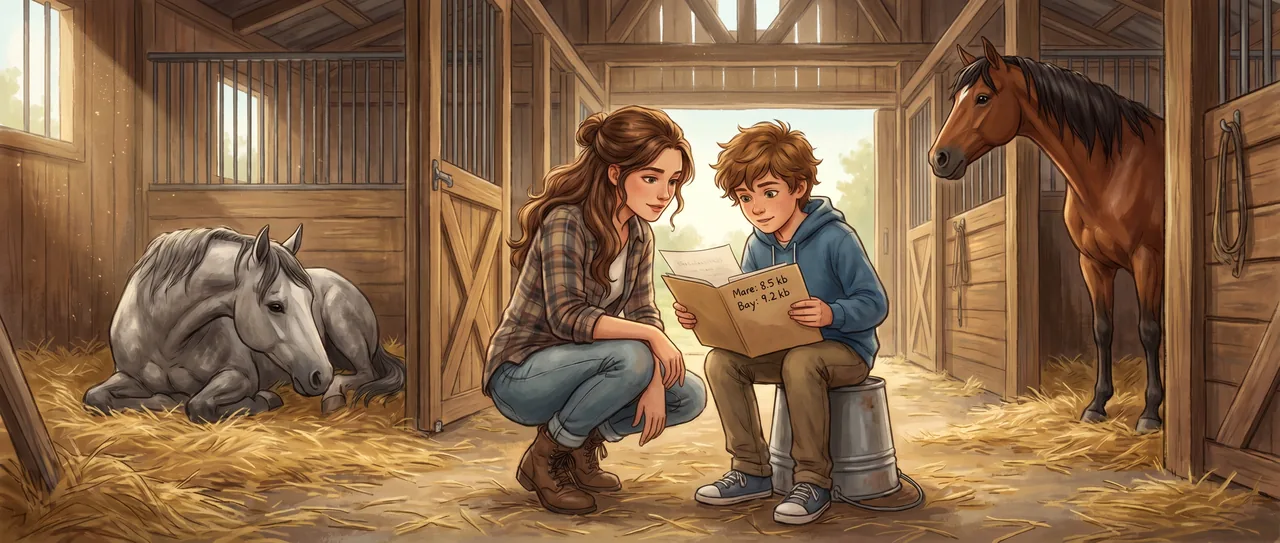
"You can't know that," Soren said. He was sitting on an overturned bucket with the intake folder open on his knees. "They came from the same auction. Same lot number. It says here they were listed as a pair."
"I still know it."
Dr. Osei walked past with a syringe of dewormer and didn't slow down. "You can guess by the teeth," she said. "Horses' teeth wear down and change angle as they age. But those two have terrible dental history. Teeth won't tell us much. Honestly, we may never get an exact age on either of them." She was already three stalls away, talking more to the horses than to them.
Maya kept looking at the gray mare. Then at the bay in the near stall, glossy and quick, snatching hay and tossing his head.
"Okay," Soren said. "Say you're right. What are you actually seeing?"
Maya was quiet, watching the mare chew.
"She moves like she's saving something," she said finally. "The bay spends everything. The mare spends careful."
Soren wrote that down. Moves like she's saving something. Then he frowned at it, because it wasn't a measurement, it was a feeling.
"That's not proof," he said.
"I didn't say it was proof. I said it's true."
He went back to the folder. There was a page from the auction, and stapled behind it, a lab sheet from a university study the rescue had signed the horses up for. Something about aging in animals of unknown age.
"Hey," he said. "They ran a test on both of them. Blood test." He read it slowly, because half the words were new. "It says telomere length. Measured in something called kilobases."
"What's a telomere?"
"Give me a second." He read the little paragraph at the bottom twice before he tried to say it. "So your chromosomes are like long threads inside every cell. The very ends have caps on them. Telomeres. Like the little plastic bits on the ends of shoelaces so the lace doesn't fray."
Maya came and crouched by the bucket. "Okay. And?"
"And every time a cell divides to make a new cell, the caps get a little shorter. The shoelace tip wears down a bit. Every single division." He looked up. "A body makes new cells its whole life. To heal, to grow, to replace old ones. So the older the animal, kind of, the more divisions have happened, the shorter the caps."
"So it's a clock," Maya said. "Inside every cell. Counting."
"A clock that runs down instead of up."
They both looked at the lab sheet. Two numbers. Two horses.
"Read them," Maya said.
Soren ran his finger to the first line. "Bay gelding. Telomeres, longer." He moved down. "Gray mare. Telomeres, shorter." He set the folder down very carefully, the way you set down something that turned out to be heavier than it looked. "The mare's caps are more worn."
Maya didn't say I told you so. She was staring at the gray mare like she'd never seen a horse before.
"But wait," Soren said, and now he was talking fast, the way he did when a thing wouldn't sit flat. "Here's the part I don't get. This isn't the same as birthdays. Two people can be born the same year, the same day even, and have different telomere lengths."
"How?"
"Because it's not counting years. It's counting wear. Stress wears them faster. Being sick a lot. A hard life. The clock inside doesn't measure how long you've been alive." He looked at the mare's bad teeth, her careful chewing, the record with no papers and no home history at all. "It measures how much living the cells have had to do."
Maya sat all the way down in the straw.
"So she might not be older," she said slowly. "Not in years. She might be the exact same age as him."
"She might."
"But something made her cells work harder. So her clock is further along." Maya's voice went quiet. "That's what I saw. Not old. Worn. I couldn't tell the difference from outside. But the difference is real."
Soren nodded. He was writing again, and his hand had gotten unsteady, because he had just understood that his own cells were doing this right now, all of them, every one carrying a little counting-down thread, and no birthday cake had ever told him the number that actually mattered.
"There's people," he said, "who are seventy and their cells look fifty. And people the other way around. And nobody can see it from the outside. You'd have to look at the shoelace tips."
"You'd have to look inside every single cell," Maya said.
"Yeah."
"And the clock is different in each person. Even twins." She wrapped her arms around her knees. "So when somebody asks how old you are, that's not even the real question. That's just the years. There's a whole other number, and it's a secret, and it's inside you the whole time."
Soren stopped writing.
Dr. Osei came back down the aisle, empty syringe in hand. "Any luck aging those two?" she asked, and this time she stopped.
Maya stood up. She didn't answer the age question. She pointed at the gray mare.
"That one had a harder life than we knew," she said. "You can't see it. But her cells kept count."
Dr. Osei looked from the girl to the horse, then picked up the folder and read the two numbers herself.
In the far stall, the gray mare finished her hay and folded her legs and lay down in the straw to rest, slow and careful, the way she did everything.
Read the interactive version, listen to the narration, and earn a gold star →
A science-verified short story for curious kids · Curiosity Land