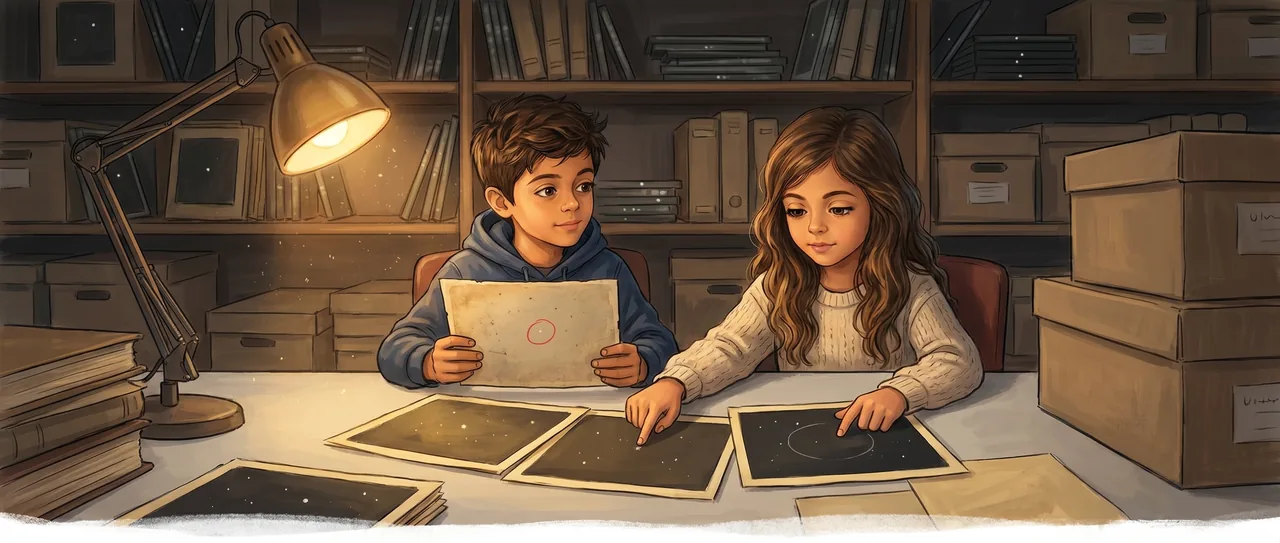
The Photograph That Was Too Dim
The archivist's name was Dr. Okonkwo, and she had told them twice already that nothing in this room mattered anymore because it was all being scanned into the cloud by Tuesday.
"Scanned better than the eye can see," she said, taping a box. "So don't get attached."
Maya was already attached. She was holding a photographic print, thick as a tile, black with a scatter of white specks. Somebody long ago had drawn a small red circle around one of the specks and written a number beside it.
"What's the circle for?" Maya asked.
"A supernova. A star that exploded. People used to compare its brightness to a chart to figure out how far away it was." Dr. Okonkwo did not look up. "That kind of supernova always burns with the same true brightness. So the fainter it looks, the farther away it must be. Simple ruler. Put it in the recycle pile."
Maya did not put it in the recycle pile.
Soren took the print from her and tilted it under the desk lamp. He had a second print in his other hand, a different one, also circled, also numbered. He held them side by side.
"These two are the same kind of star," he said. "You said it always burns the same."
"The same true brightness, yes."
"So if one looks dimmer than the other, it's farther."
"That's the whole idea."
Soren kept holding them. Maya watched his thumb move between the two specks, back and forth, the way it did when a thing was not sitting flat in his head.
"Then there should be a rule," he said. "Farther away means it looks smaller in the past. Means it was moving away faster back then, when the light left. There's a number for how fast everything's flying apart. It should all fit one line."
Dr. Okonkwo finally looked up. "You know about the expansion."
"We watched a thing about it," Maya said. "Everything's flying away from everything. The far things fly faster. The light stretches out and goes red."
"Then you know as much as anyone in nineteen ninety-eight knew," Dr. Okonkwo said, and went back to her tape.
Maya pulled a third print. And a fourth. She spread them across the desk like cards, all of them stars that were supposed to burn the same, all of them circled by someone who cared enough to draw a circle.
"Soren," she said. "The really far ones. They're too dim."
"They're supposed to be dim. Far is dim."
"No." She tapped one. "Too dim. Dimmer than far explains."
Soren stopped taping the boxes he was not supposed to be taping. He looked at the print she was tapping.
"You can't know that from looking," he said. But he did not say it like an argument. He said it like a door he wanted her to open.
"Then check it," Maya said. "You like checking."
So he checked. On the back of each print, in old pencil, was the redshift, the number for how much the light had stretched, and a distance somebody had figured from the brightness. Soren lined the prints up by redshift, smallest to largest, near to far, recent to ancient. He read the distances out loud. Maya listened for the place where the numbers stopped behaving.
The close ones fit. The middle ones fit.
The farthest ones did not fit. They were farther than the stretch of their light said they should be. The most ancient explosions had somehow ended up too far away, as if, in the billions of years while their light crawled here, the space between had grown more than anyone had ordered it to.
"They're too far," Maya said. "Not too dim. Too far. The dimness is real. The distance is real. It's the in-between that's wrong."
"It's not wrong," Soren said slowly. "It's more. There's more space now than the speed should have made. Between then and now, the pushing apart sped up."
He stood very still with the oldest print in his hand.
"Everything told us it should be slowing down," he said. "Gravity pulls in. Things thrown apart slow down. A ball goes up, it slows. That's the whole rule."
"So the ball's going up faster," Maya said. "Every year. Nobody's throwing it. It's just going up faster."
Dr. Okonkwo had put her tape down. She was looking at the two of them the way you look at something you forgot was in your own house.
"That is what they found," she said quietly. "Two teams. Nineteen ninety-eight. The far supernovae came in too faint, and everyone thought the data was broken, because faint meant far and far was impossible. They checked it a hundred ways. The data wasn't broken. The universe was doing something nobody had a name for."
"Do they have a name now?" Soren asked.
"They named it so they'd have something to call the thing they can't explain. Dark energy. Seventy percent of everything that exists, and the name is just a label on a locked box." She shook her head. "We can measure it. We can't say what it is. We still can't."
Maya was looking at the oldest print, the too-far one, the light that had left before there was an Earth to land on.
"So the circle," she said. "The person who drew this red circle. They were holding the proof and didn't know it yet."
"Somebody like that, yes."
Maya turned the print over and looked at the pencil number on the back, and then at the speck on the front, this single grain of light that had spent most of the age of the universe falling toward a room that was about to be packed into boxes.
"It's still doing it," she said. "Right now. While we're standing here. Getting faster."
"Right now," Dr. Okonkwo said.
Soren set the oldest print down in the middle of the desk, apart from both piles, the keep and the recycle, in a pile of its own that had only one thing in it. He took out his notebook and opened it flat and copied the pencil number off the back, the speck, the circle, the year.
Maya reached over and drew, in the air just above the print, a slow circle around nothing, around the empty dark between the specks, where the extra distance had come from and kept coming.
Read the interactive version, listen to the narration, and earn a gold star →
A science-verified short story for curious kids · Curiosity Land