The Metronome Room
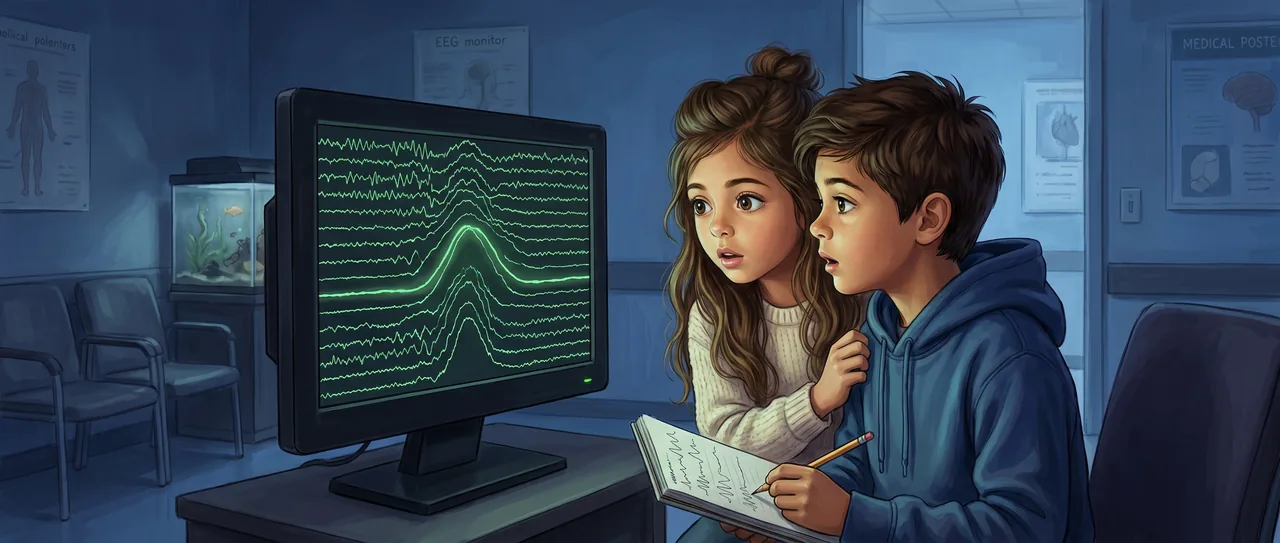
The waiting room had a fish tank with two fish and a clock that ticked too loud. Maya's cousin Nell was down the hall with twenty little wires glued to her scalp, sleeping, so the machines could watch her for seizures. Maya and Soren were watching the machines.
One screen had been left on. Nobody had told them not to look.
"That's her brain," Maya said. "Right now."
Green lines crawled across the black. Sixteen of them, stacked. Each one wiggled on its own, fast and small, like sixteen kids scribbling.
"They're waves," Soren said. He leaned in close. "Look. They go up and down. That one's slow. That one's quick."
"How do you know they're waves and not just noise?"
"Because noise doesn't come back." He touched the glass under one line, tracing. "See? Up, down, up, down. Same speed. It keeps its time."
Maya watched the sixteen lines. They were not doing the same thing. Some hurried. Some dragged.
"Nobody's in charge," she said. "Sixteen scribblers and no conductor."
"There's no wire between them either. Different parts of her head. The front and the back. They can't feel each other."
"So how would they ever agree?"
Soren didn't answer, because right then, they did.
It happened in less than a second. The sixteen little scribbles stopped scribbling and started swinging. All of them. Up together, down together, big slow waves, sixteen lines rising and falling like sixteen people breathing in one room.
Maya grabbed his arm.
"Did you see that. Did you see it do that."
"They locked," Soren whispered. "They all locked onto the same beat."
"But you said there's no wire. The front of her head and the back of her head just, what, decided?"
"I don't know." He had his notebook out. His pencil hovered, then came down, drawing the sixteen fat waves marching in step. "I don't know how they'd even hear each other."
The rhythm held. The waves rolled, together, together, together. Nell was asleep down the hall and her whole brain was keeping one enormous slow beat, and no part of it was telling any other part what to do.
"That's her dreaming," said a voice.
The technician had come back for her coffee. She was young and blinking and clearly wanted to go home. She looked at the screen the way you look at a dishwasher you've watched a thousand times.
"Slow waves like that, big and lined up, that's deep sleep," she said. "When she wakes up they'll break apart again. Faster. Choppier. That's awake."
"But how do they line up?" Maya said. "There's no wire."
"Oh, it's oscillations. Neurons firing in rhythm. Whole regions swing into the same frequency." She took a sip. "They synchronize."
"But how," Maya said again. "How does the back part know what beat the front part picked?"
The technician opened her mouth, then closed it, then laughed a small tired laugh. "You know what, that's above my pay grade. They just do. The timing lines up. That's kind of the whole thing about brains." She took her coffee and went.
Soren looked at Maya. "She doesn't know either."
"Nobody told them to lock. They just found the beat." Maya pressed her hands flat on the desk. "Sixteen strangers in the dark and they found the beat."
On the screen the great slow waves rolled on. Then, at one edge, one line stumbled. It sped up, alone, out of step, a scribbler who had lost the rhythm. Then two more.
"It's coming apart," Soren said.
"She's waking up?"
"Maybe." He watched. "Or maybe just, thinking. Look, they're not falling into mess. They're falling into a new beat. Faster."
And he was right. The lines didn't scatter into noise. They found a quicker rhythm and locked into that instead, tight little waves, sharp and awake.
"So there's a slow-together and a fast-together," Maya said slowly. "Different speeds for different, what. Different kinds of thinking?"
"Sleep was slow. This is faster." Soren was writing fast now. "So the speed is the message. Not what the neurons say. When they say it. All at the same time."
Maya went quiet, staring at the choppy fast waves. Then she said, "Soren. That's how the far parts talk. Not with a wire. With timing. If the front is beating at one speed and the back beats at the same speed, they're, they're listening at the same moments. Windows open at the same time. That's how far things reach each other. They agree on when."
Soren stopped writing.
"Say that again."
"They agree on when. Everybody opens their door at the same instant. That's the only way to get a message across with no wire. You knock when you know the other guy is listening."
He looked at her, then at the screen, then he wrote one word and underlined it twice.
Down the hall a monitor gave a soft chirp. On the screen, for just a moment, one region's fast beat pulled a little ahead. The others chased it. Caught it. The whole brain snapped back into step, and Maya felt the hair rise on her arms, because she had just watched a thing with no conductor and no wires and no voice pull itself into agreement in front of her, in the dark, while its owner slept and dreamed and did not know.
"There's a beat inside everyone," she said. "Right now. In you."
"In you," Soren said. "Sixteen scribblers finding the beat. All day. Every day."
"And when it doesn't lock right," Maya said, remembering the wires on Nell's small head, the whole reason they were here, "when it can't find the beat, or it locks too hard, that's when something's wrong." She looked at him. "That's what they're watching for. Not the wiggle. The timing. Whether her brain can keep its own beat."
They stood at the screen and watched the green waves rise and fall, together, together, together, sixteen strangers in the dark agreeing on when.
The fish tank hummed. The clock ticked too loud, one steady beat, and neither of them heard it anymore, because they were counting something else.
Read the interactive version, listen to the narration, and earn a gold star →
A science-verified short story for curious kids · Curiosity Land