The Brick That Remembered
The back room was colder than the rest of the cottage, and Maya noticed it the way you notice a held breath.
The tour had gone the other way. A man in a cardigan had walked eight people past the dials and the black-and-white photographs and out into the garden, saying the same sentences he said every hour. Maya and Soren had drifted. There was a door at the end of the hallway with a laminated sign that said Storage, No Access, and the sign had slipped sideways on its tape, which to Maya was practically an invitation.
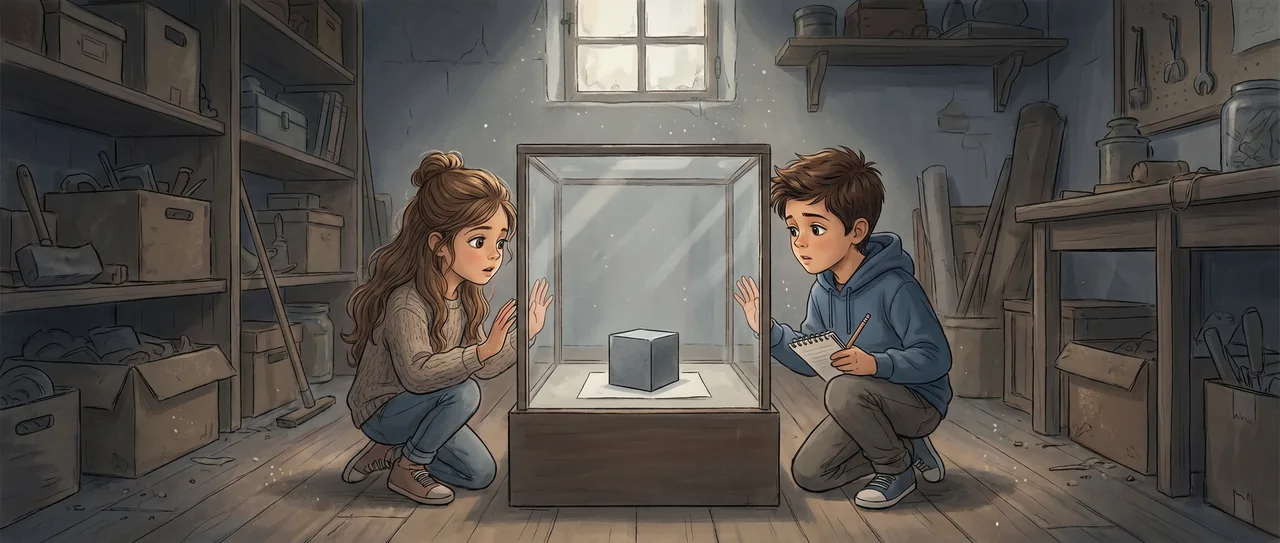
Inside there was one case. Inside the case sat a single grey block, matte and soft-looking, like a bar of very dark soap. A small card read: MODERATOR GRAPHITE, RETIRED. Do not touch case. Under it, in smaller letters someone had typed years ago: temperature monitored.
"Feel the air," Maya said.
Soren held his hand out flat, the way he always did, testing before he trusted. The room was cold. But the glass of the case, when he brought his palm near it, was not.
"Warm," he said. "The case is warm and the room is cold."
"Warmer than us?"
"No. Warmer than the room."
Maya crouched until her eyes were level with the block. Nothing was plugged in. There was no wire, no vent, no little orange light. The block just sat there being warmer than everything around it, which is the sort of thing objects are not supposed to do.
"It's not doing anything," Soren said. He had his notebook out. He drew the case, and the card, and wrote the two temperatures the way he felt them, cold room, warm glass. "Warm things cool down. That's the whole rule. You leave a mug of tea and it becomes room tea."
"Unless something inside is making heat."
"Nothing's inside. It's a brick."
Maya put her nose almost against the glass. "Then it's a brick that's making heat out of nothing, which is impossible, so it's making heat out of something." She said this cheerfully. Impossible things were, to her, just labels people put on doors that hadn't been opened yet.
Soren thought about the word moderator on the card. He knew what a moderator did. He had read it once and it had lodged in him. In an old reactor, this grey stuff had sat between the fuel, and its whole job was to slow things down. Tiny pieces flying too fast to be useful, and the graphite got in their way and took the blow and passed them on gentler.
"It got hit," he said slowly. "That was its job. For years. Getting hit."
"By what?"
"Little fast things. Out of the fuel." He was writing now without looking at the page, eyes on the block. "Every time something fast slammed into it, it knocked an atom out of place. Just shoved it sideways. A little bit off from where it wanted to be." Then she said, "And it stayed shoved."
"Some of them. Yeah. It couldn't slide them back. So they piled up. Millions of atoms all sitting a little bit wrong."
Maya pressed her fingertips against her own knuckles, feeling the bones under the skin, imagining them nudged a fraction out of line and stuck there. "That's the something," she said. "That's where the heat comes from. It's not making it. It's keeping it. It's been keeping it this whole time."
Soren felt the back of his neck prickle, and it was not the cold. "An atom that's out of place wants to go back. Going back gives off a little energy. Heat. But it can't, on its own, not down here. It's stuck partway. Like a marble held halfway up the inside of a bowl."
"Millions of marbles," Maya said. "Held halfway. For years."
They looked at the block. It looked exactly the same as before, which was somehow the worst part. It looked like nothing. It looked like a brick you would step over. And inside it was a whole crowd of atoms leaning, patient, holding a memory of every hit they had ever taken, warm with the effort of not letting go.
"So what happens," Soren said, and he stopped, because he did not want to be the one to say it. He guessed anyway, because that was the deal he had with himself. "If you warmed it up. Even a little. You'd give the marbles a nudge. And they'd start rolling back."
"All of them?"
"Once enough of them start, they warm the ones next to them. Which starts those. Which warms the next." His pencil had stopped. "It would run away from you. All that held-back energy coming loose at once. Fast. Hot."
Maya's eyes went to the small typed line. Temperature monitored.
"That's why it's cold in here," she said. "That's why nobody comes in. They're not keeping it safe from us."
Soren looked at her.
"They're keeping it cold," Maya said, "so it doesn't remember all at once."
Soren wrote that down. Then he stopped writing and just held the pencil, because the room had rearranged itself around him. He had walked in thinking a brick was the most finished thing in the world, a thing that had already happened, a full stop. And it wasn't. It was the middle of a sentence. It had spent years being struck, and it had said nothing, and it had let no one see, and it was still holding every strike inside itself right now, in the dark, warm and waiting and completely quiet about it.
"Everybody walks past it," Maya said. She was still crouched, still nose to the glass. "The whole tour goes to the garden. And this is the loudest thing in the building."
"It's not making a sound."
"That's what I mean."
Soren crouched down next to her. The glass was warm and the room was cold and between them, on the other side of a pane, a grey block sat full of everything that had ever happened to it, holding on.
Down the hall a door opened, and the man in the cardigan called out that the tour was moving on, that the garden was this way, that there was nothing to see back there.
Neither of them got up.
The warmth came off the glass in a slow, steady, patient breath, the same breath it had been giving for fifty years, and the two of them stayed down at its level in the cold, listening to a thing that would not stop remembering.
Read the interactive version, listen to the narration, and earn a gold star →
A science-verified short story for curious kids · Curiosity Land