The Bird That Filled the Sky
The rain had chased Soren into the historical society, and the historical society was empty except for a woman at the front desk stamping papers and a room full of glass cases nobody was looking at.
He walked the cases slowly. Old plows. A butter churn. A photograph of Main Street when Main Street was mud. Then a case near the back, smaller than the others, with a single stuffed bird inside.
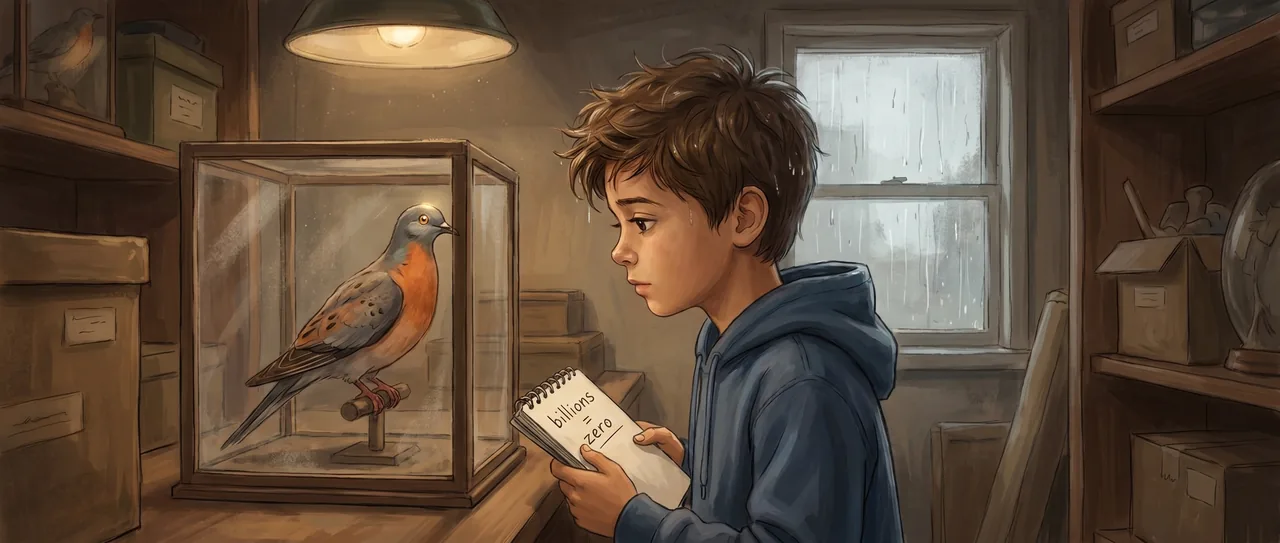
It was not a large bird. Smaller than he expected, longer in the tail than a robin, with a chest that had once been the color of a sunset gone rusty. The feathers had dulled. One glass eye caught the ceiling light. The little card beside it said passenger pigeon, and under that, a date. Nineteen fourteen.
He read the card twice.
The card said that this kind of bird had once been the most abundant bird in North America. It said flocks passed overhead that took three days to go by. It said a single flock could hold billions of birds, so many that the sky went dark under them in the middle of the afternoon, and people lit lamps at noon and waited for the birds to finish crossing.
Soren looked at the one bird in the case. Then he looked back at the card, because those two things did not fit together and he wanted to see where the mistake was.
There was no mistake. The card said the last one died in a zoo in nineteen fourteen. Her name was Martha. Before Martha there had been a few. Before the few there had been thousands. Before the thousands, millions. Before the millions, a sky that turned to night in daytime because there were so many birds alive at once that they blocked the sun.
Fifty years. That was the part he kept returning to. Fifty years between the sky going dark with them and the sky having none of them at all. Not a slow fading over ten thousand years. Fifty years. A person could have watched the whole thing happen inside one life. A person could have been a child under the three-day flock and an old man at Martha's cage.
Soren took out his notebook. He wrote billions and under it he wrote zero and then he sat with the space between the two words, which was very small on the page and had been very small in time.
He tried to picture billions. He could not. He tried to picture the sky over this exact town, over the mud version of Main Street in the old photograph, going dark at noon, everybody stopping, everybody looking up. Wings from one edge of the sky to the other. A sound he could not imagine, the sound of a billion wings, hour after hour, for three days.
And then he tried to imagine the opposite. He tried to imagine the day, somewhere in there, when someone looked up and the sky was only sky.
Nobody would have believed it was possible. That was what got him. When there are billions of something, you do not count them. You do not protect them. You cannot even imagine them ending, because ending is for rare things, for the last two of something in a far-off place. Not for the bird that darkened the sun. The passenger pigeon was too common to worry about. That was exactly why no one worried, and that was exactly how it went to zero.
The woman from the front desk had come to stand a little way off, waiting, the way adults wait when they want the room back.
"That one always gets people," she said. "Or it doesn't. Most walk right past."
"How could there be billions," Soren said, not really to her, "and then none."
"Hunting," she said. "They were easy to hit because there were so many of them. Cheap food. They'd knock them out of the trees by the wagonload and ship them off to cities. Nobody thought it mattered. There were always more." She shrugged, but not carelessly. "Until there weren't."
"But the flocks were so big," Soren said.
"That was the trouble," she said. "They needed to be big. They only nested in enormous crowds. Get the numbers too low and the ones that are left don't do well. So the last part happened fast. Faster than anyone expected." She looked at the case. "By the time people got scared, there wasn't enough left to save."
She went back to her desk.
Soren stayed. He looked at the one bird and he thought about the word abundant, which had always sounded to him like a safe word, a word that meant you did not have to count. Abundant meant more than enough. Abundant meant forever.
Except it had not meant forever. It had meant the opposite, almost. The most abundant bird in the whole continent was the one that was gone. Not the rare ones in the far-off places. The common one. The one so ordinary that nobody wrote its name down, nobody guarded it, nobody looked up in alarm, because who looks up in alarm at the sky itself.
He thought about the birds outside right now, in the rain. The gray pigeons on the wet ledges. The sparrows that were everywhere, that he never really saw because they were everywhere. The starlings crowded on the wires like beads on a string. He had never once counted them. He had never once thought they could be counted, or that they might one day fit inside a single glass case with a card and a date.
He understood, standing there, that common was not the same thing as safe. That the two words had come apart in his hands.
He put his notebook away. He did not write anything else. There was nothing else that would fit.
Outside, the rain had thinned to almost nothing. Soren pushed open the heavy door and stepped onto the wet steps, and the first thing he did, before anything else, before he even thought about it, was tip his head all the way back and look up.
A loose scatter of gray birds crossed the pale sky, eight of them, maybe nine, wingbeats quick against the clouds. He counted them. He counted every single one until they were gone behind the roofline.
Read the interactive version, listen to the narration, and earn a gold star →
A science-verified short story for curious kids · Curiosity Land