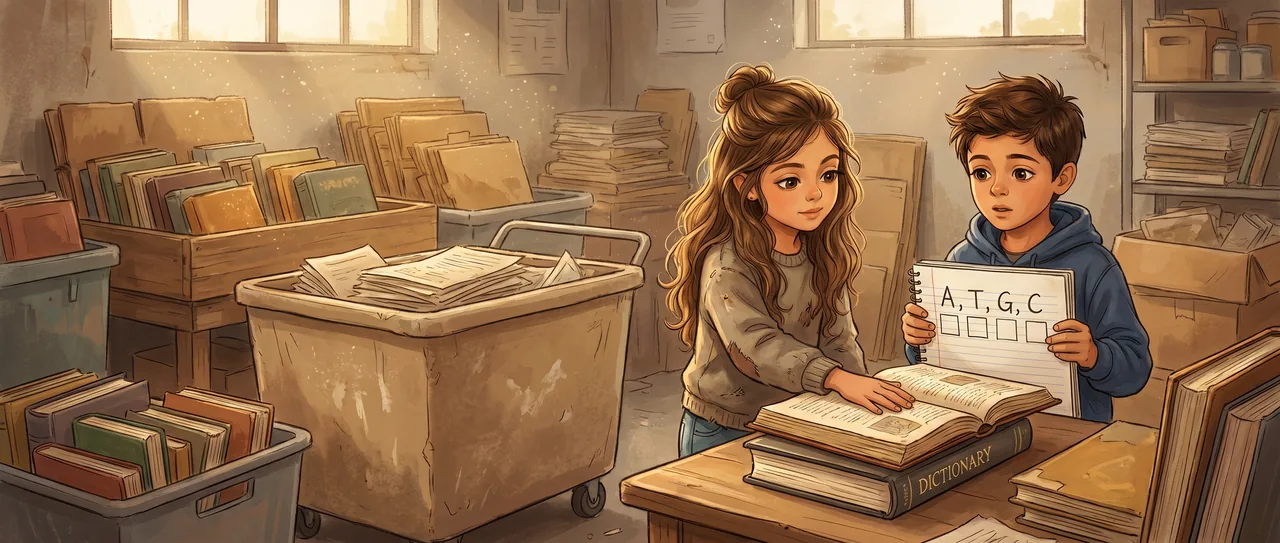
Two More Letters
The dictionary was so heavy Maya had to carry it against her chest like a baby.
"Twenty-six letters," she said, dropping it on the sorting table. "You know what's weird? Nobody ever asks why twenty-six."
Soren was pulling paperbacks out of a bin, checking each spine before he stacked it. The depot smelled like wet cardboard and old glue. Their job was easy. Books that could be resold went left. Books too damaged went into the pulp cart on the right.
"Because that's how many there are," he said.
"That's not a reason. That's just the number." Maya flipped the dictionary open to the middle. "Somebody could add one. A twenty-seventh letter. A brand new sound."
"You can't just invent a letter."
"People invented all of them, Soren. They didn't fall out of the sky already spelling things."
Soren stopped stacking. He liked her when she got like this, when a normal object turned into an argument. He picked up the next book and did not look at the spine.
"Fine," he said. "Say you invent one. A new letter. What happens when you use it?"
"People read it."
"How? Their eyes have never seen it. Their mouths have never made the sound." He set the book down. "A letter that nobody can copy isn't a letter. It's a smudge."
Maya went quiet. She looked at the dictionary. Then she looked at the pulp cart, where thousands of pages waited to be ground down and pressed into new pages, the same letters over and over, recycled into more of themselves.
"Copy," she said. "You said copy."
"I said what?"
She was already digging through the bin Soren had abandoned. Near the bottom was a battered library discard, a science book with a cracked cover. She had seen it earlier and put it down. Now she wanted it. She flipped pages fast, the way she did everything.
"Here." She flattened the book on the dictionary. "Read this part."
Soren read. It was a chapter about DNA. He knew the basics. Four letters, A, T, G, C. Every living thing spelled out of those four. His own body, the mold on the old books, the trees the paper came from. Four letters, endlessly.
"Four," he said. "See. Even life only got four. Not twenty-six. Four."
"Keep reading."
He kept reading. Then he stopped, and read the same paragraph again, the way he did when a sentence would not behave.
"They added two," he said slowly.
"Read it out loud. I want to hear you say it."
"Scientists made bacteria. Living bacteria. And they put two new letters into the DNA. Not A, T, G, or C. Two that don't exist in nature. Made-up ones." He looked up. "They call them X and Y here. Synthetic bases."
"Your twenty-seventh letter." Maya's voice had gone almost soft. "Somebody did it. Not in a book. In a thing that was alive."
"That's not the part." Soren put his finger on the page and would not move it. "Listen. The bacteria lived. And then they divided. They made more bacteria."
"Okay."
"Maya. When a cell divides it copies its whole DNA first. Every letter. It has to hand a full set to each new cell." He looked at the pulp cart again, at all those pages waiting to become pages. "The bacteria copied the new letters too. The ones that never existed before. They read a letter that had never been in any living thing, and they wrote it down again. Perfectly. And then their children did it. And their children."
Maya didn't say anything. This, from her, meant a great deal.
"You said it before," Soren went on, and now the words were coming faster, catching up to the thing in front of them. "A letter nobody can copy is a smudge. But something copied these. Something alive figured out how to hold a letter that four billion years of everything had never seen."
"Four billion years," Maya repeated. "Every animal. Every plant. Every one of them, since the very first one, spelled out of the same four letters. The whole time. Nobody ever added anything."
"And then somebody did."
They both looked at the science book. It was a library discard. Somebody had decided it was too old to keep. The information in it was already behind, already true in a way the world had moved past.
"How old is this book?" Maya asked.
Soren checked the front. "Fourteen years. Little more."
"So there are bacteria right now," she said, "somewhere, in some lab, that are way past this. This is the old news. This is the smudge that stuck." She pressed her hand flat on the open page. "Somebody out there is teaching things to read letters we haven't even drawn yet."
Soren thought about the four letters in his own cells. He thought about how they had never once, in his whole life, in his parents' whole lives, in the whole line stretching back to the first living speck, tried anything but those four. And how it had never been because four was the only number that worked. It had just never happened. Until a person made it happen. On purpose.
"It means the alphabet wasn't finished," he said. "Life's alphabet. We thought it was done. It was just the part somebody had written down so far."
Maya turned to the pulp cart. All those books going to be unmade and made again, the same twenty-six letters pressed into fresh paper, the same story of what letters were allowed to exist.
She took the science book off the dictionary. She did not put it in the pulp cart. She did not put it in the resale stack either.
"This one's mine," she said, and slid it into her backpack.
Soren didn't argue. He got out his notebook. On a clean page he drew the four letters, A, T, G, C, in a neat row. Then he left a gap. Then he drew two boxes, empty, where the new letters would go, because the book only called them X and Y and he wanted to see the shape of not knowing yet.
He held the page up. The two empty boxes sat at the end of the row, waiting.
Read the interactive version, listen to the narration, and earn a gold star →
A science-verified short story for curious kids · Curiosity Land