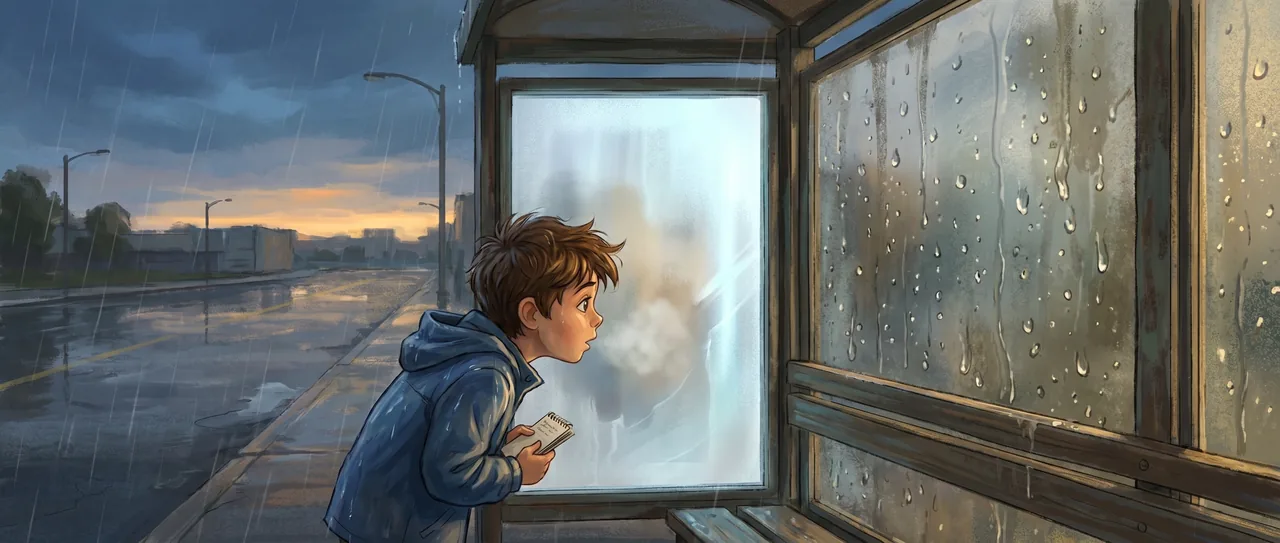
The Window That Wouldn't Get Dirty
The old bus shelter across from Soren's building had always been filthy. Pigeon streaks. A greasy smear where a hundred people had leaned their heads. Someone's ancient sticker peeling at one corner.
Then the city replaced the glass panel behind the advertisement, and Soren stopped waiting for the bus and started watching the glass.
Because the new panel would not stay dirty.
He first noticed it on a Tuesday. The rain came sideways, the kind that soaked the bench and dripped off the roof lip in a curtain. The old glass, the panels the city had not replaced, wore fat round beads of water that dried into cloudy spots. The new panel did something else. The water did not bead on it at all. It spread into a thin sheet, top to bottom, like a film of oil, and then slid off in one clean sweep and took the dust with it.
Soren stood under the roof lip and looked at both panels side by side. Same rain. Same angle. One beaded. One sheeted.
He took out his notebook and drew two circles, one round and fat, one flat and wide, and wrote the time and the fact that the sky was grey.
That was the part that nagged him. Grey sky. He came back Wednesday when the sky was grey again and it rained again, and again the new panel sheeted and cleaned itself. But he wanted the thing that was behaving wrong, and the thing behaving wrong was this: the panel had been just as clean on Monday, and Monday it had not rained at all.
So rain was not the whole answer. The rain only finished something.
He pressed his thumb against the new glass and left a smudge, a good greasy one, on purpose. Then he waited to see how long the city took to clean it.
The city did not clean it. On Thursday the smudge was fainter. On Friday, under a sky that had finally gone bright and hard and blue, the smudge was gone. No rain had fallen. Nobody had wiped it. The grease had simply left the glass.
Grease does not leave glass. Grease sits there being grease until somebody attacks it. Soren knew this from every mirror in his apartment.
He stood there long enough that a woman waiting for the number nine asked if he was all right.
"Something is eating the dirt," he said.
She looked at the panel, then at him, and moved down the bench.
He wrote it down anyway. Something eats the dirt. It works better in sun. It works even without rain, but slower. Rain finishes the job. The old glass does none of this.
Difference. He needed the difference between the old glass and the new glass. They looked the same. Both clear, both flat, both cold. But the new one had a faint blue-white haze when he tilted his head, a sheen like the thinnest possible frost that was not frost, because it did not melt and it did not wipe off.
A coating. The new panel had a coating and the old one did not.
He thought about what eats grease. Bleach. His mother used it on the tub and it stank and it needed him to open a window. But the panel had no smell, and nobody poured anything on it, and it worked in sunlight and stalled in the dark.
Sunlight. That was the piece he kept circling. Monday it cleaned in the sun with no rain. Thursday it barely changed under thick cloud. Friday, hard bright sun, and the grease vanished.
Whatever the coating was, the light switched it on.
Soren sat with that. A coating that does nothing in the dark, and in the light reaches out and takes grease apart. Light going into a surface and coming out as work. Not heat, because the panel in the sun was not even warm. Something else. The light was doing chemistry.
He had thought light was for seeing. Light bounced off things into your eyes and that was the whole story. But this coating was drinking the light and using it, the way his own arms used breakfast, and turning sunshine into a slow invisible scrubbing that ran all day for free and stopped at night to rest.
He went home and found his mother's phone and searched for glass that cleans itself. The word came up. Titanium dioxide. The same white stuff, the article said, that made toothpaste white and sunscreen white and the middle of an Oreo white. Painted onto glass in a layer too thin to see, it did exactly what he had watched it do. Ultraviolet light, the part of sunlight his eyes could not even register, struck the coating and woke it up. The woken coating pulled grime apart into nothing. And it changed how water sat on it, so rain could not bead. Rain spread flat and swept the loosened dirt away in a sheet.
Superhydrophilic, the article said. Water-loving. That was the flat wide sheet he had drawn on Tuesday.
He read the last part twice. The same coating, the article said, was being tested to split water itself, using only sunlight, into hydrogen and oxygen. Fuel. Out of a puddle. Out of light.
Soren put the phone down.
On the bus shelter, a coating too thin to see was taking a woman's headprint apart molecule by molecule while she waited for the number nine, and somewhere scientists were aiming the same trick at a glass of water to pull fuel out of it, and none of them had to touch anything, because the sun was doing it, the way the sun had been pouring down on that greasy bench every single day of his life while he thought light was only for looking.
He crossed the street in the last of the daylight. The new panel had gone quiet with the fading sun, its scrubbing slowing toward its nightly stop. He put his eye close to the surface and tilted his head until the blue-white sheen came up.
He breathed on it, one warm fogged patch, and watched the fog shrink back to clear glass from every edge at once, flat and even, water spreading instead of beading, the coating already reaching for the last of the light.
Read the interactive version, listen to the narration, and earn a gold star →
A science-verified short story for curious kids · Curiosity Land