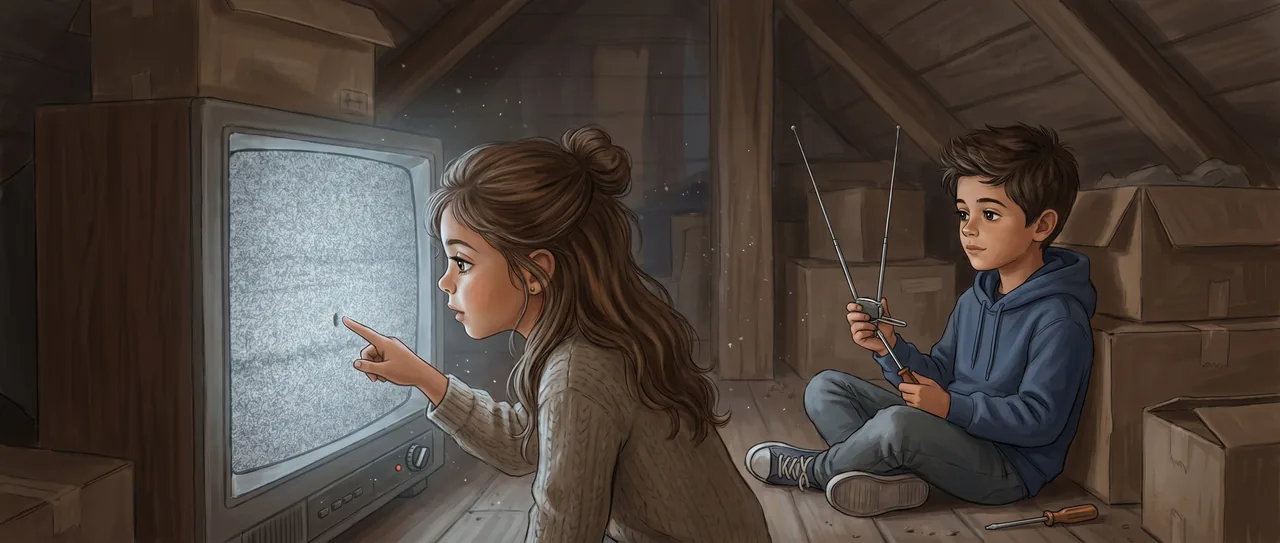
The Static Everywhere
The television made a sound like frying bacon and then filled with snow.
"That's worse than before," said Soren. He had the antenna in one hand and a screwdriver in the other, which was not a great combination.
"Turn it," said Maya.
"I am turning it."
"Turn it more."
He turned it more. The gray fuzz shivered and hissed but did not become a channel. It never became a channel. Grandpa's old set had been in the attic since before either of them was born, and the swap-meet was Saturday, and right now they had a box that did nothing but crackle.
Maya sat back on the dusty floor and watched the screen. "It's not nothing," she said.
"It's definitely nothing. It's static."
"Static is something." She leaned close, until her nose nearly touched the glass. The little points of light jumped and vanished, jumped and vanished, too fast to follow. "Where's it coming from?"
"The antenna's picking up junk. Electric stuff. The fridge downstairs, maybe. Radio." Soren waved the antenna around. The snow didn't care. It stayed exactly as loud pointing at the window as pointing at the wall. "Huh."
"See," said Maya. "You did that thing."
"What thing."
"The huh thing. You do it when something's behaving wrong."
Soren pointed the antenna straight up at the roof beams. Then straight down at the floor. Then at Maya, which she objected to. The hiss did not change. Not louder, not softer. Same everywhere.
"That's the wrong," he said. "If it was the fridge, it'd get louder near the fridge. If it was a station, there'd be a direction where it's strongest. There isn't. It's the same from every side."
"Everything that has a source has a direction," said Maya. She was thinking out loud, fast, in pieces. "So either it has no source. Or the source is everywhere."
They both looked at the screen. Snow. Even, endless, patient snow.
Soren set the antenna down. He knew a fact he had read once and never quite believed, the way you can carry a fact around in your pocket for years without taking it out to look at it. He took it out now.
"Some of it," he said slowly, "isn't from anywhere on Earth."
"What?"
"There's a thing. Old TVs, the fuzzy channels. A little bit of the fuzz, a small piece, it's from space. It's light left over from the beginning. From the Big Bang." He stopped. "I read it. I didn't understand it. I still don't understand it."
Maya did not laugh at him, which was one of the reasons he told her things. She squinted at the screen like she was trying to catch one specific snowflake.
"Say that again but slower."
"When the universe started, it was hot. Really hot, all packed together, glowing. Then it spread out and cooled down. And the glow, the light from back then, it's still traveling. It never stopped. It's been going for thirteen point eight billion years." He said the number carefully. "And it's still arriving. Right now. Some of it is landing on the antenna."
Maya was very quiet.
"Landing where," she said finally.
"Everywhere. It comes from every direction because back then everywhere was the same place. The whole sky is glowing with it. We just can't see it with our eyes, it's the wrong kind of light. But the antenna catches a whisper of it."
Maya put her hand up near the screen, not touching it, feeling the faint warmth the old tube gave off. "So the reason it's the same from every side."
"Is that it's from before there were sides," said Soren.
The attic was quiet except for the frying-bacon hiss. Outside, a car went by. Grandpa was downstairs making tea and had no idea that his broken television was doing the oldest thing in the universe.
"How much of the snow is it," Maya asked. "The space part."
"A little. Not most of it. Most is Earth junk, like I said. But some. A tiny, real some." Soren looked at the fizzing dots. "There's no way to tell which flecks. They're all mixed in."
Maya leaned in again, closer than before, until the light of the screen was the only thing on her face.
"That one," she said, pointing at a single flicker that was already gone. "Maybe that one."
"Maybe."
"Or that one."
"Could be."
"We can't know which."
"No."
She kept watching anyway. So did he. Somewhere in the wash of gray, invisibly folded into the ordinary hiss of a broken machine in a dusty attic, were specks of light that had been crossing empty space since before the Earth, before the Sun, before there was a single atom that would ever become either of them. Light with nowhere older to have come from. And it was ending its whole journey here, on the face of a television nobody wanted, in front of two kids who could not tell it apart from noise.
"It picked us," Maya said. "Sort of. It's landing everywhere and everyone ignores it. We're the ones looking."
"It's landing on everyone's everything all the time," said Soren. "On the roof. On the road. On the tea downstairs."
"On us."
He hadn't thought of that. He thought of it now, of the oldest light there was, arriving thirteen point eight billion years late and not stopping at the screen at all, passing through the glass and the dust and the walls and the two of them without asking, on its way to wherever it went next.
Maya reached over and turned the volume knob up as far as it would go. The hiss filled the attic, loud and even and coming from nowhere and everywhere.
"Leave it," she said. "I want to hear it."
Soren took his hand off the knob and let the sound roll through the attic, some of it the fridge, some of it the road, some tiny impossible fraction of it the very first morning of everything, still going, still arriving, filling the room like weather.
Read the interactive version, listen to the narration, and earn a gold star →
A science-verified short story for curious kids · Curiosity Land