The Slowest Race
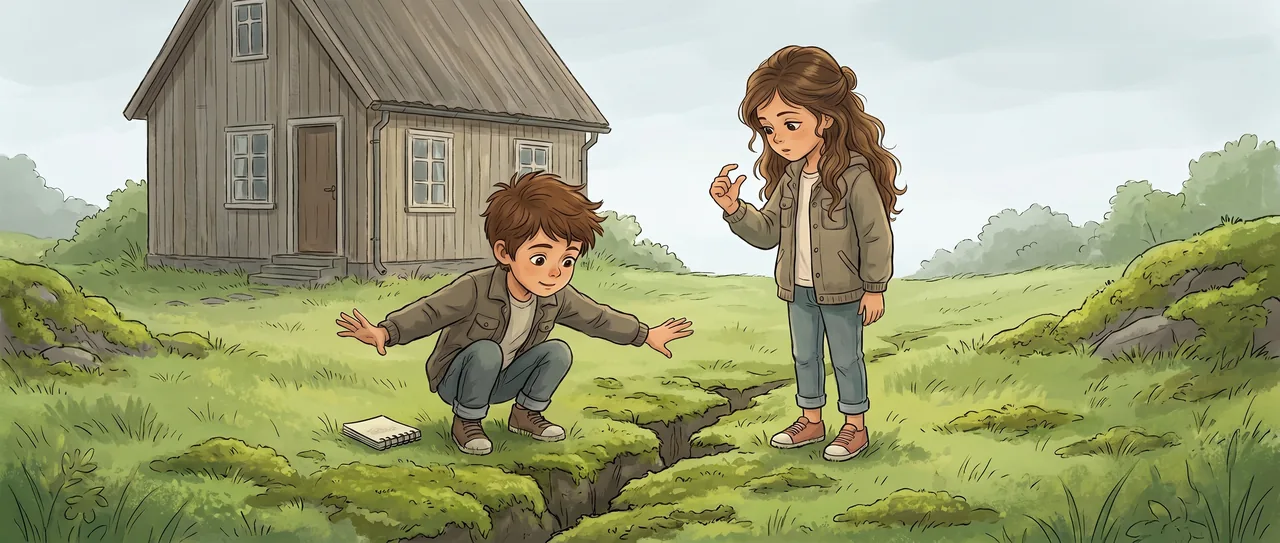
Behind the house there was a crack in the ground, and Soren was standing with one foot on each side of it.
"Which side are you on?" Maya asked.
"Both," he said. "That's the problem."
His grandmother had told them, over breakfast, that the split ran all the way down through Iceland, and that on one side of it the ground was North America and on the other side it was Europe. She had said it the way you'd mention that the milk was in the fridge. Then she went to feed the sheep.
"So your left foot is in America," Maya said.
"And my right foot is in Europe."
"Do it the other way. Put America in the fridge."
He stepped over so his American foot was near the back door. Maya crouched and looked into the crack. It was mossy at the top and dark going down and cold air came out of it like the ground was breathing on her ankles.
"It's just a crack," she said. But she said it slowly, which meant she wasn't finished.
"Amma said it gets a little wider every year."
"How much wider?"
Soren pulled his notebook out of his jacket. He'd written the number down when his grandmother said it. "Two and a half centimeters a year."
Maya held her thumb and finger apart to show two and a half centimeters. It was nothing. It was the width of a chunky crayon.
"That's slow," she said.
"That's really slow."
"So slow you couldn't even see it happen."
"No."
They both looked at the crack, willing it to move. It did not move. A fly landed on the moss and left again.
"Two and a half centimeters," Maya said again. She was frowning now, and it was a good frown. "I know that from somewhere."
"From Amma. Five minutes ago."
"No. From before." She held her fingers apart again and stared at the gap. Then she turned her hand over and looked at her own nails. They were a little long. Her mother had been on at her to cut them.
"Soren. How fast do fingernails grow?"
"I don't know. Nobody knows that."
"Somebody knows that." She kept looking at her thumbnail. "There's a white bit at the bottom, and then the top edge. That whole thing grows out and you cut it off and it grows again. In about a year, right? You get a whole new nail in about a year."
Soren looked at his own thumb. "Maybe."
"How long is a fingernail? From the white part to the tip."
He held his thumb against the notebook and eyeballed it against the little squares. "A couple of centimeters."
"Two and a half?"
He stopped eyeballing. He looked at her.
"No," he said. "That's a coincidence."
"Maybe." But she was up on her feet now. "Check it. You like checking."
Soren did like checking. He put his thumbnail flat against the ruler lines printed inside his notebook cover. From the pale half-moon at the bottom to the white edge he wanted to cut, it was a bit over two centimeters. He measured Maya's, which was longer because she hadn't cut hers. Closer to two and a half.
"That's a whole year of growing," Maya said. "That's what the top of your nail is. It's a year old. The bit at the very tip started growing last summer."
"When we were in Wales."
"Your nail remembers Wales."
Soren laughed, but he was writing now, and his handwriting had gone small and careful the way it did when he didn't want to lose something. Two and a half centimeters a year for the crack. About two and a half centimeters a year for a fingernail.
"They're the same speed," he said.
"They're the same speed," Maya said.
And then neither of them said anything, because the crack had changed.
It hadn't moved. It looked exactly the same, mossy and dark and breathing cold. But Maya was looking at it differently now, the way you look at somebody's face when you find out how old they really are.
"Soren," she said. "If it opens two and a half centimeters every year, and it's been opening the whole time there's been an Iceland."
"Amma said the island's about twenty million years old."
Maya did not try to do that multiplication out loud. She just held her fingers apart at two and a half centimeters, the little crayon-width, and then she started moving her hands apart, slowly, past the width of the crack, past the width of the back door, and she kept going until her arms were all the way open and it clearly wasn't enough, it wasn't anywhere close.
"The ocean," she said. "The whole Atlantic Ocean. That's this. This crack, doing this, this slow, for long enough."
Soren stood with one foot in America and one foot in Europe and felt, for the first time, that they really were two different places and that they really were leaving each other. Not fast. At the speed his own fingernails were growing, right now, while he stood there. He could not feel his fingernails growing. He could not feel the ground growing either. Both were happening.
"America's over there," Maya said, pointing west, past the sheep, past the sea. "New York and everything. And it's going that way. And we're going this way." She pointed east. "And nobody can feel it. Everybody's just walking around on it having lunch."
"How wide's the Atlantic?"
"I don't know. Wide. You've flown over it. It takes ages."
"And it started," Soren said slowly, "as a crack you could stand over."
Maya looked down at his two feet. She looked at the gap between them, the chunky-crayon gap, the fingernail gap.
"Cut your nails tonight," she said. "And by next summer they'll have grown back exactly as far as this crack opened. You can measure both. Same ruler."
Soren crouched down and put his palm flat on the cold moss on the American side, then reached across and put his other palm on the European side, so his arms bridged the split.
Under his left hand and under his right hand, without any sound, at the speed of the small white edge he would cut off that night and never think about again, two pieces of the world were letting go of each other.
Read the interactive version, listen to the narration, and earn a gold star →
A science-verified short story for curious kids · Curiosity Land