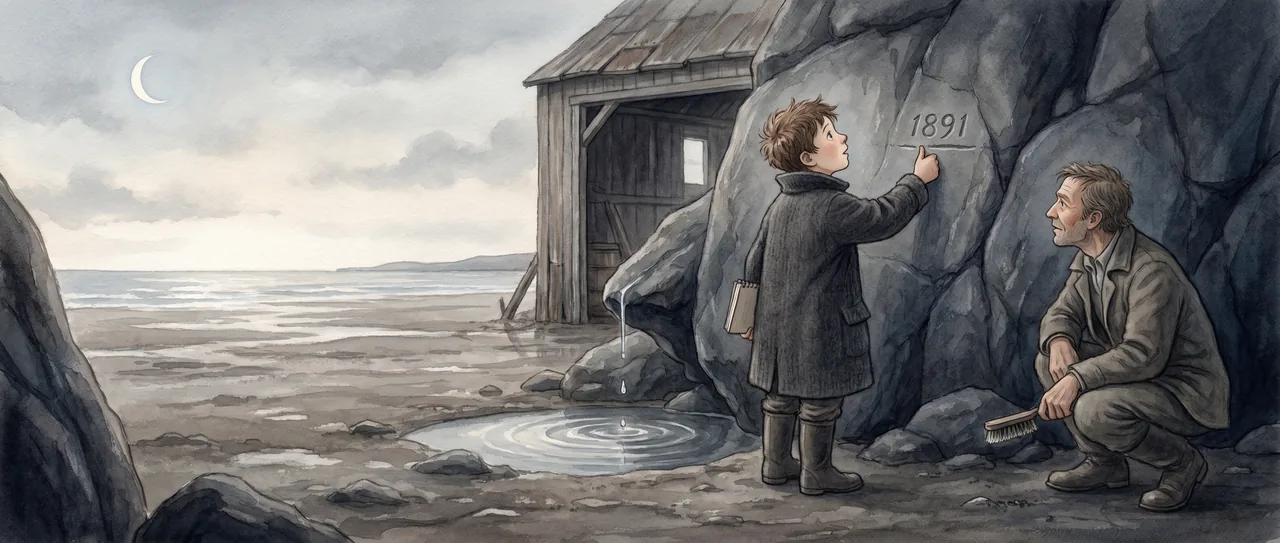
The Slowest Goodbye
The mud smelled like old pennies and salt. Soren stood on the exposed flat where the sea used to be an hour ago, and the cold came up through his boots before it reached his knees.
His uncle Bram was crouched over a slab of dark rock, brushing barnacles off it with a wire brush. Bram measured tides for the harbor. He was the kind of person who talked to the rock more than to Soren.
"There," Bram said. "Somebody carved these lines in eighteen ninety-one. High tide, low tide. Same moon, same water. Nothing changes out here."
Soren pressed his thumb into the groove of the highest line. The stone was cold enough to ache. The carved mark sat higher than any water he had ever seen touch this rock.
"The high line is too high," Soren said.
"Storm tides," Bram said, not looking up. "They get big."
Soren crouched anyway. He ran his finger along the groove. The grit of it caught under his nail. He was listening to the wet suck of the mud around his boots, the far hiss of the sea pulled back to the edge of everything, and under all of it a slow drip from the rock overhang, one drop every few seconds, patient as a clock.
The Moon hung pale in the brightening sky, low over the water, thin as a fingernail paring.
"It looks small," Soren said.
"It's far," said Bram. "Two hundred and forty thousand miles, give or take. Always has been."
Soren did not answer. He was feeling the drip. Every drop of water off the overhang hit a shallow pool and sent a ring outward, and the ring took a moment to reach the edge, and the pool never quite emptied because the drip kept feeding it. Slow. Steady. A thing you could not see move, but it moved.
He had read that the Moon pulls the ocean into a bulge, and the Earth spins under that bulge, and the bulge drags forward and tugs the Moon. He had not felt it until now, with his thumb in a groove cut by a hand a hundred and thirty years dead.
"Uncle Bram. Is the Moon always this far?"
"Practically."
"But not exactly."
Bram sat back on his heels. "It drifts a hair. Few centimeters a year. Doesn't matter. You'd need a thousand lifetimes to notice."
Soren looked at the drip. A few centimeters a year. One drop every few seconds. He thought about how the pool had been empty when they arrived and was full now, and he had never once seen it fill.
He stood and walked to the tallest rock, the black one the water never reached, and he tilted his head all the way back to look at it. It went up higher than the boat masts in the harbor. Higher than the lighthouse base.
"If the Moon is drifting away," Soren said slowly, "then it used to be closer."
"Sure. Long ago."
"How close?"
Bram shrugged. "Nobody was around to measure."
Soren turned in a full circle. The mudflat stretched out gray and endless where the sea had drawn back. He tried to picture the sea not drawing back a hundred meters, the way it did here, but drawing back for miles. He tried to picture a tide that climbed higher than the black rock. Higher than the lighthouse. A wall of water that came in twice a day and swallowed the whole coast and then fell away again.
His breath went short.
"When the Moon was close," he said, "the tides would have been enormous. Not storm tides. Every day. Miles."
Bram laughed, but it trailed off when he saw Soren's face.
Soren reached into his coat and drew out his notebook, and the pencil in his cold fingers made the letters crooked. He wrote: closer moon, bigger bulge, more drag. He looked at the pale sliver in the sky.
"The bulge drags the Moon forward and pushes it out," Soren said, more to the Moon than to Bram. "And the same drag pushes back on the Earth. It slows the spinning." He stopped. His mouth had gone dry with it. "If the Moon was closer and moving out, then the Earth was spinning faster. The days were shorter."
"Now you're just guessing," Bram said.
"Yes," said Soren. "But it has to be true. You can't slow one without the other. The water is between them." He held up his hand as if he could hold the whole system in it. "The tide is a rope. The Moon pulls the water, the water pulls the Moon, the ground drags underneath. Everything is tied to everything."
He felt it then, the way you feel a floor tilt. That the day had not always been a day. That there had been a young Earth spinning so fast the sun rose and set in six hours, with a huge close Moon and tides that came in like mountains, and it had all been slowing and drifting and letting go, one drop at a time, for four billion years, and it was still doing it, right now, under his boots, at the speed a fingernail grows.
"You can't measure it in a day," Soren said. "That's why nobody feels it."
Bram was quiet. He looked at the carved line, higher than any tide he had ever recorded, and then at the boy, and then up at the thin Moon.
"How far will it go?" Bram asked. It was the first real question he had asked all morning.
Soren did not know. He liked that he did not know.
The tide was turning. He heard it before he saw it, the hiss coming back across the flats, the sea returning by the width of a hand, then two. Water crept into the drip pool and lifted the rings and carried them toward the carved line in the rock, a little lower than last time, and a little lower than it would be tomorrow.
Read the interactive version, listen to the narration, and earn a gold star →
A science-verified short story for curious kids · Curiosity Land