The Question That Wouldn't Pick
The planetarium was closing forever, and everything was in crates except the thing on the back table, which was still humming.
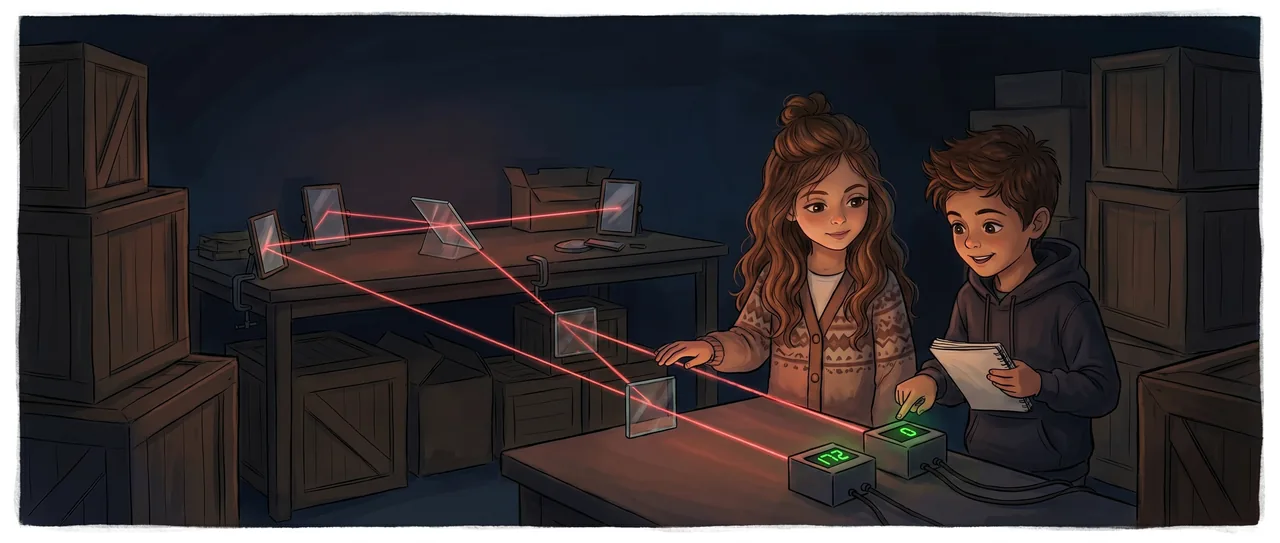
"They forgot this one," said Maya. She poked the black box. A thin red line jumped out of it, hit a little square of glass tilted at an angle, and then split into two lines that ran to two tiny detectors. Two green numbers ticked upward beside them.
"Beam splitter," said Soren, reading the label taped underneath. "Half the light goes through, half bounces off. That's why there are two beams."
"So half the light goes each way."
"Half. Yeah."
Maya put her finger in front of the box, so only a little light escaped. The green numbers slowed to a crawl. One. Then, a while later, another one.
"Turn it down more," she said.
Soren found a dial. He turned it until the beam was so faint you could barely see it, until the detectors only clicked one at a time, far apart, like a slow drip.
"Those are single photons," he said. "One tiny piece of light at a time. It says so on the card. One photon."
"Okay." Maya frowned at the two detectors. "So if it's one photon, and it hits the splitter, it has to pick. Through or bounce. Left or right."
"Right. One photon can't split in half. It's already the smallest piece."
"So one detector should click. Not both."
They watched. Left clicked. Then, later, left again. Then right. Then left.
"See," said Soren. "It picks. Each one picks a side."
"Then why does the card have a second part?" Maya flipped it over. There was a second setup drawn on the back, with two more mirrors and a place where the two paths came back together. She looked at the crates, then at the box, then started unclamping the little mirrors from a broken model in the nearest crate.
"Maya. That's museum stuff."
"It's going in a truck to be thrown away."
Soren wrote down where every piece had been, so they could put it back. Then he helped her.
It took them most of an hour to line the mirrors up so the two paths met again at a second beam splitter. Whenever a mirror was a hair off, both detectors clicked randomly, like before. They kept nudging. The clicks got fussier, then suddenly went strange.
All the clicks went to one detector.
"Wait," said Soren. He covered one path with his notebook. The clicks spread back to both detectors again, random. He uncovered it. All the clicks bunched onto one detector again.
"Do it again," said Maya.
He did it six times. Cover the path, clicks go both ways. Open the path, clicks pick one detector. Same every time.
"That's backwards," said Soren slowly. "When I block a path, I'm giving the photon fewer choices. One road instead of two. And that makes it more random. When I open the second road, it gets less random."
"More roads, more sure," said Maya. "That's backwards."
"It only makes sense if," Soren started, and stopped.
"Say it."
"If the photon went both ways. Down both roads. And then the two versions met up at the end and, and argued. And the argument decides which detector."
"One photon," said Maya. "You said it can't split."
"It can't."
"But it went both ways."
"It can't split and it went both ways." Soren looked at his own words on the page like they might rearrange themselves. "When I block a road, there's no other version to meet. So there's nothing to argue with. So it's just random, one road. But when both roads are open, something comes down each road, and they meet, and they line up or cancel out."
Maya was already reaching to cover the path and uncover it, cover and uncover, watching the clicks jump from both-random to one-sure and back.
"So which road did it take," she said. "When both are open. Which one."
"Both."
"Pick one."
"That's the thing." Soren's voice went quiet. "You can't ask it which road without blocking a road. And the second you block a road to check, it stops doing the both-roads thing. You can have the answer to which road, or you can have the argument. Not both."
Maya took her hand away from the beam and just looked at the two paths glowing faintly in the dark room. The little detectors ticked, all landing on the same one, patient, certain.
"So the question doesn't have an answer," she said. "It's not that we don't know which road. It's that it isn't one road. Until you make it be."
"Until you make it be," Soren repeated.
Maya thought about all the times a teacher had asked her to circle one answer, only one, no you can't circle two, and how she'd always felt like something true was getting bent to fit the box.
"It's allowed to be both," she said. "The whole time. As long as nobody makes it choose."
"That's what a qubit is." Soren tapped the card, where a paragraph at the bottom mentioned it. "A regular computer bit is a zero or a one. This is how you build a thing that's both, both roads at once, and you only make it pick at the very end. That's the whole idea. People are building computers out of this. Out of not-picking-yet."
Maya laughed, once, surprised.
"So the fastest way to answer something," she said, "is to not answer it for as long as you possibly can."
Soren wrote that down. His hand moved fast across the page and then stopped, hovering, because there was no way to draw a photon that was on both roads and neither, so he drew both roads and left the photon out, a gap between two lines.
Someone rattled the door at the front of the planetarium, keys, a voice calling that they were locking up.
Maya reached for the notebook to check the mirror positions, so they could put everything back exactly. Then she stopped, her hand over the box, over the two faint red roads that both existed until the moment the little detector, far down the line, ticked once more and made the light be somewhere.
Read the interactive version, listen to the narration, and earn a gold star →
A science-verified short story for curious kids · Curiosity Land