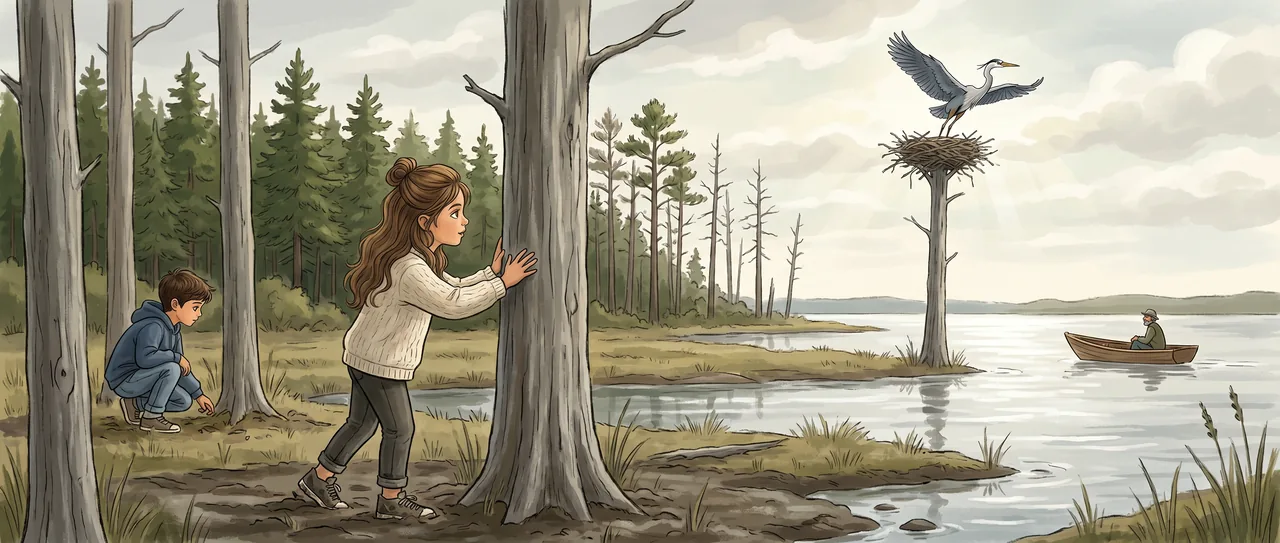
The Gray Trees
The trees at the edge of the water were the wrong color.
Maya noticed it from the boat before she noticed anything else. Behind the green pines stood a stand of trunks the gray of old bone, bare and branchless, standing straight up out of the marsh grass. No leaves. No bark, in places. Just wood the color of a cloudy sky, stuck upright in the mud.
"Cedar," said Soren's uncle Reggie, cutting the motor. He was here to check his fish traps and he said everything in the fewest words possible. "Dead cedar. Whole coast has it."
The boat drifted in. Maya could smell the marsh now, that thick smell of salt and mud and something rotting slow. She reached out and put her hand flat against the nearest gray trunk. It was warm from the sun and hard as a fence post. When she knocked it with her knuckle it knocked back, solid.
"It's not rotten," she said. "It should be soft. It's not."
Soren knocked it too. The sound was dry, hollow, like a door.
"Salt," said Reggie, hauling a trap. "Salt kills the tree and salts the wood. Keeps the bugs off. Keeps the rot off. They just stand there. Years."
Soren was looking at the ground around the trunks. Where there should have been pine needles and ferns there was only marsh grass, the low wet grass of the salt flats, growing right up to the dead trees and out past them, deeper into where the forest used to be.
"The grass is winning," he said.
"The water's winning," said Reggie. "Grass just comes after."
Maya walked in among the trunks. Her sneakers went soft into mud that had no business being under a forest. She counted trees. Green ones behind her, close to solid ground. Gray ones ahead of her, out toward the creek. And between them, a middle row, pines that still had needles but only at the very top, the lower branches already bare.
"They're dying in order," she said.
Soren came up beside her. He saw it too, the line of it, green behind and gray ahead and the half-dead ones caught right in the middle.
"Like a wave," he said. "A slow wave. Coming this way."
"The water doesn't have to flood them," Maya said slowly. She was working it out with her feet in the mud. "It just has to get to the roots. Underneath."
Reggie glanced over. "Salt gets in the groundwater. Comes up through the dirt before it ever comes over the top. Tree drinks salt, tree dies. My granddad hunted in these woods. Right here. Deer." He nodded at the water. "That's underwater half the day now."
Maya stood very still in the middle of the gray trees. Under her feet the ground was soft. Ahead of her the creek. Behind her the green.
"Wait," she said. "How fast?"
"How fast what?"
"How fast is the line moving. The gray line."
Reggie shrugged. "Faster than it used to. Ask a scientist."
But Soren had already stopped listening to Reggie. He was staring at the tallest gray trunk, the one furthest out, standing alone in open marsh like a flagpole. Then he turned and looked back at the solid ground, at the healthy pines, at the whole slope of the land.
"You can see it from space," he said.
Maya turned. "What?"
"Gray. Against green. From up high it would be a color change." He held up his two hands, one flat above the other. "Satellites take pictures of the coast over and over. Same place, every year. And this," he swept his hand at the dead cedars, at the line of them, "this is a gray edge moving into a green edge. You wouldn't even have to walk in the mud. You'd just put the pictures on top of each other and watch the gray creep."
Maya looked at the gray line with new eyes. Not a graveyard. A measurement.
"Every dead tree is a mark," she said. "Like a ruler."
"Like the tide line, but it stays." Soren crouched and touched the mud, then the base of the nearest cedar. "That's why they don't rot. If they rotted, they'd fall, and you'd lose the mark. But the salt keeps them. They stand there for years telling you exactly how far the ocean got."
Maya felt the whole thing tip and open. She had walked into a dead patch of woods. She was standing in a record. Every gray pole around her was a place the sea had reached and touched and held. The line she stood on was not the edge of a forest. It was the edge of an ocean that had not arrived yet with water, but had already arrived with salt, underground, quiet, ahead of itself.
"It's already here," she said. "The sea. We're standing in it. It just doesn't look like water yet."
Reggie had gone quiet in the boat. He was looking at the tall lone cedar, the one furthest out.
"That one," he said. "That one was green when I was a boy. Had a hawk nest in it." He said it the way he said everything, flat, few words. But he didn't start the motor.
Soren was already pacing it off, counting his steps from the green pines to the first gray trunk, his lips moving with the numbers. Maya knew he would write those steps down, and the date, and next year Reggie would take them back out and Soren would pace it again.
She looked at the gray trees, all of them, the standing ones and the half-dead ones and the green ones waiting their turn. She looked at where her sneakers had sunk into ground that used to be a deer woods.
"They're not ghosts," she said. "Ghosts are the ones that stay after everybody stops looking." She turned to Soren. "We're looking."
A great blue heron lifted out of the tall lone cedar, the one with the old hawk nest, and beat its wings slow across the open marsh where the woods used to be, and set down in the water that was standing where the trees would stand gray next.
Read the interactive version, listen to the narration, and earn a gold star →
A science-verified short story for curious kids · Curiosity Land