The Awake Room
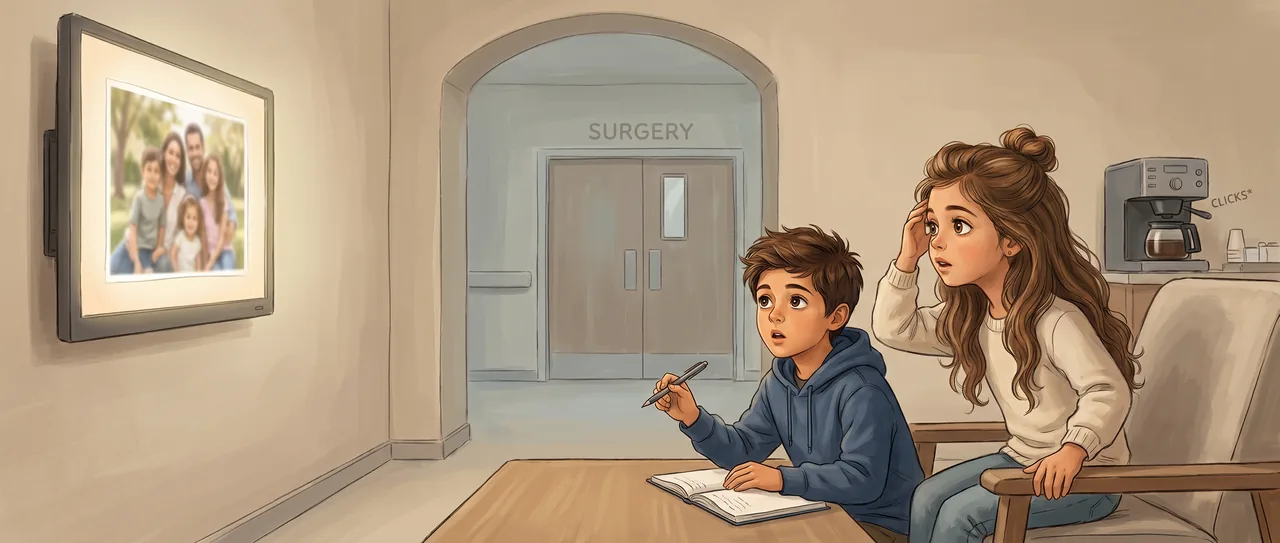
The lounge had a coffee machine that clicked but never poured, and a monitor on the wall showing a slideshow of the hospital's history. Maya had watched the same twelve photographs go around four times.
"He's awake," she said.
Soren looked up from his notebook. "Your uncle?"
"The nurse said. During the surgery. He's awake right now." Maya pointed at the closed doors down the hall, where her uncle Theo had gone in an hour ago to have something taken out of his head. "They're operating on his brain and he's talking to them."
"That's not possible."
"She said it twice. I made her say it twice."
Soren set the pen down. "They cut his skull open."
"Yes."
"And he's talking."
"She said he was naming animals when they wheeled past. A giraffe poster. He said giraffe."
Soren picked the pen back up, then put it down again. "Cutting into your body hurts. That's the whole point of hurting. It tells you stop, something is wrong."
"So they knocked out the hurting part."
"You can't knock out the hurting part and leave the talking part. They're both the brain." He frowned at the doors. "Unless."
"Unless what."
"Unless the brain doesn't feel it."
Maya turned from the slideshow. "Doesn't feel what."
"Being cut." Soren said it slowly, testing it like a stair he wasn't sure would hold. "Think about when you have a headache. Where does it hurt?"
"In my head."
"Where in your head?"
Maya put a hand up to her forehead, then moved it around. "Everywhere. Behind my eyes. Sort of."
"But the pain that tells you your finger is cut, that's in your finger. You feel it in the exact spot." He tapped the table. "A headache doesn't have a spot. It's like the whole head aches and you can't point to it."
"Because it's not the brain hurting." Maya was ahead of him now, sitting forward. "It's the stuff around the brain. The skin. The blood vessels. The muscle."
"The wrapping," Soren said.
"The wrapping hurts. The inside doesn't." Maya stood up because sitting had become impossible. "That's why he can be awake. They numb the wrapping. The scalp and the skull edges. And then once they're inside there's nothing left to hurt."
Soren was writing fast, the pen making its scratching sound. "That can't be right. The brain is the thing that does all the feeling. My finger only hurts because it sends a message up to the brain. The brain is where pain happens."
"So?"
"So how can the place where pain happens not feel its own pain?" He looked up, and there was something almost offended in his face, the way he got when a thing refused to make sense. "That's like the fire alarm being the one room in the building with no smoke detector."
Maya stopped. "Say that again."
"The fire alarm has no smoke detector in its own room."
"It doesn't need one." She was looking at nothing. "It's not there to save itself. It's there to hear about everything else."
A doctor in blue crossed the far end of the hall, and neither of them called out, because a question this size felt too big to hand to a stranger walking fast.
"The brain has no pain sensors," Maya said. "None. That's what it has to be. Everywhere else in you has them, skin, teeth, guts, all of it, little alarms. But the brain skipped them. It's the only part of you that can't feel itself being touched."
Soren stared at his own notebook. "You could put your finger right on it."
"You could."
"And it wouldn't know."
"It would know a lot of things. It just wouldn't know that."
They both went quiet. On the wall, the slideshow clicked to a photograph of the hospital in 1974, all beige and enormous.
"That's why they keep him awake," Soren said finally. "It's not a trick. It's not to be brave. It's because he's the only instrument that works."
"What do you mean."
"They're cutting near the part that makes words, right? Or the part that moves his hand. There's no line painted on the brain that says words start here. It all looks the same. Grey." He turned the pen over. "So how do they know where not to cut?"
Maya got there at the same instant, and the two of them said it almost together, half a beat apart.
"They ask him."
"They ask him," Soren said again, quieter. "They touch a spot and he talks. If the words stop, they know. If he can still say giraffe, they know it's safe. He's telling them where he is from the inside while they're in there."
"And it doesn't hurt him." Maya sat back down slowly. "Because the map doesn't hurt. Only the paper it's printed on."
Soren wrote one more line and then held the pen still above the page.
"Everyone thinks the scary part is being awake," he said. "But being awake is the safe part. Being awake is how they don't hurt the thing that makes him him."
Maya pressed her fingertips lightly against her own temple, not hard, just resting them there, feeling the warmth of her hand and the bone underneath and the quiet enormous thing beneath the bone that would never, not once in her whole life, be able to feel her doing it.
The doors at the end of the hall swung open. A nurse leaned through, found their faces, and smiled.
"He's asking for both of you," she said. "He wants to know if a giraffe really came up, or if he dreamed it."
Maya was already up. Soren closed the notebook on his thumb to keep the page.
Down the hall, through the second set of doors, someone was laughing, and the sound of it carried all the way to the clicking coffee machine that still had not poured.
Read the interactive version, listen to the narration, and earn a gold star →
A science-verified short story for curious kids · Curiosity Land