The Arm That Knew First
The corridor behind the tanks smelled like cold salt and bleach. Aunt Rue had gone to find a wrench, because the lid on tank nine kept getting nudged loose from the inside.
"She said don't put your hands near it," Soren said.
"I'm not," Maya said. Her hand was near it. "I'm watching."
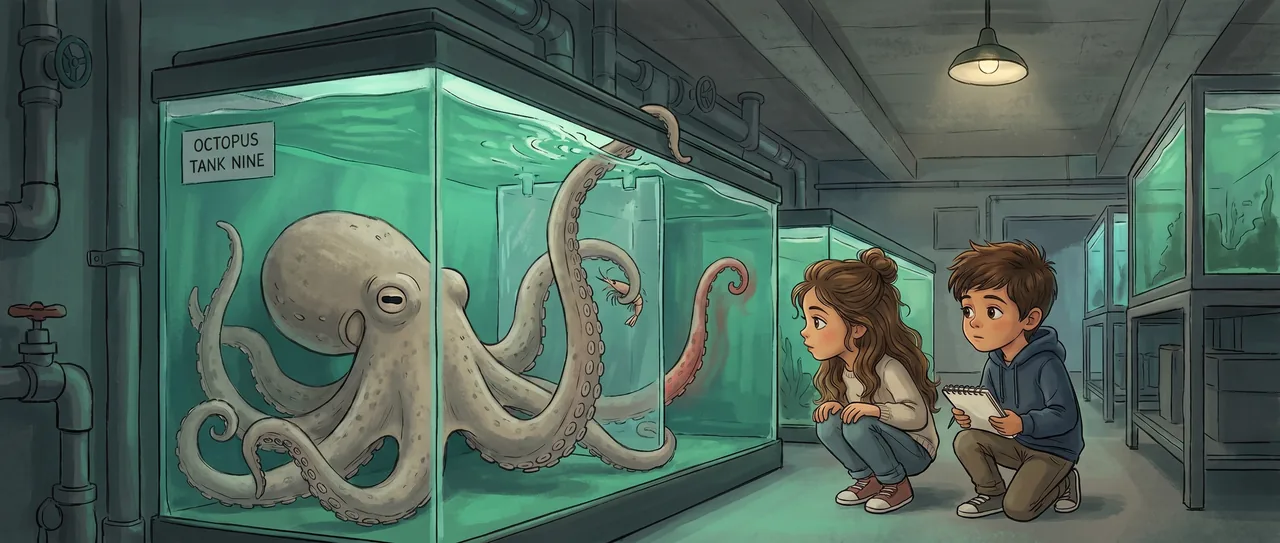
Inside tank nine, the octopus was the color of wet sand. Then it was the color of the pebbles. Then it flushed a fast red that rippled down one arm and stopped, like the arm changed its mind halfway.
"Did you see that?" Maya said. "One arm went red. The rest stayed gray."
"Maybe the light hit it different."
"No. It was one arm doing one thing." Maya crouched to tank level. "Watch the tip."
One arm-tip had curled up over the lip of the tank and was feeling along the rubber seal of the lid. Slow. Patient. The other seven arms were busy elsewhere, folding a shell, gripping the glass, doing nothing.
"It's not looking at its own arm," Soren said. He leaned in. "Its eyes are pointed at us. But that arm is working the lid."
"So how does the arm know where the gap is if the eyes aren't checking?"
Soren opened his notebook and drew a quick octopus, eight lines out from a blob. He crossed out two. "Okay. Guess time. I think the arm can feel the gap. Taste it, even. Doesn't need the eyes."
"Taste it," Maya repeated.
"Suckers. I read they can taste what they touch." He tapped the page. "So the arm touches, the arm tastes, the arm decides."
"Decides," Maya said, and went still. "You just said decides."
"I mean the brain decides."
"Which brain?"
Soren stopped drawing.
The arm-tip found the loose corner of the lid and pushed. The lid lifted a finger's width, then settled back. The octopus's eyes had not moved. They were still aimed flatly at the two children, dark and level, while down at the seal one single arm kept quietly working the problem by itself.
"Test it," Maya said. "Give it a thing to touch that its eyes can't see."
There was a food bucket of thawed shrimp by the wall. Soren fished one out and, keeping his fingers clear, set it on the flat rim of the tank behind a plastic feed-baffle, a spot the octopus could reach but could not look at from where its eyes were pointed.
They waited.
A different arm rose. Not the one at the lid. This one slid up the glass, went over the rim, and reached behind the baffle without any hesitation, without hunting, without the eyes ever swinging toward it. It touched the shrimp, wrapped it, and drew it down. The eyes stayed on the children the whole time.
"It didn't look," Soren said. His voice had gone quiet. "It never looked. The arm just knew."
"The arm knew before the middle part did." Maya pressed both hands to her knees. "Two jobs at once. The lid arm's still working the lid. This arm went and got dinner. Different arms, different plans."
"That can't be one brain running eight arms like puppets," Soren said. "It'd have to think about all of them at once. Nobody's that fast." He flipped to a clean page and wrote a number, then another. "What if the arms have their own. Their own thinking. Little brains, out in the arms."
"You just made that up."
"I did," he admitted. "But watch it and tell me I'm wrong."
Maya watched it. The lid arm pried. The shrimp arm ate. A third arm had started doing something new against the back glass, tapping in a slow pattern, and none of the three seemed to be waiting on the others.
"You're not wrong," she said slowly. "It's like eight people who all agree they're one animal."
Aunt Rue came back with the wrench and a coffee. "Told you not to feed her."
"We were testing something," Maya said. "Her arms don't need her eyes."
"Course they don't." Aunt Rue set the wrench down and looked, tired and fond, at the tank. "Most of her thinking cells aren't even up in her head. They're spread out. Down the arms." She sipped. "That's why you can't out-clever her at the lid. You're arguing with one brain. She's got the whole crew."
"How many," Soren said. "How many of the thinking cells are in the arms?"
"Most. Well over half. Read it on the sign out front." Aunt Rue was already crouching at the lid mechanism, done with the marvel of it, on to the wrench. "Also she's got three hearts and her blood's blue. Copper in it, not iron like ours. Turns blue when it carries oxygen."
"Blue blood," Maya said.
"Blue as ink." Aunt Rue tightened a bolt. "Now stand back, both of you."
Maya did not stand back. She was looking at the arm on the lid, and the arm with the shrimp, and the arm tapping the glass, three arms living three different minutes at the same time, all fed by three hearts pushing blue through a body that kept most of its mind out where the world was.
"Soren," she said. "When it reaches for something. Do you think it feels like reaching. Or does it feel like the arm just goes, and the middle finds out after."
Soren held very still with his pen above the page. "I don't know how you'd ever ask it."
"I know." Maya's voice had gone soft and fast at once. "That's the good part. Nobody knows what it's like to be that. Not even a little."
The octopus flushed a slow wave of color, gray to red to gray, that started at the tip of one arm and never reached the others. At the lid, the seal lifted a finger's width and eased back down. The eyes stayed on the children, dark and level, while somewhere down its own eight arms it went on making up its mind in ways it did not have to watch itself do.
Read the interactive version, listen to the narration, and earn a gold star →
A science-verified short story for curious kids · Curiosity Land