Four Colors and the Argument
The muralist was named Pell, and Pell was out of paint.
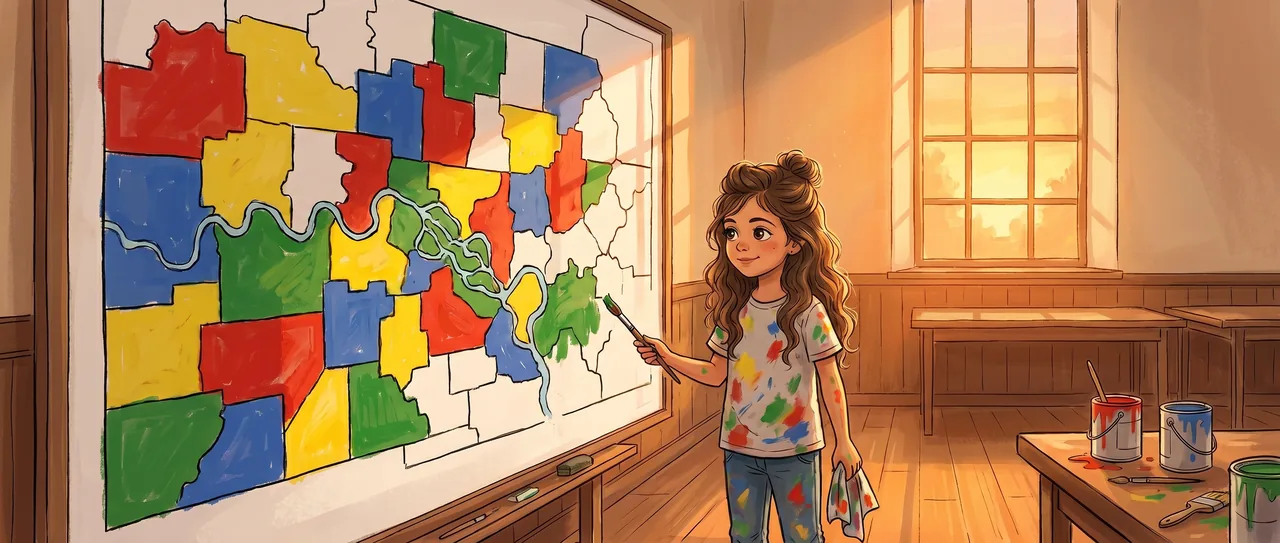
He stood in front of the mural with his hands in his hair. The mural was a map of the whole county, every township and parish outlined in black, forty-something little shapes fitted against each other like a cracked plate. Pell had painted six of them. He had ordered six colors. He had assumed, he said, that a map needed as many colors as there were shapes, more or less, and now he was staring at a wall of empty regions and a budget that was empty too.
"I'll have to reorder," he said. "Or leave half of it white. Maybe white is a color. Is white a color, do you think?"
Maya was supposed to be cleaning brushes. She stopped cleaning brushes.
"How many colors do you have left?"
"Four. Red, yellow, blue, green. But that's nowhere near enough for a map this size."
Maya looked at the wall. She had a feeling before she had a reason, the way she always did, a small tightness in her chest that meant something here was smaller than everyone thought.
"Four is enough," she said.
Pell laughed, not unkindly. "There are forty-one regions."
"Doesn't matter how many. Watch."
She didn't actually know it wouldn't matter. She only felt it. She picked up the red and started at the corner, filling one township. Yellow next to it. Then a shape that touched both red and yellow, so, blue. She worked outward. The rule was simple and mean: no two regions that shared a border could be the same color. Touching at a single corner didn't count. Only a shared edge.
For a while it was easy. Then she hit a knot near the river where five townships crowded together, and she painted herself into trouble. A region that touched red, yellow, and blue, and next to it another that touched red, yellow, and green, and she was one color short, staring at a shape that seemed to demand a fifth.
"See," said Pell, gently. "You need a fifth there."
"No." Maya scrubbed the blue back out with a rag before it dried. "I put the blue in the wrong place three shapes ago. Back there. Not here."
She went back three shapes. She swapped a blue for a green far from the crowded knot, where it had room to be either. Then she came forward again, and the knot at the river opened up, and the impossible fifth-color shape took blue without complaint.
Pell stopped laughing.
Maya kept going. Every time she got stuck, the stuck place was never the real problem. The real problem was always some choice she had made earlier, somewhere with more room, and if she went back and loosened it, the tight place came free. Forty-one regions. Red, yellow, blue, green. She used the rag more than the brush.
When she finished, the whole county was colored and Pell had not opened his wallet.
"That can't be luck," Pell said. "Do it again. Different colors."
She did it again, starting from a different corner. It worked again. It felt like the map was on her side, like the shapes wanted to be four things and not five, like there was a law under the black lines that Pell had never been told about.
"Why four," she said. Not to Pell. To the wall.
Pell shrugged. "You tell me. You're the one doing it."
And that was the tightness in her chest again, because she could do it, forty-one times, but she could not tell him it would always work, for every map anyone could ever draw, real or invented, with ten thousand shapes or ten million. She had a feeling. A feeling was not the same as knowing.
After, she went to the library and looked it up, because the feeling would not leave her alone.
It was true. It was a theorem. Any map, flat, any map at all, four colors, always, no matter how tangled. People had guessed it for over a hundred years and could not prove it, because you cannot check every possible map by hand. There are infinitely many maps. You cannot paint infinity.
What two mathematicians finally did, in 1976, was prove that every possible map was really just some combination of a fixed pile of tricky arrangements, about a thousand and a half of them, and that each one of those could be handled. But a thousand and a half was too many to check by hand without mistakes. So they gave the checking to a computer, and the computer chewed through all of them and said: yes. Every one. Four colors.
And here was the part that made Maya sit up in the hard library chair.
Some mathematicians had been angry. Not because they thought the answer was wrong. Because no single human being had held the whole proof in their head. The computer had done a part no person could sit and read in one lifetime. They asked: if nobody can check it all themselves, is it really proved? Do we know it, or does the machine know it for us?
Maya read that twice.
She had painted forty-one regions and felt certain. The mathematicians had a machine that checked a thousand and a half and some of them still did not feel certain. The gap between doing a thing and knowing why it always works was not a small gap. It was the whole argument. Grown people who had spent their lives on this were still standing on opposite sides of it, and nobody had decided who was right.
She had thought math was the place where things were finally settled. She had thought it was the one wall you could lean on.
Maya walked back to the church hall as the light went orange. Pell had gone home. The mural glowed on the wall, forty-one shapes, four colors, no two touching alike, a thing that was true and that she could not fully explain and that the smartest people in the world were still arguing about.
She picked up a dry brush and dabbed it, once, into the empty air where a fifth color would have gone, and painted nothing.
Read the interactive version, listen to the narration, and earn a gold star →
A science-verified short story for curious kids · Curiosity Land