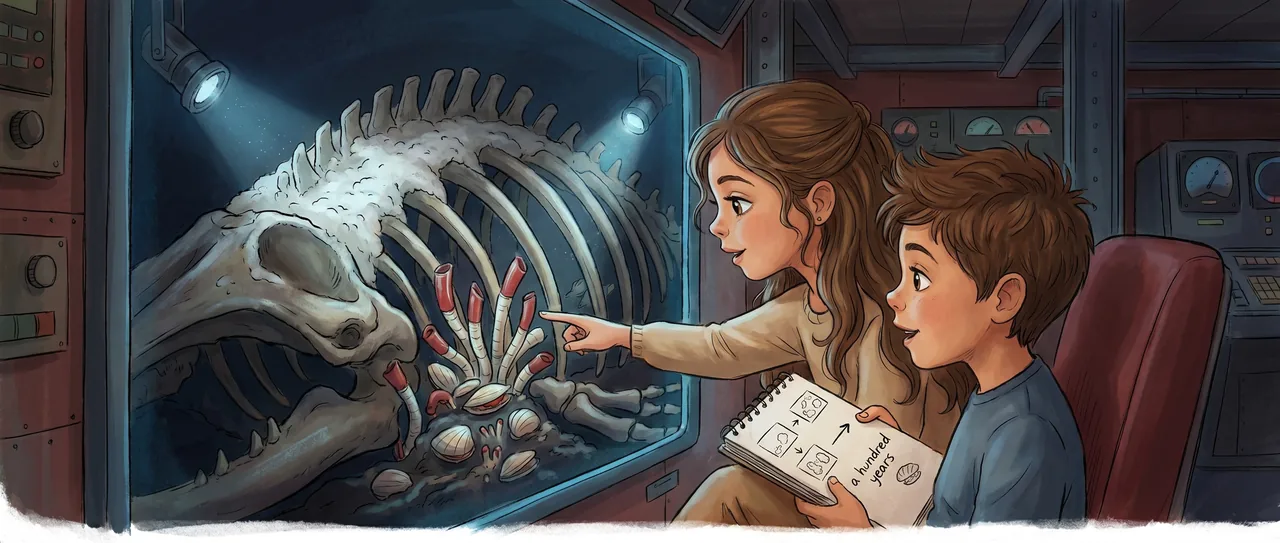
The Whale That Kept Going
The scientists had gone up to dinner and left the screen running.
"They said it's dead," Maya said. "They kept saying it's dead."
"It is dead." Soren scrolled the timeline at the bottom of the footage. Ten years of it, filmed by a robot that visited the same spot on the seafloor over and over. "That's the whole point. It sank in twenty-fourteen. This is the same whale, ten years later."
On screen, a shape lay in the dark, two miles down, lit by the robot's lamps. It did not look like a whale anymore. It looked like a long pale reef with a jaw.
"Play the beginning," Maya said.
He dragged the slider all the way left. The whale appeared whole, huge, gray, settled into the mud like a fallen building. And it was covered. Covered in moving things.
"Sharks," Soren said. "Sleeper sharks. And those pink ones are hagfish." He leaned in. "They found it fast. Two miles down, no light, and they found it in days."
"How."
"Smell, mostly. The whole ocean floor is empty. Then suddenly there's a mountain of food. Everything that can smell comes."
Maya watched the hagfish pour into the body like water finding a drain. "Okay. So they eat it. Then it's gone."
"Skip forward."
She dragged the slider. The screen jumped a year. The big scavengers were gone. The whale was bones now, mostly, a white cage lying in the mud. But the mud around it had changed color.
"That's wrong," Maya said. "The ground's the wrong color."
"That's a different set of animals." Soren checked the little labels the scientists had left in the file. "Worms. Snails. Crustaceans. They're not eating the whale. They're eating the mud the whale soaked into. All the fat and stuff dripped down into the sediment and now there's a whole crowd living in the dirt around it."
"So the whale fed one group. Then it fed a totally different group."
"Different group that didn't even want the meat. They wanted the leftovers in the ground."
Maya was quiet. Then she said, "Skip again."
Another year. The bones were still there. But something white and fuzzy was growing on them, spreading across the ribs like frost.
"Is that mold," Maya said. "Two miles under the ocean?"
"Bacteria." Soren read, then read again to be sure. "They're breaking into the bones. Whale bones are full of fat. The bacteria crack the bones open and pull the fat out and turn it into"—he paused—"chemicals. Sulfur chemicals. That white stuff is a whole carpet of bacteria eating a skeleton."
"That's the last part, then."
"No." Soren pointed. "Look what's living on the bacteria."
Maya looked. Around the white carpet, clinging to the bones, were things she had no name for. Pale clams packed into the crevices. Tube worms with red tips. Small mouths and stalks she couldn't identify.
"Those animals aren't eating the whale," Soren said slowly. "The whale's basically gone. They're eating the bacteria. Or living off what the bacteria make. There's a whole town on a skeleton, and it runs on chemicals coming out of the bones."
"How long does that part last?"
He checked. He read the number twice. Then he said it out loud, carefully.
"They think up to a hundred years."
Maya turned to look at him.
"A hundred years," he said again. "One whale. The chemical part alone can go a hundred years."
Neither of them said anything. The robot's lamps swept slow across the bones on the screen.
"Play it all the way through," Maya said. "Fast. All ten years at once."
Soren set it running at speed. And they watched a whale become four different worlds without ever leaving the same patch of mud. First the swarm of scavengers, thick and fast, gone in a flicker. Then the mud lighting up with worms, a slow bloom around the bones. Then the white carpet climbing the ribs. Then the clams, the tube worms, the town that ran on sulfur, settling in like they meant to stay a century.
"It's not dying," Maya said. "That's the thing they kept getting wrong. Upstairs. They said it's a dead whale."
"It is a dead whale."
"But watch it." She put her finger on the screen, on the white bones, on the red-tipped worms breathing there in the dark. "The whale doesn't stop. It just keeps handing itself to different animals. One group finishes and the next group is already moving in. It's like a relay. The whale's the baton."
Soren pulled his notebook out of his jacket and opened it on his knee. He drew four boxes and an arrow through all of them. Over the last box he wrote a hundred years and drew a small clam.
"Some of these animals," he said, still writing, "live nowhere else. That's what the label says. There are species that only live on dead whales. Nowhere in the whole ocean except on a sunk whale, two miles down, in the dark."
Maya sat back. "So how do they get from one whale to the next one? If a whale only sinks here every, what, hundred years, how does a clam that only lives on dead whales find the next dead whale?"
Soren stopped writing.
"That's," he said.
"That's a real question," Maya said. "That's not a small question."
"No." He looked at the screen. "The next whale could sink a hundred miles away. The clams here will die when the bones run out. And somehow their babies have to find a whale that hasn't died yet. That nobody knows will die."
"So either they can smell one from a hundred miles."
"Or there are more dead whales down there than anyone thinks," Soren said. "Enough that there's always one close. A whole trail of them. Stepping stones across the whole ocean floor. Dead whales all the way across, close enough to hop between."
They looked at each other.
"Nobody's counted," Maya said. It wasn't a question.
"Nobody's counted."
On the screen the ten years finished and looped back to the start. The whole whale again, gray and enormous, sinking into the empty floor. And out of the dark, before it had even landed, the first pale shapes were already coming, from somewhere, from something they had smelled across all that water.
Soren reached up and paused it there, on the empty ocean just starting to arrive.
Read the interactive version, listen to the narration, and earn a gold star →
A science-verified short story for curious kids · Curiosity Land