The Same Book, Different Page
The touchscreen had frozen on a spinning cell, so Maya poked it three more times and gave up.
"It's dead," she said. "But the video's still going."
On the wall above them, a looping film showed a skin cell, flat and boring, and then a beating heart cell, and then a nerve cell reaching out long fingers. A voice said each one came from the same person. Then the loop restarted.
Soren was reading the little card beside the dead screen. "Same person means same DNA," he said. "Every cell in your body has the same DNA. Your skin, your brain, your heart. All the same instructions."
Maya turned around slowly. "That can't be right."
"It's right. It's on the card."
"No, I believe the card. I mean it can't be right, like, it doesn't make sense." She held up two fingers. "A skin cell and a brain cell have the same instructions. But they do completely different jobs. Completely."
"Yeah," said Soren.
"So how does a cell know which one to be?"
Soren looked at the frozen screen like it owed him an answer. "Something's different between them. Has to be. If it's not the DNA, then what."
Maya started walking along the exhibit wall. There were framed panels, and she read them fast, the way she read everything, skipping the parts that felt like decoration.
"Here," she said. "It's a book."
"What's a book."
"The DNA. It says imagine your DNA is a book with every recipe in it. Skin recipe, blood recipe, heart recipe. Every cell has the whole book." She tapped the glass. "But a cell only reads some pages. A skin cell keeps the skin pages open and the rest shut."
Soren came over. He had his notebook out and was copying the word expression off the panel.
"So they're not different cells," he said slowly. "They're the same book. Turned to different pages."
"Yes." Maya's eyes were very bright. "Yes, that's it. The cell isn't what it's made of. It's what it's reading."
They stood with that for a second. Down the hall a museum guide was explaining fossils to a group of little kids in matching shirts. Nobody was watching the broken station but them.
"Okay but wait," Soren said. "If it's just pages, and the whole book is still in there." He stopped writing. "Then you could turn back."
Maya spun toward him.
"Say that again."
"A skin cell shut all its other pages. But it didn't tear them out. They're still in the book." He was talking faster now . "So if you could reach in and turn the pages back to the beginning. Before it decided to be skin."
"It wouldn't be skin anymore."
"It would be whatever it was before it was anything."
They both looked at the wall. The video had reached the part where the flat skin cell sat there doing nothing interesting.
Maya walked to the next panel, and then she made a small noise, the kind she made when a thing she'd invented in her head turned out to be already true.
"Soren."
"What."
"They did it."
He came and read over her shoulder.
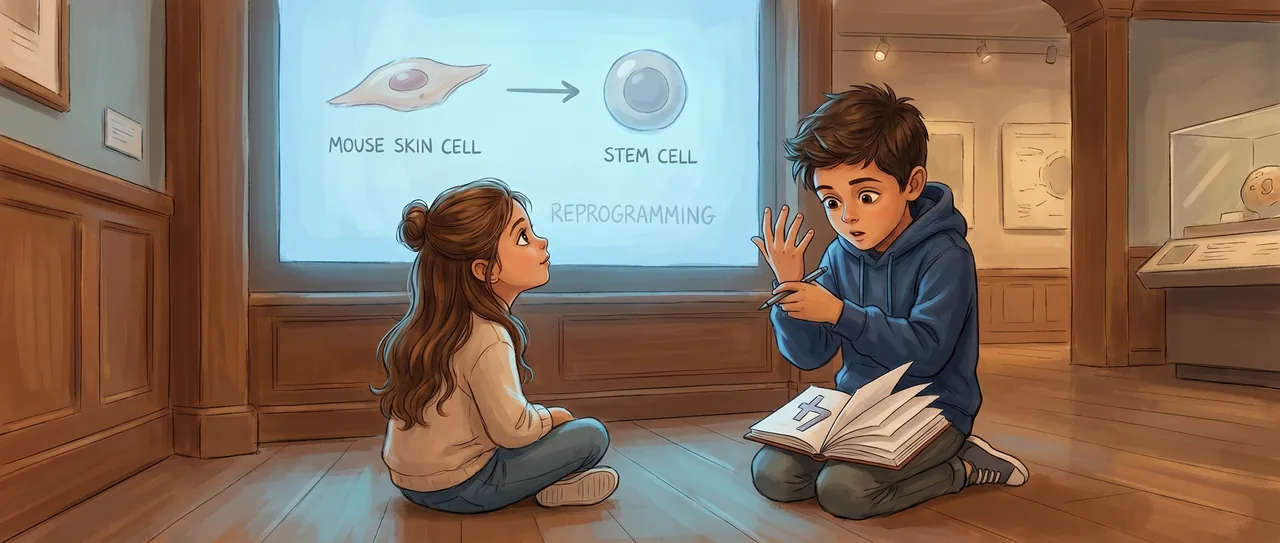
The panel said that in two thousand six, a scientist took ordinary skin cells from an adult mouse. He didn't add new DNA. He didn't cut anything out. He switched four genes back on, four master pages, and the skin cell forgot it was skin. It rolled all the way back to a stem cell, the kind of blank beginning cell that could become anything. Heart. Nerve. Blood. Bone.
Four.
"Four genes," Maya said. "That's all it took. Four."
"From skin," Soren said. He read it twice to be sure. "An adult skin cell. Something that already decided its whole life what it was going to be. And it went back."
Maya sat down right there on the floor in front of the panel, which the guide would probably not have allowed, but the guide was busy with fossils.
"Everybody thought it was one direction," she said. "You start blank and then you become a thing and that's it. That's you. Skin forever."
"And it isn't," said Soren.
"It isn't. The instructions to be anything else were sitting inside the skin the whole time. Just closed." She looked up at him. "Every skin cell on your arm right now is holding the recipe for a heart. It's just not reading it."
Soren stopped. He looked at the back of his own hand for a long moment, at the ordinary skin there, the knuckles, the pale hairs.
"That's a lot to be holding," he said quietly.
Maya was still going, half to herself. "So when a person can't grow something back. A nerve, or a piece of an organ. It's not that the cells don't know how. They know how. They've always known how. Somebody just has to help them turn to the right page."
"And somebody figured out four of them," Soren said. "Four out of the whole book."
"Which means there's more." Maya was on her feet again. "There has to be. If four genes turn skin all the way back to blank, then somewhere there's a set of pages that turns blank straight into heart. Or straight into the exact cells somebody needs. Nobody's found all of them yet."
"Nobody's read the whole book," Soren said.
They looked at each other.
The frozen screen behind them suddenly unfroze, the spinning cell resuming its slow turn as if nothing had ever been wrong with it, ready to show its whole loop again to no one.
Maya didn't even glance at it. She was pressing Soren's pen back into his hand.
"Write down four," she said. "Then write down the number that comes after nobody knows."
Soren opened the notebook on his knee and wrote the number four, and beside it drew a book with its pages fanned open, and left the last page blank.
Read the interactive version, listen to the narration, and earn a gold star →
A science-verified short story for curious kids · Curiosity Land