The Galaxy That Isn't There
The last car crunched out of the gravel lot, and the observatory got very quiet. Only three people were left in the control room: Maya, Soren, and Dr. Okafor, who was rubbing her eyes and closing windows on a screen full of numbers.
"You two can wait inside until your dad gets here," she said. "Don't touch the red buttons. There are no red buttons. Don't touch anything."
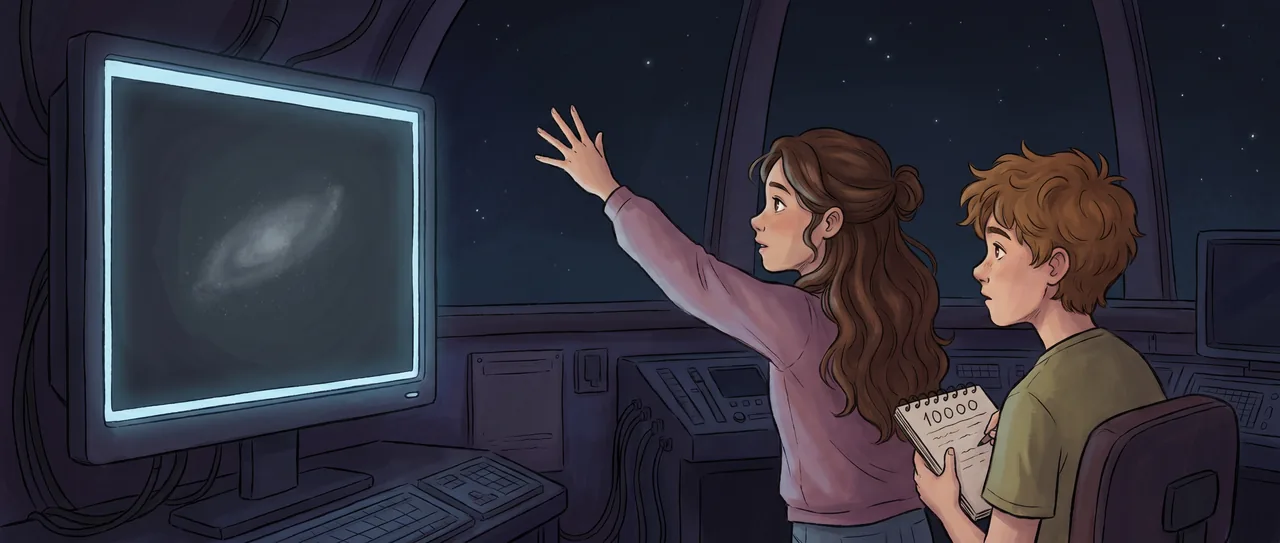
On the biggest monitor there was a smear of faint light. Not a bright spiral. Not a photo from a poster. Just a soft gray blur, like a thumbprint on a dark window.
"What's that one?" Maya asked.
"Dragonfly forty-four," Dr. Okafor said, not really looking. "Failed galaxy, some people call it. Barely any stars. We almost didn't count it."
Maya leaned closer. Soren pulled out his notebook and copied the shape of the blur, the way you'd sketch a cloud before it changed.
"It's dim because it's far," Soren said.
"It's dim because it's nearly empty," Dr. Okafor said. "Hardly any stars at all. Should have fallen apart a long time ago." She yawned. "Anyway. Numbers are backing up. Give me ten minutes."
She turned to another screen and stopped talking, which was its own kind of answer.
Maya stared at the blur. "If it's almost empty," she said slowly, "it shouldn't hold together."
"Why not," said Soren, who liked to make her say the middle part.
"Because the stars move. Right? Everything in a galaxy is falling around the middle." Maya circled her finger over the screen. "If there's barely anything there, there's barely any pull. So the stars should just wander off. Slow ones drift away."
"So it should be coming apart," Soren said.
"But it isn't. It's a ball. It's a whole round thing." Maya sat back. "That doesn't fit."
Soren looked at the numbers running down the side of the screen. He didn't understand most of them, but he understood one column, because Dr. Okafor had explained it to a room full of grownups an hour ago. It was how fast the stars in a galaxy were moving.
"The stars in that one are going fast," he said. "She said the fast ones need a lot of pull to stay. A slow galaxy holds slow stars. A fast galaxy needs to be heavy."
"So it's heavy," Maya said.
"But it's almost empty."
They both looked at the blur.
"Okay," Maya said. "Two things are true and they don't match. It's almost empty. And it's heavy enough to keep fast stars from flying off. Those can't both be true."
"Unless," Soren said, and stopped.
He wrote a number in his notebook, then crossed it out. He wrote another one.
"Dr. Okafor," he said. "How much of that galaxy is stars? Like, out of all its weight."
Dr. Okafor didn't turn around. "Round number? About one part in ten thousand."
Soren went still. He looked at the one and the four zeros he had written.
"One part in ten thousand," he said to Maya. "That's everything you can see. Every star. All the light. That's the whole part that's actually there."
"And the rest?" Maya said.
"The rest is the heavy part," Soren said. "The part doing the holding."
Maya was quiet. She put her hand near the screen but not on it, hovering over the gray smear like you'd hold your palm near something warm to check.
"So the stars," she said. "The light. That's not the galaxy."
"That's the decoration," Soren said.
"That's the sparkles on top," Maya said. "The galaxy is the thing underneath. The thing that weighs almost all of it. And we can't see any of it."
Dr. Okafor turned around now. She had the look of someone deciding whether to say the true thing or the easy thing.
"We can't see it with any telescope we have," she said. "Not this one. Not the big ones. Not the ones in space. It doesn't glow. It doesn't block light. It doesn't bounce light. We only know it's there because of the pull." She tapped the fast-moving column. "The stars tell on it. They move like something huge is holding them, so something huge is holding them. We just can't point at it."
"What is it?" Maya asked.
"That," said Dr. Okafor, "is the actual question. That's the whole question. There are very smart people who have spent their whole lives on it, and the honest answer is we do not know what it is made of." She almost smiled. "We named it so it would feel less embarrassing. We call it dark matter. Naming a thing isn't the same as knowing it."
"So that blur," Soren said, pointing. "Almost all of it is a kind of stuff nobody has ever figured out."
"Almost all of it," she said. "And here's the part that keeps me up. It's not just that galaxy."
Maya's head came up.
"Say it," Maya said.
"Most of the matter in the whole universe is the stuff we can't see," Dr. Okafor said. "The stars, the planets, you, me, this building, every glowing thing in every telescope picture ever taken. Add all of it up. It's the small part. It's the sparkles on top of everything."
She went back to her packing like she hadn't just turned the room inside out.
Soren looked down at his notebook, at the one and the four zeros, and understood that he had been drawing the wrong thing all night. He'd been sketching the light. The light was the part that didn't matter much.
Maya wasn't looking at the screen anymore. She was looking at Soren, and then at her own hand, and then at the dark window of the control room where the parking lot lights had switched off and the real dark started.
"There's more of it in here," she said. "Right now. Isn't there. Going through the room."
"Passing through us," Soren said. "Probably. She said it doesn't touch anything much."
"Passing through us," Maya repeated, testing it, and held her open hand up into the empty air between them, fingers spread, as if she might feel a whole invisible galaxy going by.
Outside the window, the stars came out over the hills, the thin bright skin of a universe that was almost entirely something else.
Read the interactive version, listen to the narration, and earn a gold star →
A science-verified short story for curious kids · Curiosity Land