The Crack That Closed Itself
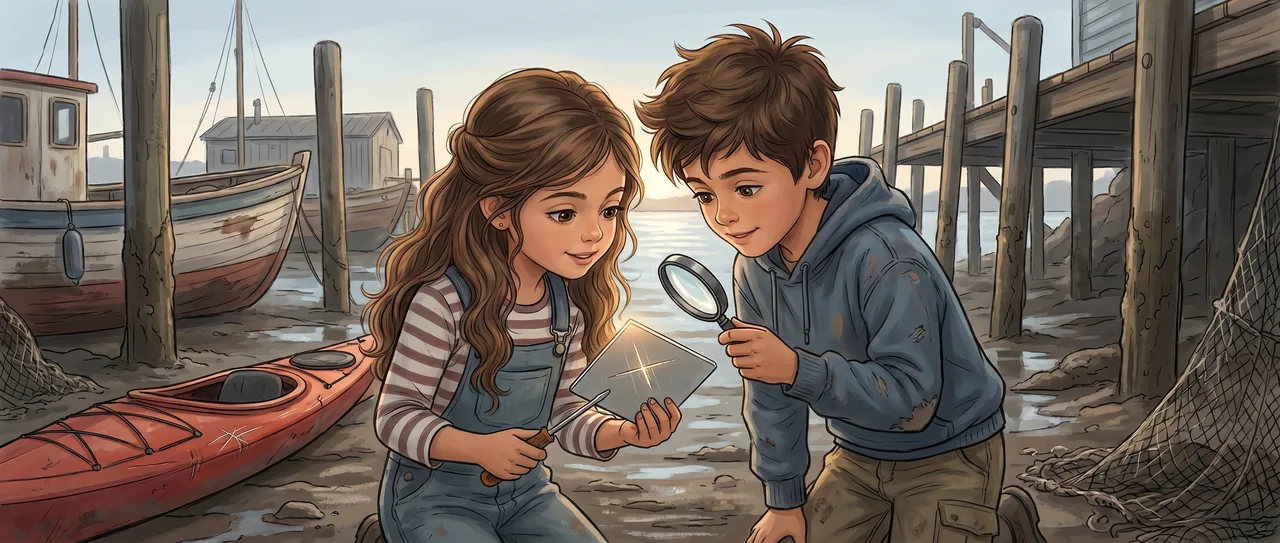
The kayak had a scratch across its belly, and the tide had gone out far enough to leave the whole boatyard smelling of salt and diesel and warm mud.
"Hold it steady," Soren said. He was dragging a screwdriver tip along the old scratch to clean out the grit.
"You're making it worse," Maya said.
"I'm making it clean. There's a difference."
The repair worker, a woman named Priya with paint on her forearms, had told them they could use any of the patch samples in the blue crate as long as they logged what they took. She'd said it fast, on her way to a phone call, and hadn't come back.
Maya was already digging through the crate. Little squares of coated plastic, each one labeled with a number in marker. Most were boring gray. One was labeled with a star instead of a number.
"This one," she said.
"That one's not a number."
"Which is why it's the interesting one."
She scratched the star sample with the screwdriver, a real scratch, deep, the kind that would make you wince if it were a car.
"Maya. She said log it, not wreck it."
"Watch the scratch," Maya said.
They both leaned in. The scratch sat there, a pale line in the coating.
"It's a scratch," Soren said. "It's doing scratch things."
"Give it a minute."
They gave it a minute. Gulls argued somewhere over the mudflats. And the line, the pale sharp line, went soft at the edges. Something was seeping into it. Not from outside. From inside the coating, filling the groove like water finding the low place in a road.
Soren stopped talking.
He picked up the sample and turned it toward the light. Where the scratch had been there was now a faint healed seam, glossy, slightly raised, like the skin over a cut that has decided to close.
"Do it again," he said.
"You do it."
He scratched a fresh line, lower down on the same square. Same wince-worthy depth. They watched. Same thing. The groove darkened, filled, went smooth.
"Okay," Soren said slowly. "Where is the stuff coming from."
"Inside."
"Inside where? It's a flat piece of plastic. It's not bleeding. There's no tank."
Maya took the sample back and held it very close to her eye, tilting it.
"It's not smooth," she said. "Under the shine. It's got little dots in it. Tiny ones. Everywhere."
Soren found a hand lens in his pocket, the one he never admitted to carrying, and looked.
The coating was full of bubbles. Thousands of them, so small they were almost a texture instead of shapes. Round little pockets suspended all through the plastic like seeds in bread.
"They're capsules," he said. "Little sealed capsules. Full of something."
"And when you scratch it," Maya said.
"You break the ones along the scratch."
"And they spill."
"Into the crack. Exactly into the crack. Because that's where you broke them." He sat back on his heels. "That's the whole trick. You don't have to aim the glue. The crack aims it. Wherever the damage is, that's exactly where the capsules pop, so that's exactly where the healing goes."
Maya was quiet, turning the square over.
"It can't be everywhere," she said. "There's only so many capsules. If you scratch the same spot twice."
She scratched the first healed seam again, right along the old line.
They watched.
The groove stayed. A thin fresh cut, this time, with nothing rising to fill it.
"It didn't heal," Soren said.
"Because I already used up the capsules there. The first scratch popped them. Now that spot's got nothing left." She looked up. "It heals once. Every place heals once."
Soren pulled out his notebook. He drew a square, then filled it with dots, then drew a line through it and crossed out the dots the line touched.
"So it's not like it's alive," he said. "A cut on your arm, your body brings new stuff, forever. This is more like it came pre-loaded. A whole coating full of tiny first-aid kits, one use each, waiting."
"Waiting for a crack that might never come," Maya said.
"Right up until it does."
Maya went still. "That's why they scatter them everywhere. They don't know where it's going to break. Nobody knows. So you put a repair in every single spot, ahead of time, just in case." She held the square up between them. "The whole thing is prepared for damage it can't predict."
Soren looked at the crate. All those gray numbered squares. Boring, he'd thought. Now he wondered how many of them had cracks already healed inside, invisible, seams he'd never see because they'd sealed themselves before anyone came to look.
"There could be cracks in this that already happened," he said. "And closed. And we'd never know."
"That's the point," Maya said. "You're not supposed to know."
They sat with that. The tide was starting to think about coming back, the mud beginning to shine at its far edge.
"They got the idea from us," Soren said. "From skin. From how a cut closes. Somebody looked at a scab and thought, what if plastic could do that."
"Somebody who wouldn't leave the scab alone," Maya said.
"Somebody like you."
"Somebody like us."
Soren looked back down at the kayak, at its old dumb scratch that would stay a scratch forever because it was ordinary plastic with no help waiting inside.
He took the star sample and pressed it flat against the kayak's scratch, lining up the healed seam over the broken one, as if the two lines could see each other.
Maya took the screwdriver and, very lightly, drew one more line across a fresh corner of the star sample. Then they both stopped talking and watched the plastic quietly pull itself back together.
Read the interactive version, listen to the narration, and earn a gold star →
A science-verified short story for curious kids · Curiosity Land