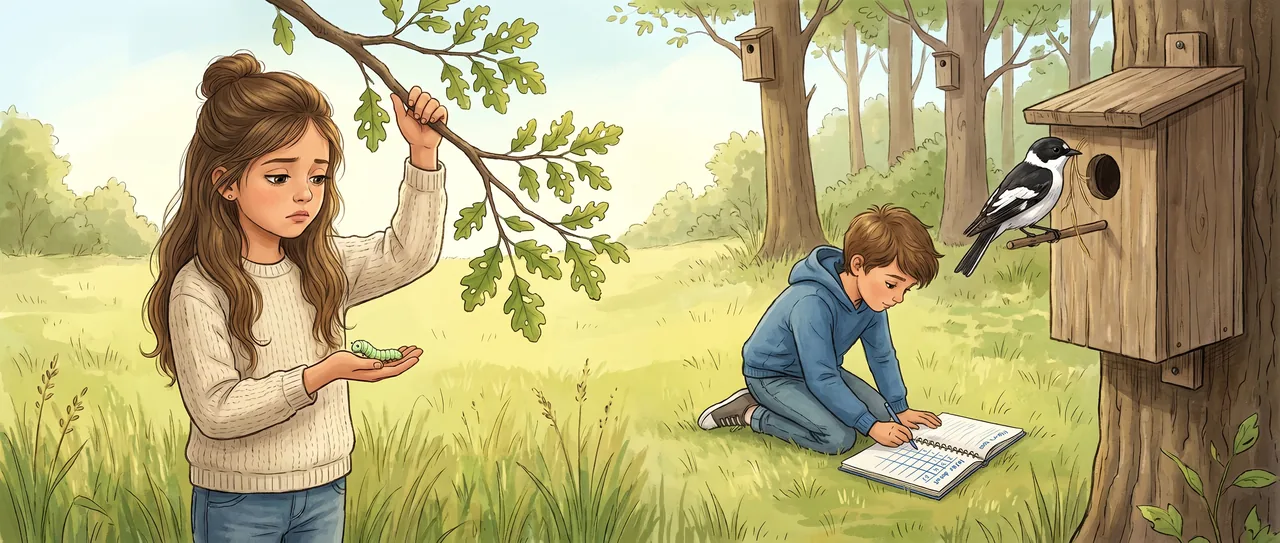
The Wrong Week
Mrs. Okafor had kept a chart on her kitchen wall for forty-one years. When she died in February, her daughter didn't want it, so she gave it to Maya and Soren along with the four nest boxes from the woods behind the house.
The chart was just columns of dates. First leaf. First caterpillar. First bird back. First egg. Four columns, forty-one rows, written in four different pens as the pens ran out over the decades.
Soren copied it into his notebook that same night, line by line, because the paper Mrs. Okafor had used was going soft at the folds and he didn't trust it to last.
"Look at the leaf column," Maya said. She was standing on a chair to see the top rows.
"It's getting earlier."
"It's getting a lot earlier." She ran her finger down. "April twelfth. April tenth. Then it just keeps walking up the page. This year it's March twenty-ninth."
Soren checked his numbers against hers. The first leaf had moved almost two weeks earlier across the forty-one years. The first caterpillar had moved with it, close behind, like something tied to the leaf by a string.
But the bird column had barely moved at all.
"That's the pied flycatchers," Maya said. "She wrote it in the margin. They come from Africa."
They went out to the boxes the next morning. Two had flycatcher pairs already, chittering, carrying nothing yet. The woods were loud with the sound of birds who had crossed a whole ocean to be exactly here.
Maya stood very still under the oak. Then she reached up and pulled a low branch down to eye level.
The new leaves were already chewed. Little windows eaten out of them, edges brown and healing.
"The caterpillars already came," she said. "They're already big."
Soren pulled down his own branch. Same thing. He found one caterpillar, fat and pale green, and it was enormous, nearly ready to stop being a caterpillar at all.
"So there's food," he said. "There's tons of food. That's good."
Maya didn't answer right away. She was looking at the box, and then at the chewed leaves, and then back at the box.
"The birds just got here," she said. "They haven't even laid eggs."
"Okay."
"So they lay eggs this week. Then the eggs take two weeks. Then the babies hatch." She counted it on her fingers, then stopped counting because her fingers had run out of caterpillar. "By the time the babies are hungry, these are all gone. They'll be moths."
Soren looked at the fat caterpillar in his palm. He tried to argue with her. He wanted to, because what she was saying was ugly and he did not like it.
"They could eat other stuff," he said.
"Baby flycatchers eat caterpillars. She wrote that too. In the margin. Underlined."
He checked the notebook. She was right. Underlined twice.
They went back to the chart. Soren laid his notebook copy on the grass and they knelt over it, and this time they read it as two things at once. The leaf line and the caterpillar line, sliding earlier year after year, arm in arm. And beside them the bird line, holding still, because a bird in Africa in February cannot feel that a wood in another country has warmed up early. It has no way to know. It leaves on the day the African light tells it to leave.
"They're not late," Soren said slowly. "That's the thing. They're on time. They're doing exactly what they always did."
"But on time used to be right." Maya sat back on her heels. "On time and right came apart."
He wrote that down. On time and right came apart. He didn't know yet where to put it, so he put it on the page.
They looked at the last rows of the chart, the ones in Mrs. Okafor's final pen, thin blue. The egg column. The number of eggs. It got smaller near the bottom. Six. Five. Then a year with two. Then a year she wrote a zero and next to the zero, small, she had written the word empty.
"She saw it," Maya said. "She watched it happen for forty-one years and she saw it and she just kept writing the dates."
"Maybe she didn't know why."
"She knew." Maya touched the zero. "You don't underline caterpillars twice if you don't know."
They sat with that. A flycatcher landed on the nearest box and looked at them, black and white and completely certain, a bird that had flown four thousand miles on perfect instructions to arrive one week after the food was gone. It had done everything right. Everything it was built to do, it had done.
Soren felt the size of that. Not one bird making a mistake. A whole living clock that used to keep time with another clock, and now the two clocks were drifting apart a little more every spring, and neither clock could see the other, and neither clock was wrong.
"We can't tell them," Maya said quietly. "That's the part. There's nobody to tell. The bird can't know. The leaf can't know. We're the only ones standing here who can see both columns at the same time."
Soren looked down at the chart, at forty-one years of one woman standing in this exact yard, holding both columns in her head, the only creature in the whole wood who could.
He understood why she never threw it away.
"We could keep filling it," he said.
Maya looked at him.
"The chart. We know where the boxes are. We know how to read leaves." He turned to a clean page. "Somebody has to be the one who can see both columns."
Maya stood up. She pulled the low branch down one more time and counted the caterpillars on it, out loud, slow, so he could write the number.
"Eleven," she said. "March thirtieth. Eleven, and already this big."
Soren wrote March thirtieth, and the number, and started a new column beside Mrs. Okafor's last one, in his own pen, the fifth pen now.
Above them the flycatcher carried a single strand of dry grass into the box and disappeared inside, beginning, right on schedule, the nest for eggs that would hatch into the empty week.
Read the interactive version, listen to the narration, and earn a gold star →
A science-verified short story for curious kids · Curiosity Land