The Wrong Way Round
Maya's cousin Deo had said it during dinner, in the flat voice he used for facts.
"Hot water freezes faster than cold."
Maya put her fork down. "That's backwards."
"It's true. A kid figured it out. In Tanzania, where my mom's from. He was making ice cream."
"Making it doesn't make it true."
Deo shrugged, which was worse than arguing. He went back to his food and left the whole thing sitting on the table like a dare.
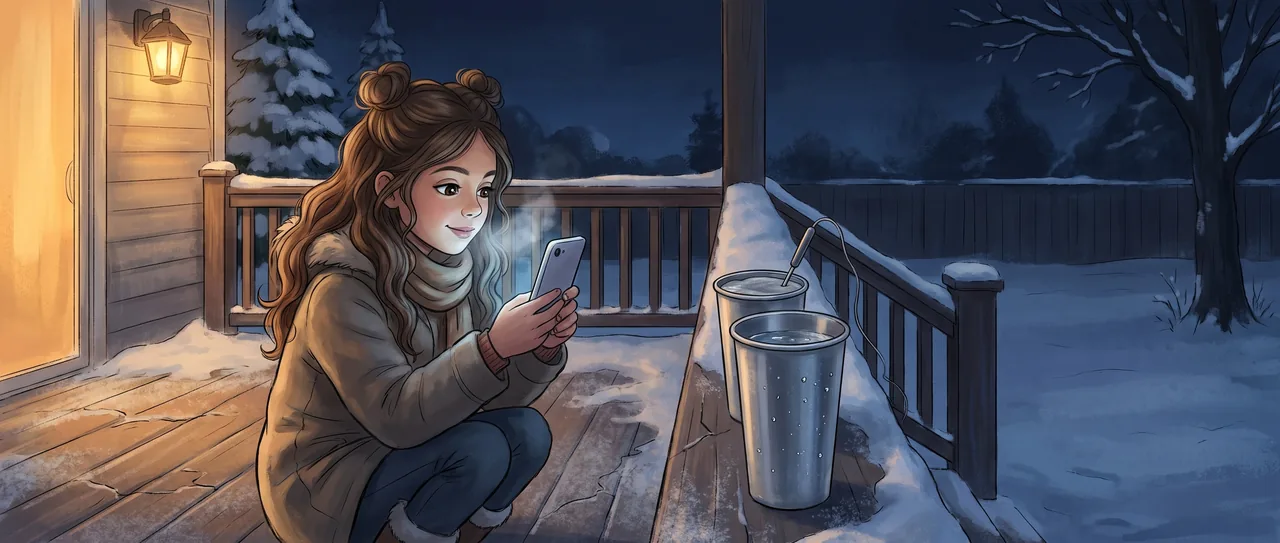
So now it was after dinner and dark and cold enough that the deck boards cracked when she stepped on them, and Maya was setting up an experiment to prove her cousin wrong.
She had two identical steel cups. She had the meat thermometer from the kitchen drawer, the one with the long probe. Into one cup she poured water straight from the cold tap. Into the other she poured water she had boiled and let stop steaming, still hot enough to fog the metal.
Her plan was simple. Cold starts closer to freezing. Cold has less distance to fall. Cold wins. She would take a picture of the cold cup freezing first and send it to Deo and that would be the end of it.
She set both cups on the deck rail and checked the temperatures. Cold cup, four degrees. Hot cup, well above sixty. The cold cup was practically at the finish line already. This was going to be quick.
Maya blew into her hands and waited.
At first everything went the way it was supposed to. The cold cup dropped fast, two degrees, one degree, sitting right at the edge. The hot cup was still steaming faintly, miles behind. She lifted her phone to catch the cold one crossing the line.
Then the cold cup stopped.
It hung there, just above freezing, refusing to tip over. The number flickered up a tenth, down a tenth, up again. Meanwhile the hot cup was falling like a stone, the way hot things do, giving up heat fast because it had so much to give. She watched the gap close. She watched the gap disappear.
The hot cup froze first.
Maya stood very still on the cracking deck. She checked the cups again, sure she had mixed them up. She had not. The steel that had been too hot to touch now had a skin of ice across the top, thin and gray in the porch light. The cold cup was still liquid, sulking at one degree.
She did not send Deo a picture. She poured both cups out, wiped them, and did it again.
Same two cups. Same tap. Same boil. She stood closer this time, breathing slow, watching the cold cup approach the line and stall there like it had forgotten what to do. She noticed something on the second run that she had missed on the first. The cold water had tiny bubbles clinging to the inside of the cup, little silver dots of dissolved air. The hot water had none. She had boiled the air out of it.
The hot cup froze first again.
Maya sat down on the freezing deck without meaning to. She was not upset about being wrong. Being wrong was interesting. She was upset because she could not find the reason, and she always found the reason.
She ran through what she knew. Hot water evaporates, so there is less of it left to freeze. But she had watched, and the hot cup had barely dropped in level. Hot water has less dissolved gas. The cold cup had all those little bubbles and the hot cup was clear. Maybe the gas mattered. Maybe the way heat moved through the water in slow rolling currents mattered. Maybe the cold cup had cooled below freezing without ice forming, holding its breath, supercooled, waiting for one speck to start it. Maybe all of those were true a little. Maybe none of them were the whole thing.
She went inside and looked it up, expecting to find the answer she had missed.
The boy's name was Erasto Mpemba. He had been thirteen, making ice cream in a school in Tanzania, and he put his mix in the freezer while it was still hot because the good spots were filling up. It froze before the cold batches. When he asked his teacher why, the teacher told him he was confused. Mpemba was not confused. He kept asking, past the point where it was comfortable to keep asking, until a visiting physicist agreed to test it with him and it turned out to be real.
That was in nineteen sixty-nine.
Maya kept scrolling, waiting for the part where someone explained it. The paragraph where a scientist in a clean lab says here is the reason, here is the mechanism, case closed.
That paragraph was not there.
Instead there were arguments. Evaporation, some said. Dissolved gases, said others. Convection currents. Supercooling. The way the bonds between water molecules stretch and store energy. Whole teams of grown scientists, with freezers far better than her deck rail, and they still had not agreed. Some of them argued about whether the effect was even reliable, whether it happened every time or only sometimes, under conditions nobody had fully pinned down.
Maya read that twice.
Water. The most ordinary thing there was. The thing she drank and washed in and boiled for pasta, the thing that fell out of the sky for free. And it did something that a thirteen-year-old noticed while making ice cream, something real enough to test and stubborn enough that fifty years later the smartest people on Earth were still writing papers with question marks in them.
Deo had not lied to her. He just had not known the good part. The good part was that nobody knew.
She went back outside. The hot cup's ice had thickened. The cold cup, finally, was starting to skin over too, late, in its own time. She crouched with her phone and took the picture after all, both cups side by side, the hot one already solid and the cold one still catching up.
She did not send it to prove anything.
Maya put on her coat again and filled both cups fresh, one hot, one cold, and set them on the rail to watch the wrong-way-round race one more time.
Read the interactive version, listen to the narration, and earn a gold star →
A science-verified short story for curious kids · Curiosity Land