The People Who Are Nobody's
The dataset was free. That was the strange part. Anybody could download the genomes, thousands of them, from every country that had sent samples to the public archive. Soren had found them the way he found most things, by following a link from a link at eleven at night when he should have been asleep.
The bone was forty thousand years old. The database called it Sample K, from a cave, from a jaw. Someone had ground a sliver of it into powder and pulled the DNA out and posted the sequence for anyone to compare.
"Compare it to what," Soren said out loud.
"To living people," the assistant said. It was just a voice and a map on his screen, a tool his cousin had installed. "I can check Sample K against every modern genome in the archive. Do you want me to?"
"Yes."
He expected it to belong somewhere. That was how it usually worked. Old bones matched some living group, and you could say, these are their grandchildren, thousands of times removed. He wrote a number at the top of a fresh page and waited to fill in a country name beside it.
"It matches no population," the assistant said. "There is no group where Sample K is common."
Soren put his pen down.
"But it is not gone," the assistant went on. "A short stretch of Sample K appears in living people. Small amounts. Less than one percent in the people who carry it."
"Where."
"That is what I am not sure how to say. Shall I map it?"
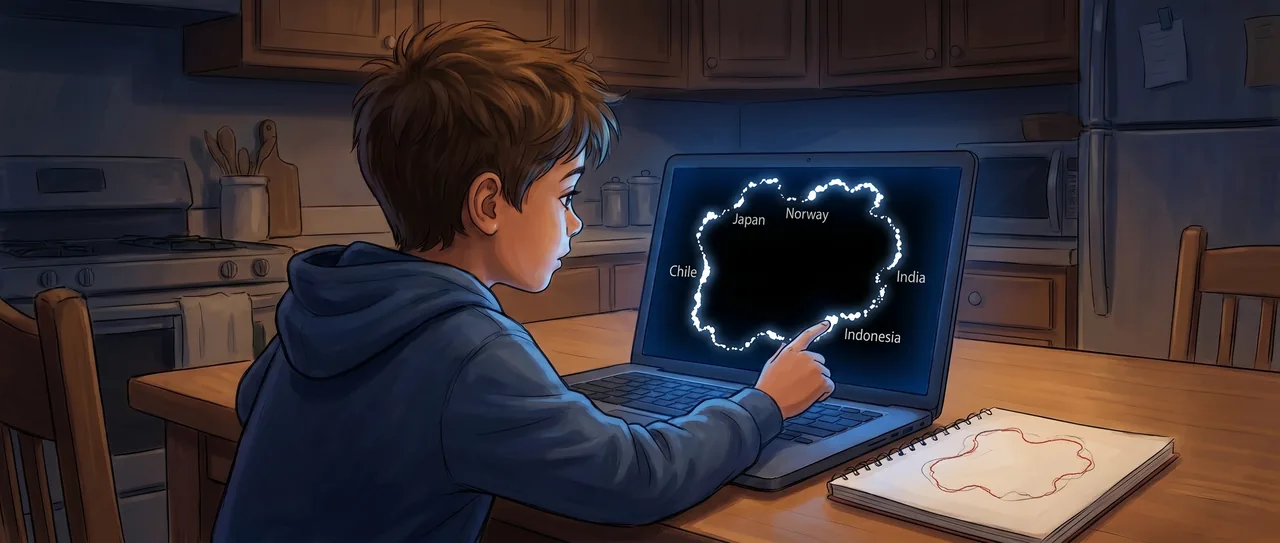
Dots began to appear. A few in Chile. A few in Japan. Two in Norway, one in Portugal, a scatter through Indonesia, a handful along the bottom edge of India. Australia. New Zealand. The bright dots spread across every continent, thin and even, like salt thrown across a dark table.
Soren leaned in. It looked like nothing. It looked like the fragment was simply everywhere and nowhere, which made no sense, because DNA travels through families, and families come from places.
"That can't be right," he said. "If it's on every continent, it should be thickest somewhere. Everything has a home."
"I can show density," the assistant said. "Brighter for more carriers."
Some dots swelled. Chile brightened. So did the coast of Japan, and a curl of Indonesian islands, and the western edge of Norway where the land breaks into fjords. Portugal's dot sat right on the sea. The Indian dots ran along the shoreline and stopped.
Soren stared. Then he did the thing his teacher hated, which was to answer a question with his hands before his mouth was ready. He dragged his finger along the screen, following the bright dots.
They were on the edges. Every one of them.
"Take away the map," he said. "Leave the dots. Just the dots on black."
The continents vanished. The land went dark. And the dots stayed exactly where they were, and without the countries underneath them they drew a shape he knew. A ragged loop. A coastline. The dots traced the place where water meets land, all the way around the world, as if someone had run a wet finger along every shore.
Soren did not move for a while.
"They're all on the coast," he said finally. "Not inland. Not the middle of anything. The edges."
"Yes," the assistant said. "The carriers cluster near coastlines on every continent."
"Then they didn't walk." His voice came out smaller than he meant. "People who walk spread inland. They fill up the middle. These people never went to the middle. They went along the water."
"That is a hypothesis I cannot confirm," the assistant said, carefully. "The genome tells us where the fragment is now. It does not tell us how it got there."
"But it's the same everywhere," Soren said. "The same little piece in Chile and in Norway and in Japan. That's the same people. One people. And they touched every coast and they left almost nothing." He looked at the dots strung around the black. "A little bit in a lot of people, and no home anywhere."
He reached for his notebook and drew the loop of dots, freehand, getting the shape of it into the paper. His hand pressed hard enough to dent the page underneath.
"How many other pieces are there," he asked. "Of Sample K. Not just the one that survived. How much of them is left, added all together, in everybody?"
The assistant was quiet for a moment, working.
"Spread across all the living people who carry any part of Sample K," it said, "there is more of that genome present in the world today than exists in the bone itself. In pieces. In thousands of people at once. No single person holds much. But together they hold more of these people than the cave does."
Soren felt the room change size around him.
They had no country. No group carried them thick enough to be called their descendants. On no map did they get a name or a color. If you asked where they were from, there was no answer, because they were from the edge of everywhere and the middle of nothing. They had gone to sea when almost no one went to sea, and they had left no ships and no tools and no cities, only a thread of themselves in the blood of strangers on every shore.
And they were not lost. That was the thing his chest could not hold. They were scattered so thin that no one had ever noticed, one tenth of one percent at a time, hidden inside people who had no idea they were carrying a sailor from forty thousand years ago. You could stand next to one of them at a bus stop. You could be one of them.
"Show me my region," Soren said. "Where I'm from. Is the fragment there."
The map came back. A single dot brightened near the coast an hour from his house, close enough to bike to on a Saturday.
Soren picked up his pen and, under the loop of coastline dots, wrote one word and circled it twice.
Someone.
Read the interactive version, listen to the narration, and earn a gold star →
A science-verified short story for curious kids · Curiosity Land