The Mile That Wouldn't Fit
Uncle Devan had a foam cup and a permanent marker, and he was drawing a face on the cup like this was a normal thing to hand a person.
"Draw something," he said. "Anything. It's going down with the lander tomorrow."
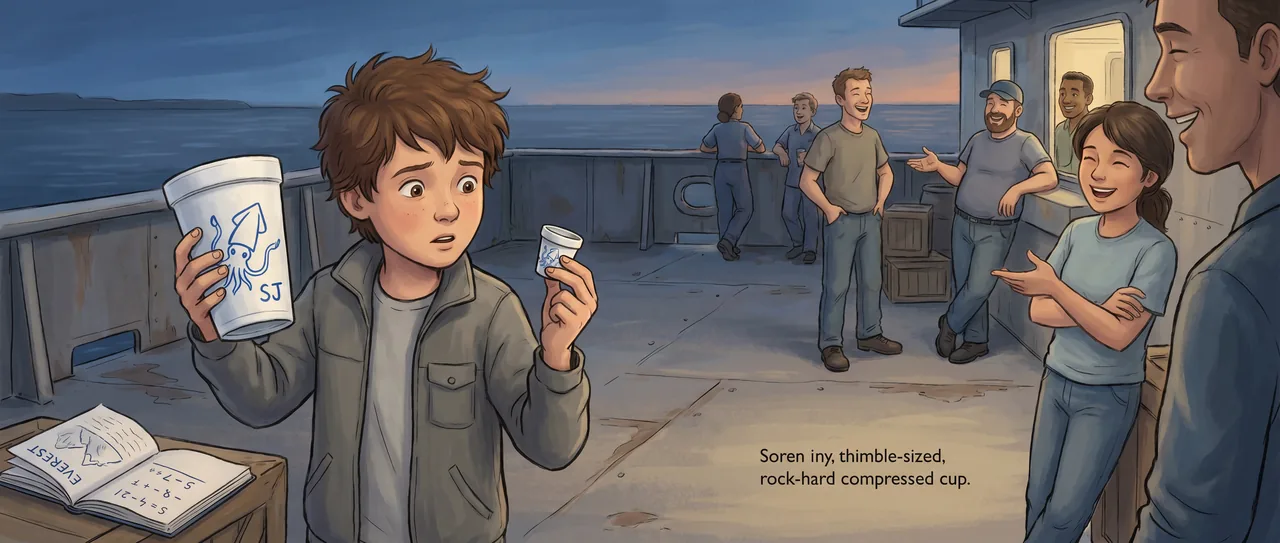
Soren drew a small squid, because squid seemed appropriate. He wrote his initials under it. The cup was ordinary, the kind that held bad coffee at every dock in the world.
"Why does it go down?" he asked.
"You'll see when it comes up." Devan grinned and dropped both cups into a mesh bag. "That's the whole trick. You have to wait."
Soren did not love waiting. He walked to the rail instead and looked at the water, which at night was just a darkness that moved. Somewhere under the ship the seafloor was seven miles down. He had read the number so many times it had gone smooth in his head and stopped meaning anything.
So he tried to make it mean something.
He took out his notebook. He wrote Everest, and under it he wrote 29,032, and under that he wrote the trench number, 36,000-ish. He subtracted. There was a mile left over. You could sink the tallest mountain on Earth into that hole and the peak would still be a mile underwater, dark, with nothing near it.
A mile of nothing on top of the mountain that people died trying to climb.
He looked at the black water and could not find the bottom of the feeling.
In the morning the lander went over the side, and the crane arm swung, and the yellow frame slid under and was gone. Soren watched the dive screen in the control cabin where a technician named Priya kept one eye on the depth counter and the other on a crossword.
The number climbed. One thousand meters. Three thousand. Priya filled in a clue.
"Doesn't it get boring," Soren asked, "the same water forever?"
"It's not the same," she said, not looking up. "Every ten meters you add another atmosphere of pressure. By the bottom you've got about a thousand of them stacked on top of you. A thousand times what's pressing on you right now."
Soren pressed his hand against his own arm to feel what one felt like. It felt like nothing. It felt like air.
"So the cup," he said slowly.
"So the cup," Priya agreed.
He understood then why Devan wouldn't explain it. A thousand times. He tried to picture a thousand of the sky he was standing under, all of it folded down onto one foam cup at the bottom of the deepest hole on the planet.
The lander sat on the bottom for two hours. On the screen its lights made a small yellow room in water that had never seen the sun, not once, not in the whole history of light. The bottom temperature was a few degrees above freezing. The pressure was the kind that would crush a submarine flat.
And across the camera, unhurried, swam a fish.
It was pale and soft and about the size of Soren's hand, with a tail like a wet ribbon. It nosed along the sediment. Behind it, small shrimp-looking things flicked through the light and were gone. The fish did not hurry. It was not visiting. It was home.
"It lives there," Soren said.
"Snailfish," Priya said. "And amphipods. And down in the mud, more living things than you'd believe. Microbes that have never needed us or the sun."
Soren watched the soft small fish move through a thousand skies of pressure like it was nothing, like it was air, the way one atmosphere was nothing to him. He put his hand on his own arm again. The fish was not fighting the pressure. It wasn't holding anything back. It had no air spaces inside to crush. It was built the exact shape of that place, filled so full of the deep that the deep had nothing to squeeze.
He thought about a mile of dark water on top of a drowned mountain, and a fish that would find that mile perfectly comfortable, that would think the surface, if it ever got there, was a horrible thin emptiness where everything came apart.
There was a whole world that was only unlivable if you were shaped wrong for it.
The lander came up in the late afternoon. The crane hauled it dripping onto the deck and everyone crowded the mesh bag. Devan cut it open and handed Soren his cup.
Except it wasn't his cup.
It was the same cup. It was the same foam, the same squid, the same initials in the same hand. But it had come back the size of a thimble. Every bubble of air trapped in the foam had been pressed out and never came back, so the whole thing had shrunk down hard and small and heavy-looking, a perfect tiny cup he could have hidden in his fist. The squid was still there, squeezed onto a surface a fraction the size.
Devan was laughing. Priya was laughing. Soren was not laughing. He was turning the little cup over and over.
This was what a thousand skies did to something with air inside it.
And the fish had swum through the exact same weight, soft as anything, and gone looking for dinner.
"Now do you get it," Devan said. "Why I made you wait."
Soren didn't answer. He held the shrunken cup in one hand. In the other he still had his notebook, open to Everest and the leftover mile, and he understood that he had subtracted the wrong thing. The mile wasn't the point. The point was that in the worst place he could imagine, the coldest darkest most crushing place on the whole planet, something small and soft had simply moved in and called it ordinary.
He set the thimble-cup on the rail. He looked back down at the flat black water, and this time he did not try to find the bottom of it. He knew now that something down there was looking up at his sky the way he looked at outer space.
Read the interactive version, listen to the narration, and earn a gold star →
A science-verified short story for curious kids · Curiosity Land