The Machine That Could Copy Anything
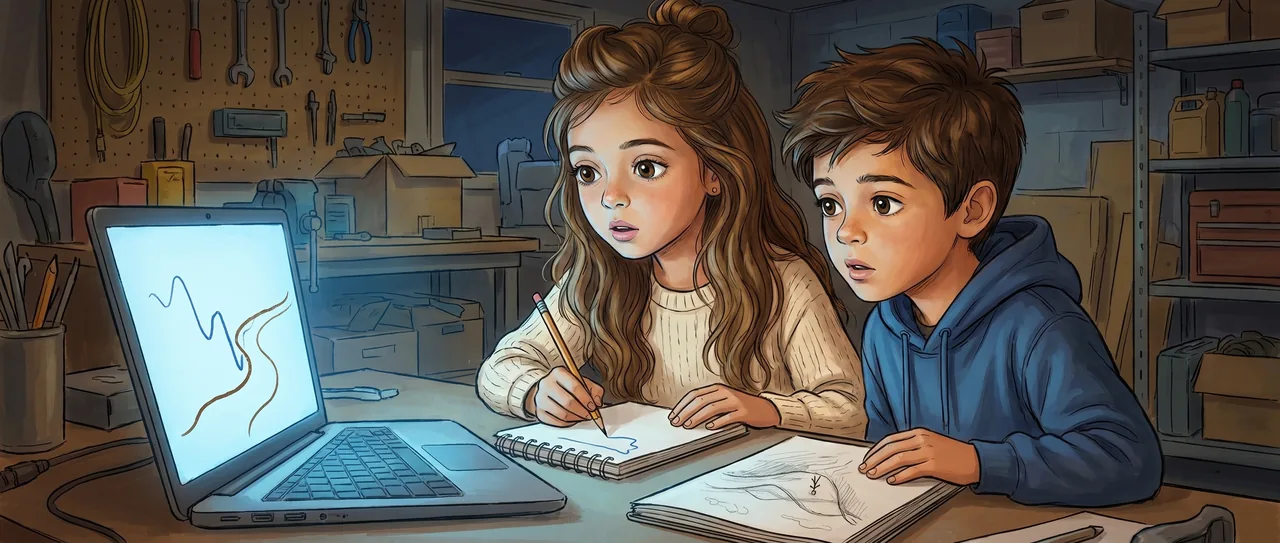
The river on the map bent like a dropped piece of string. Maya had drawn it by hand, every wiggle, and now the little program was trying to draw the same wiggle by itself.
It was close. It was almost embarrassing how close.
"Look at that," Maya said. "It's got the big bend."
"It's missing the little one near the bottom," Soren said. He tapped the screen where the program's line cut a corner the real river didn't. "Every time. Right there."
They had built the thing over two afternoons from a tutorial. It was not smart. It was a row of tiny switches, Soren said, each one adding a little bump to a line, and if you stacked enough bumps in the right places you could build up any shape you wanted.
"Add more switches," Maya said.
Soren changed a four to a forty. The line got closer. It found the little bend near the bottom. It found a wiggle Maya had forgotten she'd drawn.
"Whoa," Maya said. "Make it a thousand."
He made it a thousand. Now the program's line lay almost exactly on hers, so close you had to lean in to see two lines instead of one.
"Okay," Maya said slowly. "So it can copy anything."
"Anything I've drawn," Soren said. "That's different."
"No." Maya sat back. She had the look she got when something was bothering her and she didn't have words for it yet. "Draw something horrible. Something with no pattern at all."
Soren scribbled. A mad zigzag, spikes, a loop, a flat part, then more spikes. Nothing that meant anything.
They ran it. The line struggled. Then it settled. It matched the horrible scribble. Every spike. The loop. The flat part.
"It got the mess too," Maya said. Her voice was quiet. "Soren. It got the mess. There's no rule to the mess. It still got it."
Soren stopped typing.
"That's the part," he said. "That's actually a proven thing. I read about it. A row of switches like this, even one row, can get as close as you want to any smooth line at all. Any one. They proved it with math."
"Any line." Maya looked at the horrible scribble. "So somewhere in there is a setting for anything. Anything anyone could ever draw."
"The settings exist," Soren said. "That's what the theorem says. It says the switches exist."
Maya heard something in how he said it.
"You said that weird," she said. "You said the settings exist. Like that's not the whole thing."
"It's not the whole thing." Soren pulled his notebook over and drew two boxes. "The theorem says the right settings are out there. It doesn't say we can find them. Watch."
He erased the program's memory and started it again on the same horrible scribble. It fumbled. It got worse. It found a shape that was close but wrong, and then it stopped moving, stuck, pleased with itself, wrong.
"Run it again," Maya said.
He did. Different fumble. Different wrong place to get stuck.
"So it doesn't always get there," Maya said.
"It almost never gets all the way there," Soren said. "It walks downhill. It takes the settings and nudges them toward less wrong, over and over, tiny steps. But it can only see the ground right under its feet. Sometimes it walks into a dip that isn't the deepest dip, and it just, stops."
Maya was very still. Then she took the pencil and drew a landscape, hills and valleys, in the margin.
"So the perfect answer is a valley somewhere in here," she said. "The deepest one. And the program is a little person walking downhill in the fog."
"Yes."
"And the theorem is a person standing way up high who can see the deepest valley exists. But can't tell the walker how to get there."
Soren looked at her margin drawing for a long moment.
"That's exactly it," he said. "That's better than the book said it."
Maya put the pencil down. "So there are two different things," she said. "There's what's possible. And there's what you can reach."
"And they're not the same size," Soren said.
"They're not the same size." Maya said it again like she was testing whether it would hold weight. "The possible is huge. Somewhere in those settings is the exact curve of that river, and the exact scribble, and your face, and the sound of rain, and a song nobody's written. All of it. It's all in there. The switches for it exist right now."
"They exist," Soren agreed. "And the fog is real too."
Maya looked at the screen, where the little walker was still stuck in its wrong valley, patient, certain, close but not right.
"That's the part nobody tells you," she said. "Everyone talks about how the machines can learn anything. They can. It's true. But the true part isn't that they always find it. The true part is that the answer is already sitting there in the dark, finished, and finding it is a completely separate problem."
Soren wrote one line in his notebook, then stopped and read it back to himself, and didn't cross it out.
"There could be a perfect setting for your river," he said, "and no walker that ever finds it."
"Or a walker we haven't invented yet," Maya said. "One that climbs."
She reached over and hit run again.
The little line trembled, found its wrong valley, stopped. She hit run. It trembled, found a different valley, stopped. She hit run again, and again, watching the line try a new fog-blind path each time toward a perfect answer that was already there, waiting, in a place none of the walkers could see.
Read the interactive version, listen to the narration, and earn a gold star →
A science-verified short story for curious kids · Curiosity Land