The Jellyfish That Goes Backward
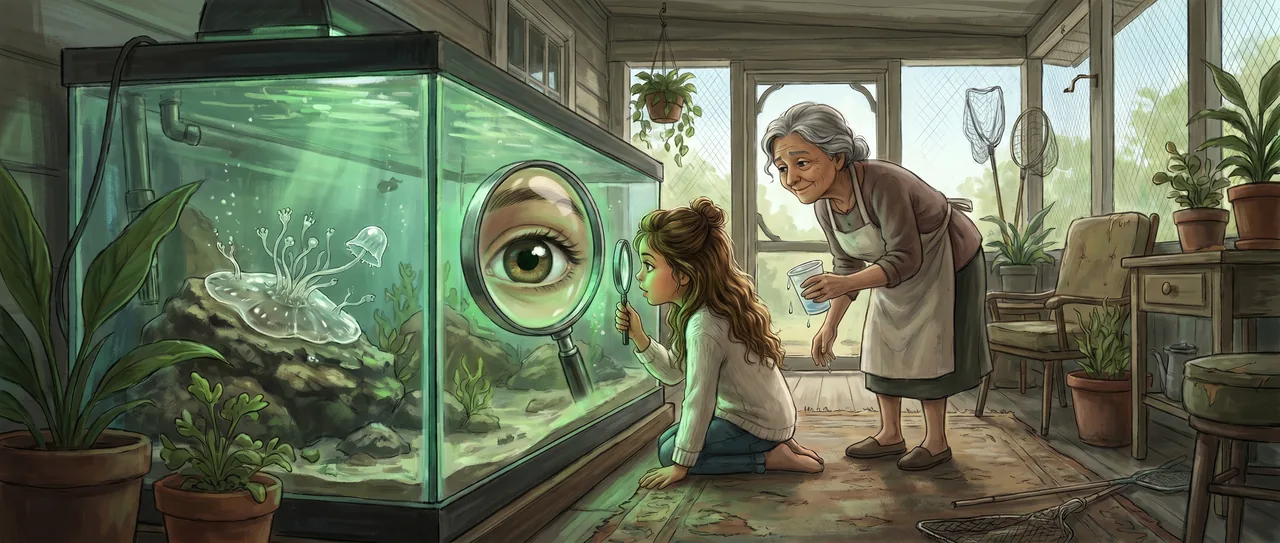
The porch smelled of salt and old newspaper, and the tank light hummed a green that got under Maya's eyelids.
Gran had scooped the thing up in her tidal net by accident, along with periwinkles and a crab the size of a fingernail. Now it drifted in the corner glass, smaller than a pea, a clear bell trailing threads so fine they only showed when the light caught them sideways.
"It's dying," Gran said, not unkindly, wiping her hands on her apron. "They do that. Little jellies. You watch it a week and then it's gone."
Gran was usually right about the tank. She knew which snails were sulking and which were dead. But Maya put her nose close to the glass, close enough to fog it, and something in her chest said no.
The bell had been swimming when Gran first brought it in. Maya remembered that. It had pulsed around the tank like a tiny umbrella opening and closing, opening and closing, hunting the water for specks. Now it wasn't pulsing. It had sunk. It sat on a rock and had gone soft and lumpy, the way a balloon goes when the air leaks out slow.
Dying, yes. That was what dying looked like. Sinking and losing your shape.
Maya watched it anyway. She watched it for a long time, until her knees printed red rings on the porch boards.
The lump was doing something.
It was flattening against the rock, spreading, the way a drop of honey spreads if you leave it. The graceful bell shape was gone completely now. What sat on the rock looked less like a jellyfish and more like a smear of clear jelly with the faintest bumps rising out of it.
Maya sat back. Dying things fell apart. They did not organize themselves.
She went inside and came back with the magnifying loupe Gran used for splinters, and she screwed her eye to it until the bumps swam huge and blurry and then sharp.
They were not lumps. They were little towers. A cluster of tiny stalks, each one growing up out of the smear, each one topped with a nub that was starting to open into a fringe of arms.
Maya knew what a baby jellyfish looked like. There was a book with pictures, dog-eared, on the kitchen shelf. A baby jellyfish did not look like a bell. It looked like this. It looked like a little polyp, a stalk on a rock, waving.
The cold went up her arms before the thought did.
This was a grown jellyfish. A swimming bell, a medusa, the finished thing. And it had gone backward. It had melted its own body and rebuilt itself into a baby. Not a baby it had made. A baby it had become.
"Gran," Maya said. Her voice came out strange. "Gran, come look."
Gran came, drying a cup. She bent to the loupe and squinted.
"Well," she said. "It's grown some polyps. That happens. The jelly dies and leaves polyps behind, and they'll grow into new jellies. That's the way of it. The old one gives up its body for the young ones."
Maya shook her head slowly. She had watched. She had watched the whole week with her knees on the boards.
"There's no old one left," she said. "There was one jelly. It sank. It didn't fall apart and leave anything. It turned into this. I watched it the whole time. It's the same animal."
Gran straightened up. She looked at Maya the way she looked at a snail she'd called dead that turned out to be crawling.
"That's not how it works, sweetheart," she said. But she said it slower than before.
Maya pressed her eye back to the loupe. The polyps waved. Somewhere in that smear of clear jelly was the same creature that had pulsed around the tank hunting specks, except now it had unmade all of that. It had taken its adult self apart, cell by cell, and put the cells back together younger. The way you might melt a candle and pour it back into the mold it came from.
And then it would grow up again. It would bud a new bell off the polyp and swim, and hunt, and get old, and instead of dying it could sink and soften and melt and pour itself back into a baby. Again. And again. There was no last time built into it. There was no end of the line where the animal had to stop.
Maya thought about every living thing she knew. The crab the size of a fingernail. Gran, with her splinter loupe and her sure hands. Herself, eleven, with red rings on her knees. All of them arrows pointing one way. Born, older, older, gone. One direction only, no going back, no melting yourself young.
Except this. This one thread of jelly on a rock had a door in it that everything else was locked out of.
"It doesn't have to die," Maya whispered. "It can just. Keep going around."
"Nothing keeps going around," Gran said.
But she didn't take her eyes off the tank, and she didn't dry the cup, and the cup dripped a small pool onto the porch boards.
Maya looked into the loupe again. One of the new polyps had grown a little bump on its side, and the bump was already narrowing at the top, already dimpling into the beginning of a bell. A baby about to be born from the body of the grown-up that had become it, which had once been a baby exactly like this, which would grow up and sink and soften and become one again.
She watched the little bell begin to pinch off from the stalk, clear and new, getting ready to swim.
Read the interactive version, listen to the narration, and earn a gold star →
A science-verified short story for curious kids · Curiosity Land