The Half-Finished Boy
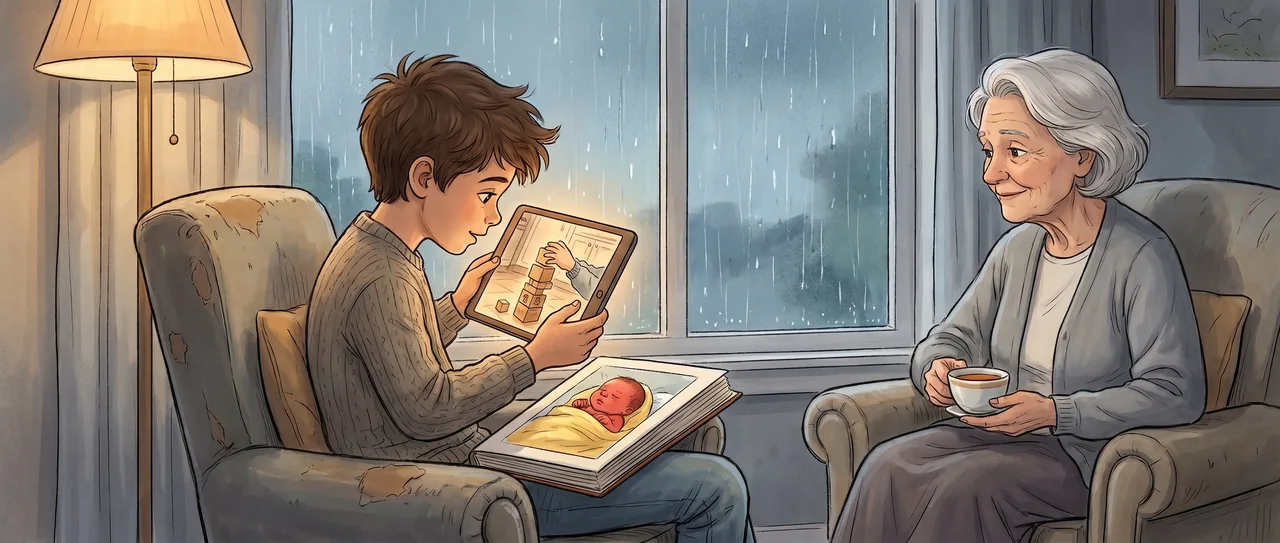
The album smelled like a closet nobody opened. Grandmother set it on Soren's knees and went to answer the whistling kettle, and there he was on the first page, a red wrinkled thing wrapped in a yellow blanket, eyes shut, fists like small stones.
He did not recognize himself at all.
"That is you at two days," Grandmother called from the kitchen. "You screamed for a week."
Soren turned the pages. Two days. Two months. A first birthday with cake pushed up his nose. He was looking for the moment the baby became him, the way you look for the frame in a film where the caterpillar turns, and he could not find it. Every page was a different person and all of them were named Soren.
He opened his notebook and wrote: when did I start.
Grandmother came back with two cups and a plate of the hard ginger biscuits nobody liked. She was ninety and she moved slowly and she never pretended things were simpler than they were, which Soren liked about her.
"You could not do anything," she said, sitting. "A newborn horse stands up in an hour. A baby whale swims the day it is born. You could not hold your own head." She said it fondly, like it was a joke he had eventually gotten better at.
"Why not," Soren said.
"Too big a head," she said. "They have to send you out early, before you are finished, or you would never get born at all. You come out a quarter done and you cook the rest on the outside."
Soren stopped with a biscuit halfway to his mouth.
A quarter done.
He thought of the horse standing in its hour, finished, factory-sealed. And the baby in the yellow blanket, sent out into the cold air with only a corner of a brain, blinking at a ceiling he could not understand.
"So it grows after," he said.
"Everything grows after."
"No," Soren said, and he heard his own voice go careful, the way it did when he was close to something. "Not everything. My hands were hands. Small, but hands. My heart was a heart." He put the biscuit down. "The brain came out a quarter size. So it did most of its building out here. Where I could watch."
Grandmother sipped her tea and did not rush him.
He went back through the album, slower now, looking at the eyes. Two days: unfocused, aimed at nothing. Two months: catching on a face. One year: pointing at something outside the picture, wanting it named. He was watching a thing get built in real time, page by page, and the strangest part was that the builder and the building were the same.
"Where's the video," he said. "The one from the kitchen. With the tower."
She knew the one. She found the tablet, thumbed through it with one slow finger, and handed it over.
On the screen a smaller Soren, maybe three, sat on the kitchen floor stacking wooden blocks. He built a tower of four. It fell. He built it again. It fell. He built it a third time and it stood and his whole face opened like a window.
Soren watched himself learn to stack blocks and felt something turn over in his chest.
"You did that a hundred times," Grandmother said. "You would not let me help."
And Soren understood that he had not been watching himself remember. He had been watching himself wire. Every time the tower fell, something inside that three-year-old head had reached across a gap and tried a connection, and kept the ones that held, and let the useless ones die. More connections made and lost in those years than in all the years since. A forest planting itself and thinning itself at the same time, faster than it would ever grow again.
"I don't remember any of this," he said.
"No," Grandmother said. "The part of you that remembers was still being built."
Soren sat with that. The person who did the most important construction work of his entire life, who wired the floor he was standing on right now, had done it before he could form a single memory. The most furious, most crowded, most creative years of his brain were finished before the part that keeps records had come online. He had been there. He would never get to see it. He was living in a house he had built and could not remember building.
He looked at his own hands. They were bigger than the stones in the yellow blanket. The brain behind his eyes was ninety percent of the size it would ever be, and it had reached that ninety percent by the time he was five, in a rush of wiring so fast the rest of his life would be mostly careful editing.
"Grandmother," he said. "When you were little. Do you remember learning anything?"
"Nothing," she said. "Ninety years and the most important part is a locked room." She smiled at the rain on the window. "Everyone's is."
Soren picked up his pen. He wanted to write the whole thing down, that every finished, fluent, competent person he had ever met, every adult who spoke as if they had always known things, had started as a quarter of a brain screaming at a ceiling, and had built the rest in the dark, on the outside, without watching, and could not remember the work.
He wrote instead: we all forget the hardest thing we ever did.
Then he looked up at Grandmother, who was very old and finished-seeming and had once been the red thing in a blanket too.
"You're still doing it," he said. "A little. Right now. Aren't you."
"Every day I lose some and keep some," she said. "Same as you."
On the tablet the video had reached its end and looped back to the start. The small Soren reached for a fallen block, set it on another, and held his breath while the tower found its balance.
Soren leaned toward the screen and watched the three-year-old's hands, waiting, the way you wait for someone to say something for the first time.
Read the interactive version, listen to the narration, and earn a gold star →
A science-verified short story for curious kids · Curiosity Land