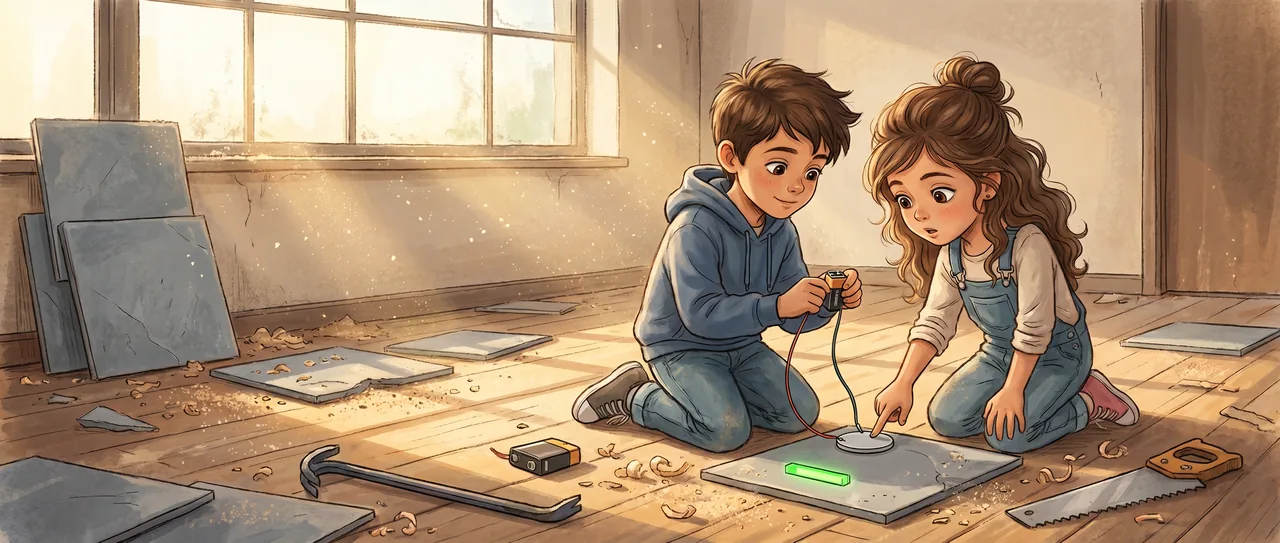
The Floor That Kept Score
"This one lights up when you jump on it," Maya said. She jumped. A little green bar along the tile's edge flickered and died. "See? It doesn't even need a battery."
"It has to need something," Soren said. He was on his knees, prying up a loose tile with a flathead. "Things don't just make electricity because you asked them nicely."
"I didn't ask nicely. I jumped."
The studio smelled like sawdust and old varnish. A dozen of these tiles had survived from some exhibit the building used to host, back when the whole floor was supposed to power the lights. Most of them were dead now. A few still blinked when you stepped hard.
Soren got the tile free and turned it over. Underneath the rubber top was a thin gray disc, pale as a coin, wired to the little green bar.
"That's the whole thing," he said. "That disc. No battery. No plug."
Maya crouched next to him. "Tap it."
He tapped the disc with the screwdriver. The green bar twitched.
"Tap it harder."
He pressed the flat of the screwdriver against it and leaned. Nothing. Then he lifted off fast, and the bar flickered on the release.
"Huh," Maya said. "It didn't like the push. It liked the letting go."
"It liked both. Squeeze and unsqueeze." Soren sat back. "So it's the bending. Something in there makes electricity when it gets bent."
"Then it's not the jump," Maya said slowly. "It's the floor pushing back on me."
Soren looked at her.
"When I land," she said, "I press on the floor, and the floor presses on me, exactly as hard. That's the rule, right? The one Mr. Okonkwo drew arrows for."
"Equal and opposite."
"So the disc feels my whole weight coming down, and it squishes, this tiny bit, and squishing is what makes the light." She stood and stepped on the bare disc with one careful foot. The green bar climbed. "It's counting how hard I hit it."
"Keeping score," Soren said, and wrote something in the notebook balanced on his knee.
They found a small speaker in the box of exhibit leftovers, the kind with two bare wires. Maya wanted to know if she could hear a footstep. Soren wanted to know if the disc worked backwards.
"Backwards how?" she asked.
"If bending it makes electricity," he said, "maybe electricity makes it bend."
He touched the disc's two wires to a nine-volt battery from the toolbox. There was a faint tick. He did it again. Tick.
"It moved," he said. "You hear that? That's the disc snapping out and back. It's a tiny drum."
Maya put her fingertip on the gray surface and told him to do it again. He tapped the battery on. She felt it, a buzz too fast to count, a shiver going straight up into the bone of her finger.
"It's shaking," she said. "Really fast. Faster than my ears." She pulled her hand back and looked at it. "How fast can it shake?"
"Depends how fast you switch the electricity."
"So if I switched it super fast, thousands of times a second, it would just be humming. And if I switched it faster than that?"
Soren stopped tapping the battery. "Then it'd be shaking faster than anything can hear. It'd be making sound you can't hear."
They looked at the little gray disc sitting on the floor between them.
"That's a real thing," Maya said. "Sound too high to hear. My aunt got a picture of my cousin before he was born. They said it was sound."
"Ultrasound," Soren said. "They bounce it off things and listen to the echo." He turned the disc over in his fingers. "You'd need something to make the sound. Something that shakes when you push electricity through it."
Neither of them said anything for a second.
"It's the same disc," Maya said. "It's this. This exact thing. The floor tile and the baby picture are the same trick."
"One way makes electricity out of a squeeze," Soren said, and he was writing fast now, the pencil scratching. "The other way makes a squeeze out of electricity. It's the same thing running two directions."
Maya sat down hard on the floor. "So what's in it? What's the gray part actually made of that it can do that?"
"A crystal," Soren said. "Has to be a crystal. Something where the insides are lined up so neat that when you push on one end, it lets go of a little charge out the other." He looked up. "That's what quartz is. That's a watch."
"A watch?"
"A quartz watch. There's a little piece of quartz in it and they run electricity through it so it shivers, and it shivers so evenly you can count the shivers, and that's the seconds." He said it slowly, like he was laying each piece down where he could see it. "It's this. A watch is this disc, kept perfectly on time."
Maya picked up the tile they had pried loose and held it in both hands. Somewhere in the gray coin was an order so exact that a footstep became a number and a spark became a sound and a shiver became a second.
"The exhibit was supposed to power the lights," she said. "With people walking. Everybody thought that was the amazing part. The free electricity."
"It wasn't the amazing part."
"No." She turned the tile toward the window so the light caught the disc. "The amazing part is it works both ways and nobody has to choose. You can hand it a footstep and it hands you a number. You can hand it a number and it hands you a sound the baby's picture is made of."
Soren tapped the battery to the wires one more time. The disc ticked in the quiet room.
"Do it again," Maya said. "Faster this time."
He tapped it faster, and faster, until the ticks ran together into a thin hum, and then his thumb was going as fast as it could go and the hum climbed past where they could follow it and thinned out into nothing.
Maya held her finger against the disc and felt it still buzzing, up past the top of her hearing, into the place where a machine could have listened to it bouncing back a shape they would never see with their eyes.
Read the interactive version, listen to the narration, and earn a gold star →
A science-verified short story for curious kids · Curiosity Land